
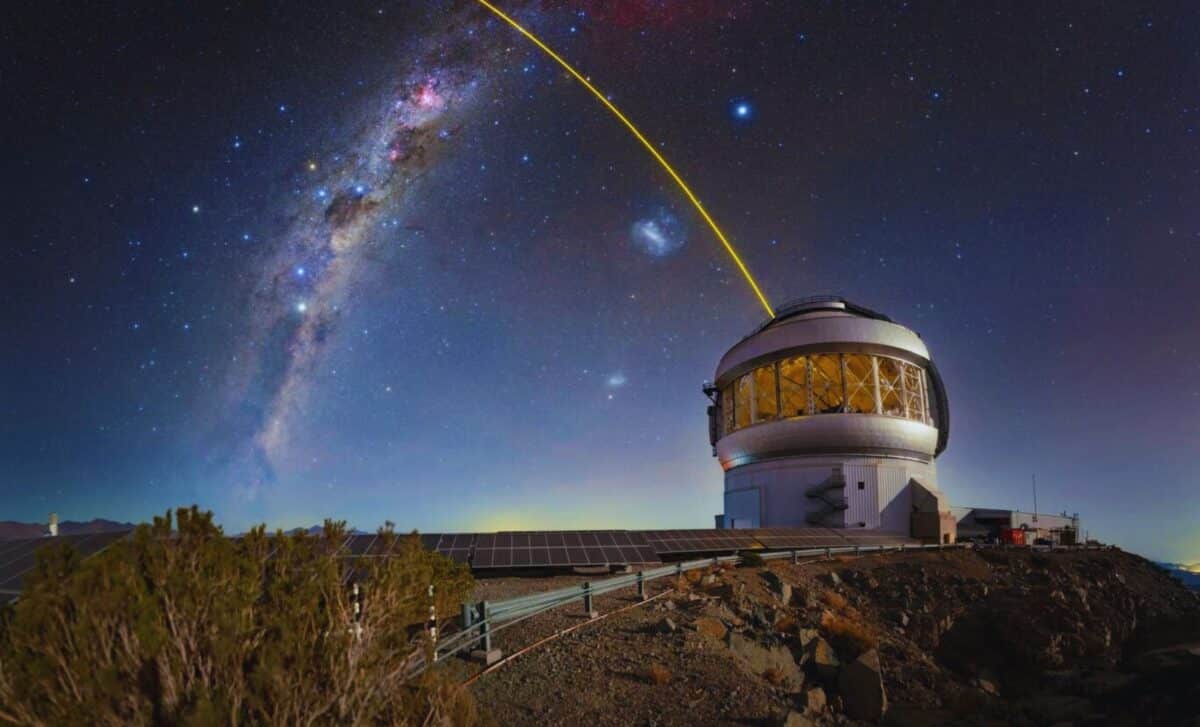
Astronomers have detected a colossal cloud of vaporized metals circling an unidentified object in deep space. The dense cloud, observed using the Gemini South telescope, obscured a distant star’s light for nearly nine months, triggering interest and confusion across the scientific community.
The structure, unofficially referred to as Cloud-9, exhibits highly unusual behavior and composition, suggesting it does not fit into any known category of celestial objects. Its existence could indicate the presence of previously undetected types of matter or remnants of galactic systems that never fully formed.
A Nine-month Dimming Triggered the Investigation
The first sign of Cloud-9 came when astronomers noticed an unexplained and sustained dimming of a star’s brightness, far longer than typical eclipses caused by exoplanets. According to Astronomical Journal, this gradual darkening continued for almost nine months, an anomaly that prompted further spectroscopic analysis.
That analysis revealed something unexpected. The light had been partially absorbed by metallic vapors, particularly iron and magnesium, indicating the presence of a dense, fast-moving cloud of vaporized metals. The event did not resemble the kind of transit or outburst normally seen in variable star systems, and the absorption signatures pointed to a chemical makeup not associated with typical interstellar dust.
 This image uses magenta to pinpoint where neutral hydrogen gas was detected in “Cloud 9.” Credit:NASA, ESA. G. Anand (STScI), and A. Benitez-Llambay (Univ. of Milan-Bicocca).
Rather than forming a disk or tail like a comet, the material appeared loosely bound and highly dynamic. It seemed to be swept around an invisible central mass, leading researchers to conclude that the obscuring body was a vast envelope of metallic gas.
Composition Dominated by Vaporized Metals
Spectral data gathered during the event identified strong traces of metals such as iron and magnesium. As stated by the latest research, the cloud’s composition is distinct, dominated by elements usually found in extreme environments like stellar interiors or remnants of high-energy events.
The material appears to be held in place, or even stirred, by powerful forces. The cloud’s behavior, staying in orbit and maintaining its structure for months, suggests interactions with a gravitational source, even though the central object itself remains undetected.
 Artist’s impression of a debris disk cloaked in dust and gas passing in front of a star. Credit: International Gemini Observatory/NOIRLab/NSF/AURA/P. Marenfeld & M. Zamani
This metallic signature makes Cloud-9 stand out from more familiar space phenomena. Its consistency and prolonged presence support the idea of a stable but unconventional system, where the metals are likely in a gaseous state due to intense heat or past collisions.
Possibility of a Dark Matter-dominated Object
While the central body behind the cloud remains a mystery, its gravitational influence is evident in the orbital movement of the metallic vapor. As Phys.org reports, one hypothesis under consideration is that the object could be part of a population of small, dark matter-dominated structures, possibly the remnants of galaxies that never fully formed.
These so-called failed galaxies would have enough mass to draw in material but not enough to ignite star formation. The idea gains traction from the fact that Cloud-9 lacks any observable star or core but still maintains a coherent cloud in orbit.
Although no firm conclusions have been drawn, the presence of a metallic cloud without a visible energy source suggests the object may be hiding within a dense dark matter halo or surrounded by an unusual gravitational field.