
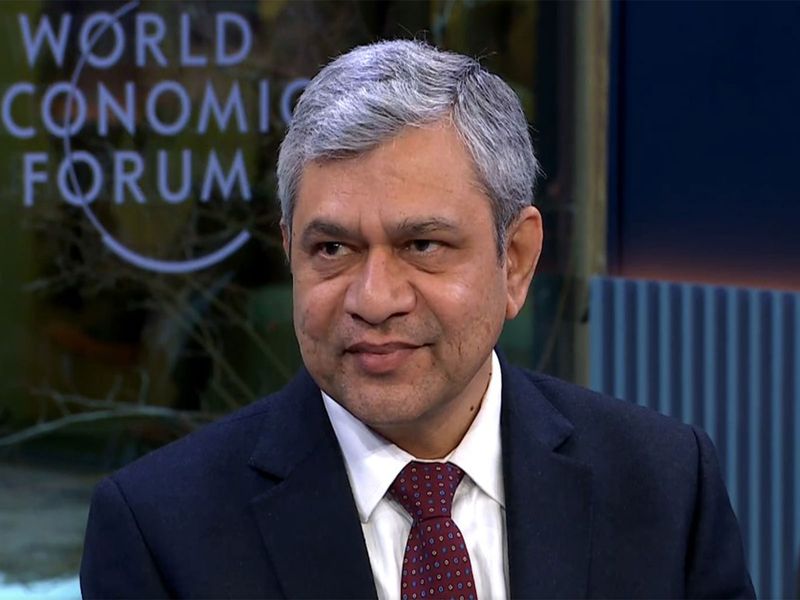
Union Minister for Railways, Communications, Electronics & Information Technology Ashwini Vaishnaw said India’s reform momentum has transformed the country’s economy into a high-growth, resilient and globally trusted destination.
At the World Economic Forum 2026 in Davos, Vaishnaw said India has undertaken landmark reforms in recent years, including labour code reforms, simplification of the goods and services tax, reforms in the energy sector and opening up of nuclear energy to the private sector, which are generating strong investor confidence across sectors.
He cited several instances, including IKEA announcing plans to double its investment and Qualcomm significantly expanding its workforce in India. He said India is today the fastest-growing major economy in the world, with a consistent growth trajectory of 6–8 per cent projected over the next five years.
Commenting on the on global uncertainties, Vaishnaw emphasised the need to strengthen internal capabilities to enhance resilience amid geopolitical, geoeconomic and geotechnical turbulence. He stated the government is focused on ensuring that all foundational building blocks of the economy are firmly in place to enable India to weather global disruptions.
He further added that India is systematically building its own semiconductor ecosystem, developing a comprehensive artificial intelligence stack, rapidly scaling up defence production and enabling Indian IT firms to transition from traditional software services to AI-driven solutions.
Furthermore, the global perception of India at Davos, as Vaishnaw said, has been overwhelmingly positive, with India being widely regarded as a trusted country demonstrating consistent economic growth. He noted that deliberations across panels reflected a broad consensus that India’s emergence as the world’s third-largest economy is now a matter of timing rather than possibility.
In another panel discussion titled ‘Can India Become the Third Largest Economy in the World’ at Davos, Vaishnaw outlined that India is going to grow with 6-8 per cent real growth and a moderate 2-4 per cent inflation, and a nominal growth of 10-13 per cent with a 95 per cent confidence interval in the next 5 years.
This growth story is built on four pillars: the pillar of public investment in physical, digital and social infra; the pillar of making sure that the entire society grows along with the growth of the country, so very inclusive growth; third, the pillar of manufacturing and innovation; fourth, the pillar of simplification, he explains.
With regard to economic growth, Vaishnaw said, “India is resilient economy. The fundamentals, macro as well as micro, are very strong. And that really helped us through this turbulent period. The country’s exports have actually increased despite the tariffs. And, with that, our producers are finding new markets and we are growing our export sector in multiple ways. For example, electronics has now become the third largest exported commodity out of India, after, of course, engineered goods and petroleum products — which was like unbelievable even 10 years ago.”