
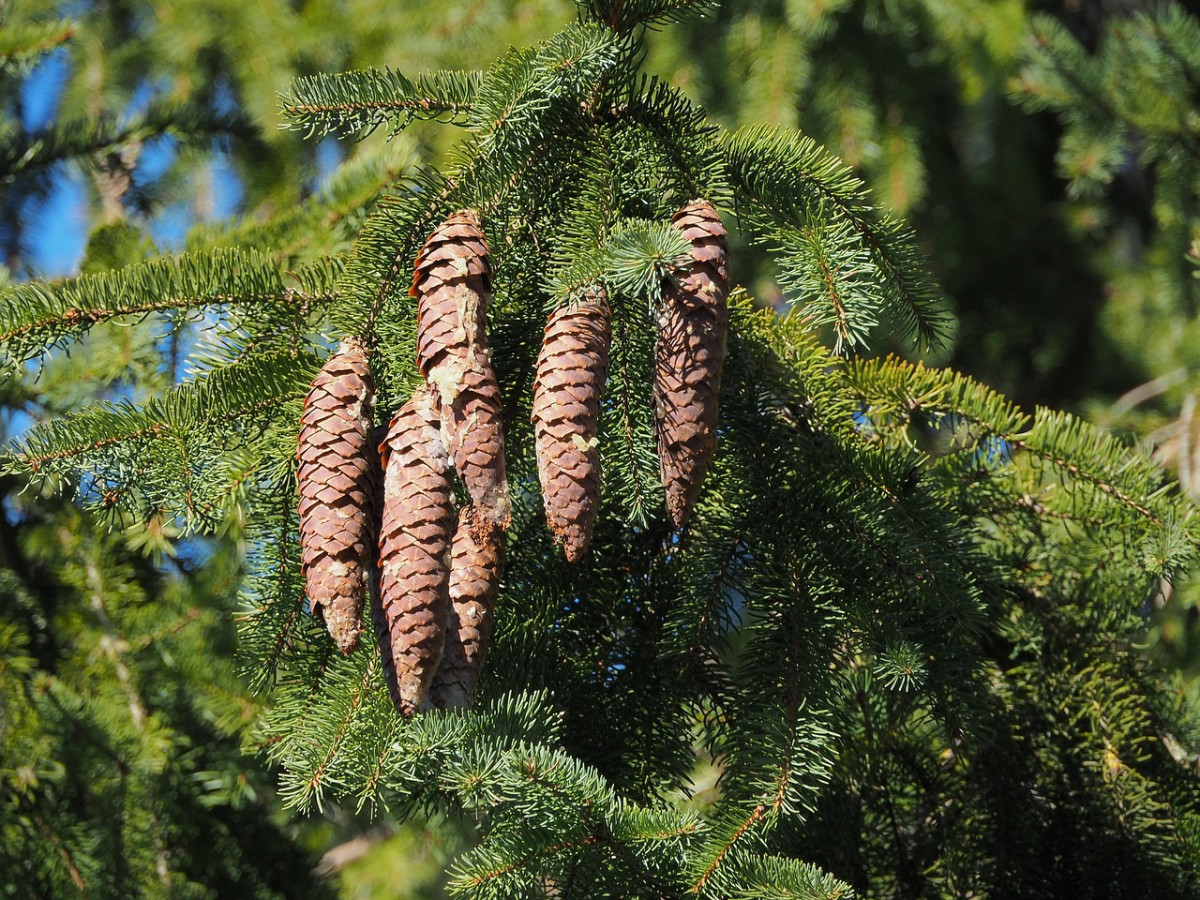
A remarkable study has revealed that some of the world’s oldest plants don’t rely on colour or scent to attract pollinators, but use heat instead. The researchers found that these cycads – or ancient seed plants – use a metabolic system linked to the plant’s body clock to warm their cones to send infrared cues to beetle pollinators. Chris Smith has been speaking with plant biologist Alex Webb, who has written a perspective piece on the work…
Alex – They found that the reproductive organs of cycads warm up at the beginning of the evening. Now, cycads are a family of plants which are part of the gymnosperms, which are plants which produce seeds, but they’re a very early form of the seed plants. The seeds are naked, like you would find in a pine nut, whereas later plants like the angiosperms, which are the ones that produce flowers, have their seeds enclosed, like in an apple. So these cycads, which are found in the tropics, produce cones, and those cones are the reproductive organs. And just like the later flowering plants, which we’re perhaps all more familiar with, the cycads are pollinated by insects. And the authors were interested in the mechanism of this, and they suspected that the warming of the cones attracted beetles, flying beetles, to the cones, first to male plants, to get pollen, and then later on in the evening to take the pollen from the male plants to the female plants.
Chris – How do the plants know what time it is, though, Alex, to do that?
Alex – Well, plants have a circadian clock, and in fact, what these authors found is that there’s just this beautiful timing in that the male plants warm up just after dusk, and then three hours later, the female plants warm up. And the authors think this is due to the circadian clock, which is a 24-hour clock inside all living organisms. We have one; this drives our sleep-wake cycle, makes us want to go to the toilet during the day but not at night. Plants have circadian rhythms, controls movements of leaves, movements of flowers, and the authors speculate that this warming up is controlled by the circadian clock. They actually didn’t demonstrate that. It’s a reasonable hypothesis. There are some other possibilities. It might be the plants responding directly to light signals, but in either way there’s a really interesting question that was raised by the papers. How do the plants know, if you like, to warm up the male plants three hours before the female plants? And that’s a really interesting bit of biology that we’re working on across all different organisms, how you can end up with different timings of events in different organs and different individuals.
Chris – The male parts warm up, this lures the pollinators in, they pick up pollen, then the temperature presumably drops, and meanwhile the females have warmed up, so they exit the premises in favour of a hotter venue.
Alex – The previous hypotheses around this was that the beetles were gaining warmth, or possibly scents were being volatilised by the warming of the plants so that the scents spread further and the beetles could detect it. But actually, what the authors show here is quite interesting. They show that the beetles are not gaining anything from the warmth; they’re directly detecting the infrared radiation produced when an object gets warm. And they’re doing this because they have sensors in their antenna, very similar to the sensors that are in snakes, which allow snakes to detect their prey through warmth. And they’re directly sensing the heat, rather than gaining a reward from warming up from the heat or something like that. So from a distance, they can see the warmed-up cones and then fly towards them, and then when they see that the female cones are warmed up, they’re attracted to those as well.
Chris – And why does this matter in evolutionary terms? You’ve said this is a very early process before flowering processes evolve, so this is presumably one of the first rudiments of pollination, how some of the earliest species that were on the land got pollinated. But is that what it is, a sort of stepping stone, and then plants built on this and developed more efficient or other ways of doing it, including flowers?
Alex – There’s been a long-held mystery, in fact, even Darwin was interested in this: why are there so many flowering plants? There’s about 350,000 species of flowering plants. And the cycads, there’s 24 species. So there’s this interesting question. The cycads are pollinated by insects, and the flowering plants are pollinated by insects. Why did the flowering plants become so diverse? And this paper led us to conclude, myself and my colleague Beverly Glover, who’s the Director of the Botanic Gardens here, looking at this paper, we wondered if there’s a reason that the cycads didn’t generate so many species, specifically because they used this warming mechanism. With this warming mechanism, they’re mostly going to attract beetles at night. The warming mechanism is going to be the best signal early in the night, so you’re going to only attract nocturnal beetles. But also this warming signal, you can’t do much with it; it’s either on or off. Other plants, the flowering plants, develop the ability to attract pollinators using colours, and of course, there’s more receptors for colours; insects can see different colours, so you can mix and match those different colours, making a huge variety of signals to attract the pollinators. So you can have pink flowers, blue flowers, white flowers, and each one of them might be tuned to attract a specific family of pollinator, or a whole group of pollinators. But also, what’s interesting is that if you use colour, you can attract insects in the day and in the night, because white can be seen at night under moonlight. So by using colour signals, perhaps the flowering plants were able to interact with a wide range of insects, those active during the day and those active at night, and specialise on different insects, and this would drive evolution of new species in the flowering plants. And possibly what we’ve got is that the cycads got stuck with one pollinator; it works fantastically well, if things are working well, then evolution doesn’t need to change it.