
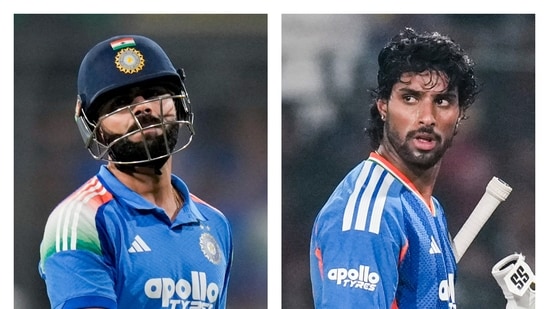
India might not have Virat Kohli in T20Is anymore, but the job he owned hasn’t disappeared. In World Cups, someone still has to play that calm in chaos innings – especially when chases wobble early or the middle overs get sticky.
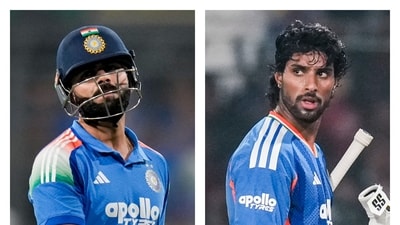 Tilak Varma, could be India’s ideal replacement to play the Virat Kohli role in T20Is (AFP Images)
For the T20 World Cup 2026, India’s most natural structural replacement for that responsibility is Tilak Varma. Not as a copy of Kohli, but as the modern version of the same function control plus tempo.
Why Kohli’s exit still creates a tactical vacuum
Kohli stepped away from T20 internationals after the 2024 T20 World Cup, closing out as one of the format’s defining run-getters. The important part isn’t nostalgia. It is role clarity. When India were 20/2 in a chase, Kohli’s presence meant the innings could be rebuilt without the run rate becoming a crisis. Removing that profile forces a team to either (a) stack hitters and hope the surface stays true, or (b) find a batter who can stabilise without slowing the game down.
What Tilak Varma’s numbers say
Tilak’s T20I record already sits in the rare category: elite consistency with elite tempo. His career summary in T20Is shows 40 matches, 37 innings, 1182 runs, average 49.25, strike rate 143.98, with two hundreds and six fifties. That is not promising, but the proof of a modern-day anchor.
This is the key point: a batter averaging around 50 in T20Is usually does it by playing safe, and finishing slower. Tilak’s output comes while at nearly 144, the exact combo you need in pressure chases where you can’t afford a 10-ball lull to become a 20-ball sinkhole.
The real ‘Kohli role’ is not runs, it’s control under pressure
Kohli’s T20I value was often about making pressure feel smaller: keeping wickets in hand, rotating through match-ups, and ensuring the required rate never spiked into panic territory. Tilak gives India a similar comfort, but with a more contemporary scoring rhythm. He can absorb early damage yet still keep the innings moving fast enough that the death overs aren’t forced into a desperate all-in.
The left-handed factor
Tilak being left-handed is not a cosmetic detail. It makes the opposition bend their bowling plans against India. Left-right combinations force captains to reshuffle overs, delay ideal match-ups, or burn premium bowlers at awkward times. That soft advantage becomes huge across a World Cup because it creates overs where the opponent is simply bowling their second-best plan.
Tilak also offers occasional spin overs as a flexibility leveller, which can help balance an XI on nights when conditions demand extra options.
The injury timelines is why his availability changes India’s whole blueprint
Tilak underwent surgery for an abdominal issue on January 7, 2026, and was ruled out of the first three T20Is against New Zealand, with availability for later matches dependent on recovery progress. With the World Cup not too far away, the runway is tight not just for fitness but also for match sharpness.
That is why the impact of his absence isn’t just one batter missing. It is structural.
If Tilak misses out or is undercooked, here is what India looseMiddle overs stability without sacrificing scoring speed
Without Tilak Varma, India risk becoming too finisher-heavy. That can work on flat tracks, but on slightly gripping surfaces, early wickets plus spin match-ups can turn a chase into a choke.
A dependable No.3/4 identity
World Cups punish teams that treat No.3 like a rotating seat. If Tilak isn’t there, India may have capable names, but the role becomes more match-up dependent – and match-up plans are the first that collapse when you are 25/2.
What the bigger picture says for T20 World Cup 2026
India doesn’t need a new Virat Kohli as a personality or brand. They need a batter who can do the Kohli job in modern T20 terms: absorb pressure, win the middle overs, and stoll score fast enough. On verified output, role-fit, and tactical value, Tilak Varma is that answer.