
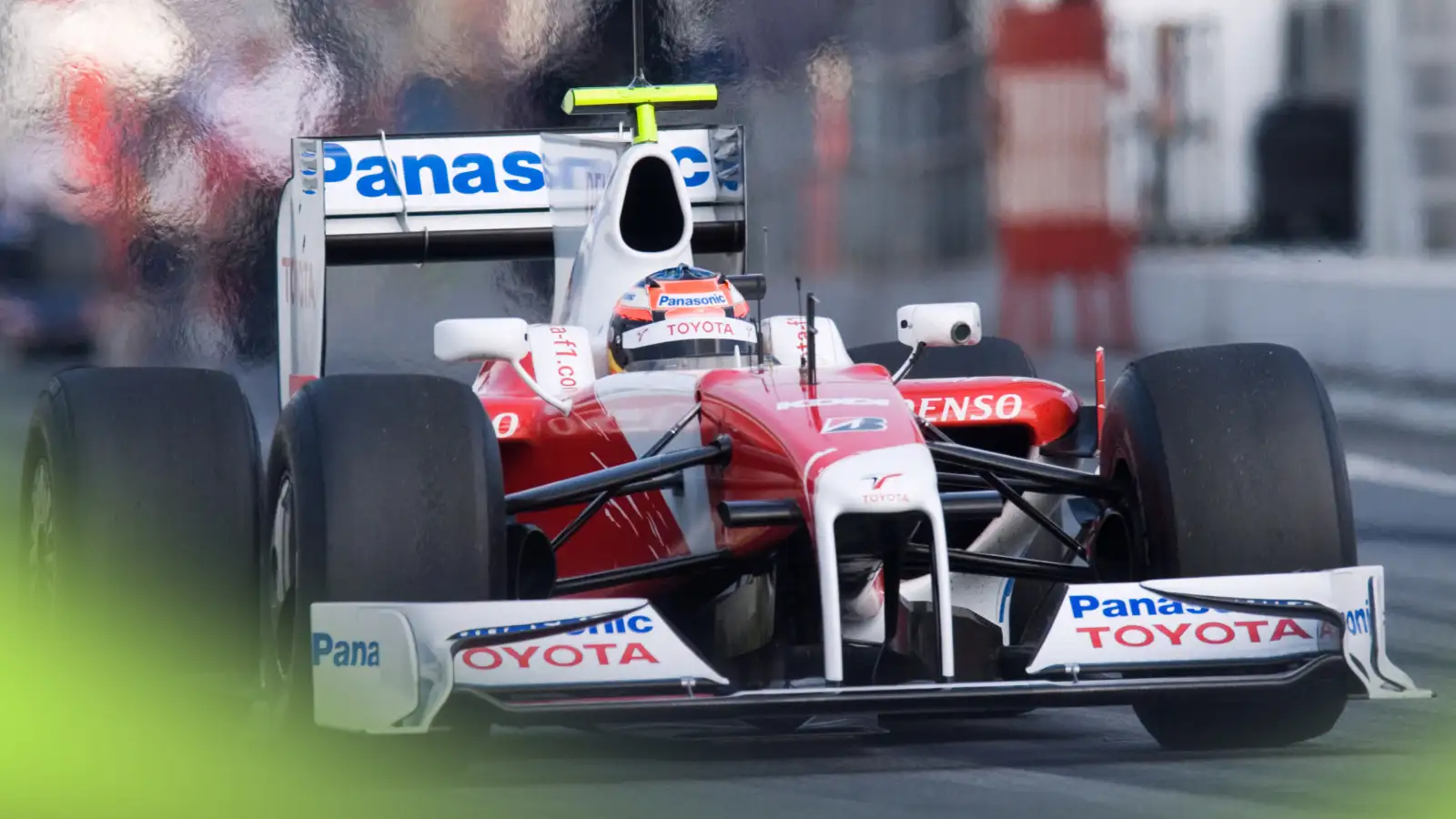
Formula 1 cars are engineering marvels, carefully crafted and designed to produce the greatest possible performance without compromise on its one job: to go faster than everyone else.
To do that, they’re intensely protective of their expertise, their plans, anything they feel might blunt their edge. And sometimes, that means producing a part they know absolutely won’t work.
Inside Toyota’s clever front wing deception: how the TF109 fooled F1 rivals
Want more PlanetF1.com coverage? Add us as a preferred source on Google to your favourites list for news you can trust.
The Toyota TF109 was the Japanese giant’s final F1 car. After a seven year spell on the grid, as the global financial crisis hit, it ended its programme, despite having a 2010 car fully developed and ready to race.
In many ways, its departure marked the end of the era of excess, where teams would spend with wild abandon. Toyota had two state-of-the-art wind tunnels at its Cologne base running 24/7, which were constantly fed with fresh new ideas.
During development of the TF109, one such idea came from Sammy Diasinos. A young Australian CFD engineer, he’d landed the job while completing his PhD in aerodynamics. More specifically, on the interaction between a front wing and the wheel of a car. Where they’d all been studied in academia in isolation, Dr Diasinos brought them together, blending the used of CFD and wind tunnel testing at a time that it was the very leading edge of engineering development in F1.
A motorsport fan, Dr Diasinos studied aeronautical engineering on the advice of Harvey Postlethwaite, who’d worked for Hesketh, Tyrrell, Ferrari, and Honda. In a column for Racecar Engineering, he outlined the pathway into F1, a blue print Dr Diasinos followed to the letter.
“I was just a teenager watching Formula 1, dreaming one day of designing those cars,” Dr Diasinos told PlanetF1.com. “I never had the ambition of being a driver, I always just wanted to design. I used to read this magazine, Racecar Engineering. At the time, Harvey Postelthwaite was writing a two-page monthly column, and he outlined his ideal path for students now to enter Formula 1. It was to study aerospace engineering and the go off and do a PhD in some sort of vehicle dynamics or aerodynamics – that supposedly was going to make you attractive for Formula 1 teams. That’s exactly the path I followed.”
Through high school, he tinkered with model cars and had been part of the World Solar Challenge programme, helping design a racecar of sorts while still a teenager. That continued into his time at university, before stepping back as he worked through his doctorate. Instead, he began to work in the local motorsport scene, gaining real world experience in the second tier of Australian Supercar competition and Formula series.
“I finished up leading the solar car team at the University of NSW,” Dr Diasinos recounted. “I got very close with the Dean of Engineering at the time, because he oversaw this project, and he helped me get a scholarship to do my PhD, but it was under the condition that I wouldn’t continue working on the solar car project.
“Because of that, I went out and started looking at local racing car teams that I could help. So while I was doing my PhD, I was doing Formula 4000 (ed- what had been Formula Holden and, before that, Formula Brabham). Back then, the second tier series for the V8 Supercars was called Konica Series, so I was doing race engineering for them, just volunteering, trying to learn more to get experience.”
The combination of people he met in the motorsport industry, the experience he gained, and his academic exploits landed him on the radar of Toyota’s F1 team and, in 2007, Dr Diasinos found himself in Europe working with F1’s newest – and one of its best funded – teams as a CFD engineer. Timing was perfect as, soon after, front wing rule changes were introduced that spoke directly to what Dr Diasinos had spent the last four years investigating – the relationship between a front wing in ground effect and a wheel directly behind it.
“My PhD turned out to be really instrumental in my career,” Dr Diasinos explained. “In academia, I had noticed a lot of people had studied just a wing in ground effect by itself; they had studied wheels by themselves. I always looked at open wheel cars and I looked at the front wing and the front wheel and thought those work so closely together, they’re going to be interacting with each other. So that’s what I investigated for my PhD.
“The thing I investigated in my PhD was having no overlap to complete overlap and variations in between with different angles of attack and height for the wing as well.
“While I was working at Toyota, for the 2009 season, the FIA introduced a new rule set, and the new rule set was the first time that front wings were going to completely overlap the front wheels. It was fantastic for me, it was exactly what I’d studied for the last four years.”
He duly found himself as part of the front wing design team, he developed a novel new concept for a front wing end plate. At a time when the double diffuser was the key performance differentiator, thanks to Dr Diasinos, Toyota headed into the new year with some interesting developments at the other end of the car.
Imitation is the greatest form of flattery and, Toyota’s design team was well aware that rivals would begin reverse engineering the design from the moment the end plate broke cover. While Dr Diasinos’ design had worked well in the wind tunnel, and found its way onto the race car, it wasn’t the only concept explored. Somewhat perversely, those failed avenues initially proved more valuable as the TF109 was unveiled to the world.
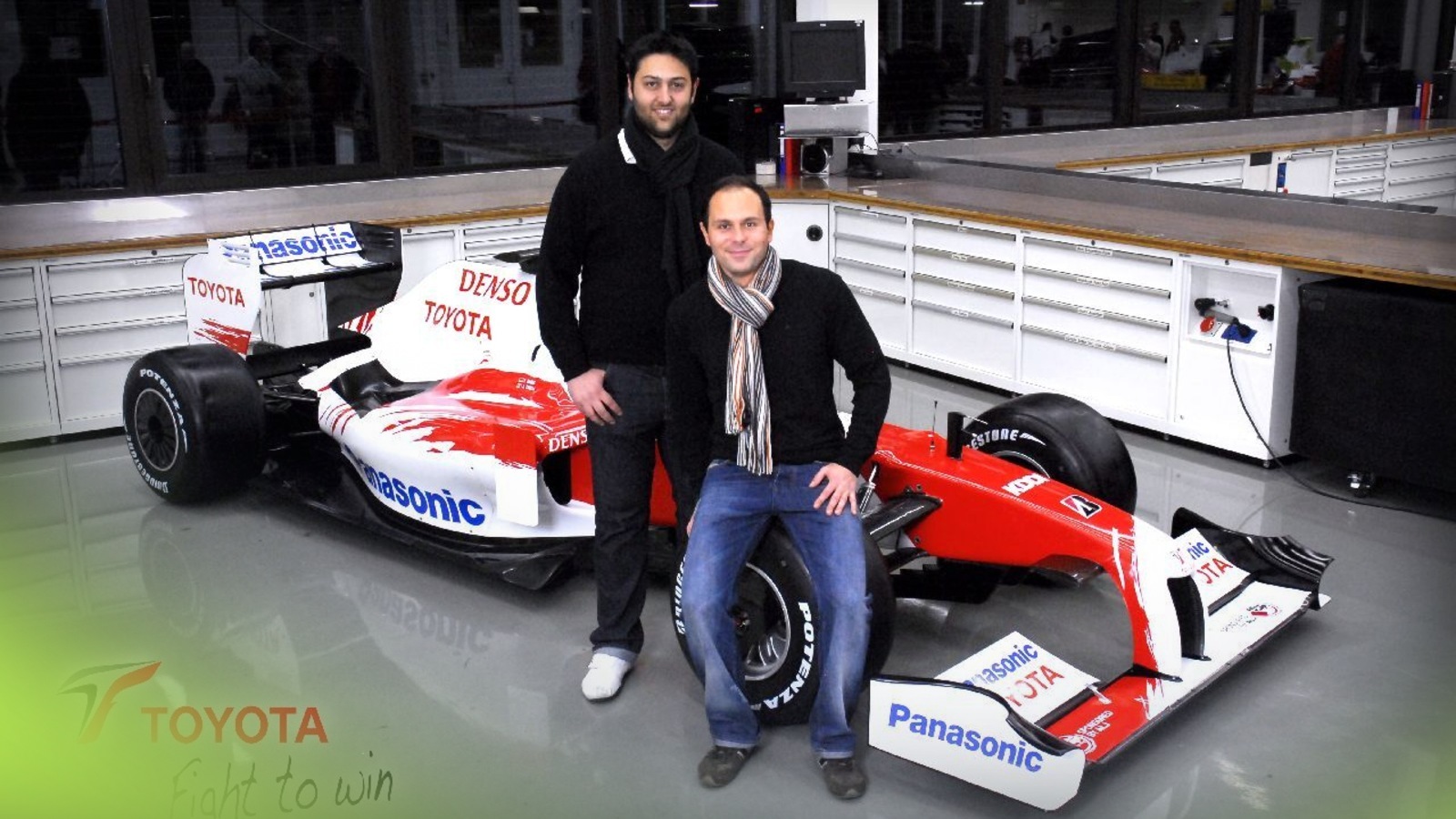
Dr Sammy Diasinos (standing) with the Toyota TF109.
At launch, Dr Diasinos’ front wing end plate featured on the car, only not the real one; he’d been tasked with creating a dummy design, one that drew on all the failed concepts, in a ploy designed both to hide the final solution as long as possible, but with any luck to send rivals down development rabbit holes (see image above). Three days later, the car made its track debut at the Algarve in Portugal, sporting an entirely different end plate solution.
“I designed the slotted front wing end plates that you first saw on the TF109,” he said. “The really cool thing for me about that car was, we had a double diffuser, so everyone was hiding their diffusers because the diffuser was the big performance differentiator that year, but Toyota was the only team in pre-season testing that was also covering up their front wing, because they were trying to protect this end plate design that I initiated.
“The other exciting part of that front wing design was that management recognised that it was going to be a unique design, so they actually asked me to design a fake front wing end plate for the launch car. So we designed this fake front wing end plate basically cobbling together all the ideas that didn’t work together, made it look refined, and then 3D printed this massive fake end plate for the launch.
“I had former colleagues or friends in other F1 teams at the time looking at that fake front wing and saying ‘Wow, Sammy you’ve done a nice job on that end plate. It looks really good,” only for a week later for the real thing to be released.
“There’s a lot of images of the TF109 that are circulating at the moment that have this fake front wing end plate on it.”
It highlights the lengths teams are prepared to go to in their attempts to deceive or cloud rivals with misinformation; a type of corporate espionage and competition intended to tie up resources and slow down development, and therefore prolong any advantage. Today, such subterfuge its easier with digital renders used instead of a real world car, with components often simplified or many generations old such that they’re of no meaningful value.
“I feel really privileged that I got to work in Formula 1 before this limitation of wind tunnel testing and CFD testing came in,” said Dr Diasinos. “AT Toyota, we had two tunnels running 24/7, in parrallel to each other. The office for the aerodynamics department literally was the bridge that was across those two wind tunnels.
“It meant they needed people feeding ideas into these programmes to try; you can’t keep a tunnel running 24/7 if you don’t have the ideas to test. They were very open to trying things which were a little bit out there sometimes. I’ll never forget, when I first drew up that slot gap front wing end plate, my manager was like, ‘that’s not going to work’. I was like ‘Oh well, I’ve submitted it to the cluster. Let’s see what happens.’ Lo and behold, it did work. So it was just being able to have the resources to be able to try things.”
By the following season, slot gaps were standard design features as teams look to control the airflow off the front wing, ahead of the front wheel– critical areas when it comes to efficiency and downforce downstream of the wing.
At the end of the season, with three years of F1 experience to his name, Dr Diasinos moved to Williams, the team he’s supported as a child, as a senior CFD engineer. It was a brief tenure, but one in which his experience linked the CFD and wind tunnel world had a real world impact on a team that, at that point, hadn’t fully grasped the relationship.
“I had both CFD and wind tunnel experience, which at the time, those two tools were very segregated in how they were used and who was using them,” Dr Diasinos explained. “I don’t think it’s like that now, but back then, that was the case. Because of that, they saw me as a good person to try and connect what was being done in CFD with the wind tunnel programmes and trying to maximise the two together.”
The approach was different at Williams. There was less innovation or analysis going into development and the outcome of testing.
“It was more about just feeding the cluster, feeding the wind tunnel, not really thinking about what it was that was being tested and why it might not be working,” he said.
“I was able to show them a different way of how you would use the CFD tools, and then understand that certain components are not there to just add performance, but to help link different parts of the car together and optimise them as a package.
“The under nose turning vanes is how I achieved that for the brief time I was at Williams. They had tested that concept before I arrived and not understood what they were supposed to do, and I was able to show it’s actually a tuning device that helps you tune any front wing change that you make to work with your front floor. So I was able to demonstrate that through a series of CFD simulations and create a wind tunnel programme around that. After running that wind tunnel programme with them, those devices made it onto the car.”
Dr Diasinos’ tenure at Wiliams was brief before he moved on to Caterham, one of the three squads that joined F1 in 2010. It was a vastly different experience to that of Toyota, but one where Dr Diasinos’ influence could be made.
It was there that he learned a lesson he’ll never forget. A design choice, to lower the steering rack in the interests of improving the aerodynamics at the front of the Caterham CT01, contributed to a brake cooling issue that blighted the team for the next two season.
“That will remain with me forever, because it was a mistake,” he admits. “It was clearly a mistake that I made.
“When we were designing the CTO1 for Caterham, I was tasked with running a wind tunnel programme to determine what the front suspension layout should be from an aerodynamics point of view. One thing that I was very keen on testing was dropping the steering rack down towards the bottom of the monocoque, and having the steering rod go alongside the leading edge of the bottom control arm. In the wind tunnel, that was fantastic, it was a gain straight away. It looked really beneficial to have it, and so we went with it.
“But the reason that this was a mistake was because we struggled with brake cooling that entire year. And the reason we struggled with brake cooling was because that steering rod was now connected to the upright in the most prime location for cooling the disc.
“That was just something that my inexperience caused, so the whole year, we struggled with running oversized brake ducts, because we couldn’t get the cooling that we needed. This lost more efficiency that we gained by moving that steering link down. It’s something that I learned halfway through the season, and unfortunately, that monocoque carried into the next year as well. So that was a problem that the team carried for more than one year because of a decision I championed without understanding what the ramifications were for it.”
Today, Dr Diasinos is using the experience and lessons learned from working in F1 to teach the next generation and help them realise their engineering ambitions as a senior lecturer in mechanical engineering at Macquarie University. He’s continued his early career academic work, contributing to a range of research papers broadly centred on aerodynamics and CFD. It’s work that keeps him at the bleeding edge, just as he was almost two decades ago when he first headed to Europe. And through it all, his passion for F1 remains.
Want to be the first to know exclusive information from the F1 paddock? Join our broadcast channel on WhatsApp to get the scoop on the latest developments from our team of accredited journalists.
You can also subscribe to the PlanetF1 YouTube channel for exclusive features, hear from our paddock journalists with stories from the heart of Formula 1 and much more!
Read Next: Mercedes W17 reveal raises first technical puzzle of F1 2026