
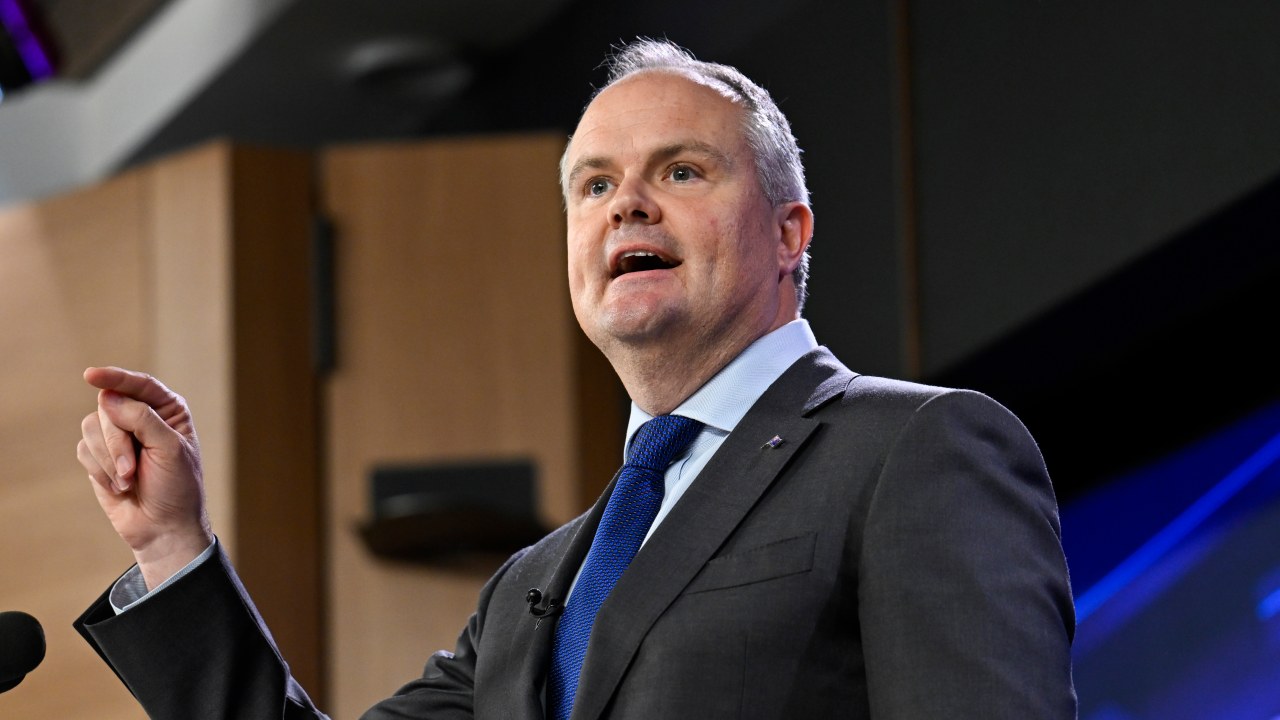
Shadow treasurer Ted O’Brien has joined calls for the government to use its massive majority and enact ambitious economic change to raise the living standards for all Australians.
Labor’s economic management was dealt a blow this week when the Organisation for Economic Co-Operations and Development (OECD) raised a litany of concerns about the nation.
Amongst those was waning competition, the depreciation of real disposable incomes as post-pandemic inflation surged and large government spending that needed to be reeled in amid growing pressures from an ageing population and energy transition.
Mr O’Brien said the government now needed to be bold and utilise its large majority for vital economic change which might not be popular in the short term.
“Unfortunately, what I see today is a government that is very short term focused and focused only on the politics,” he told Business Weekend.
“I don’t understand their timidity. You have a government which does have a whopping big majority and yet they are completely averse to making some hard decisions.
“They’re completely averse to having ambition for the country and if you don’t have ambition for the country then you don’t have ambition to raise the living standards for everyday Australians.”
The OECD’s report arose as Treasurer Jim Chalmers handed down a record $47.8b upward revision in the cost of government services earlier this week.
This revised figure is larger than the forecast budget deficit and just shy of the $51b the government plans to spend on defence this year.
Economist Chris Richardson noted the average revised costs in the six years prior to the pandemic averaged $0.7b.
This grew to an average of $18.4b after the pandemic.
Mr O’Brien said reeling in government spending and allowing the private sector to dominate could bolster life for all Australians.
“The more we can have the private sector doing the heavy lifting and growing the economy, rather than government, then you’ll see all boats lift,” he said.
“That’s what we want to see because that is what raises the living standards of everyday Australians.
“That’s what’s going to raise productivity. That’s the task that lies ahead.”
The OECD report also stated there was “no longer any strong need for fiscal support to households or firms”, a finding at odds with Labor’s major outlay on electricity rebates.
“With federal and state budgets projected to be in deficit for years to come and growing fiscal pressures coming from population ageing and the climate transition, there should be a greater sense of urgency about improving the public finances,” the OECD said.
“The planned gradual fiscal adjustment should be implemented by raising spending efficiency and improving the functioning of the tax system.”
The report included a series of recommendations which could help bolster the tax system.
These included reducing concessions to superannuation, indexing tax brackets, phasing out negative gearing, removing some capital gains tax discounts, and changes to road user charges and inheritance tax.
Mr Richardson said the damning picture the report painted of Australia’s economy echoed complaints many economists had been making for years.
“There’s a whole bunch of things that could be done that would make Australia more productive and more prosperous,” he told Business Now on Thursday.
“(They) would push our living standards up (and) would have our political classes… giving a tailwind to our living standards instead of a headwind.
“But, you know, we haven’t seen much of that from either side for a very long time.”