
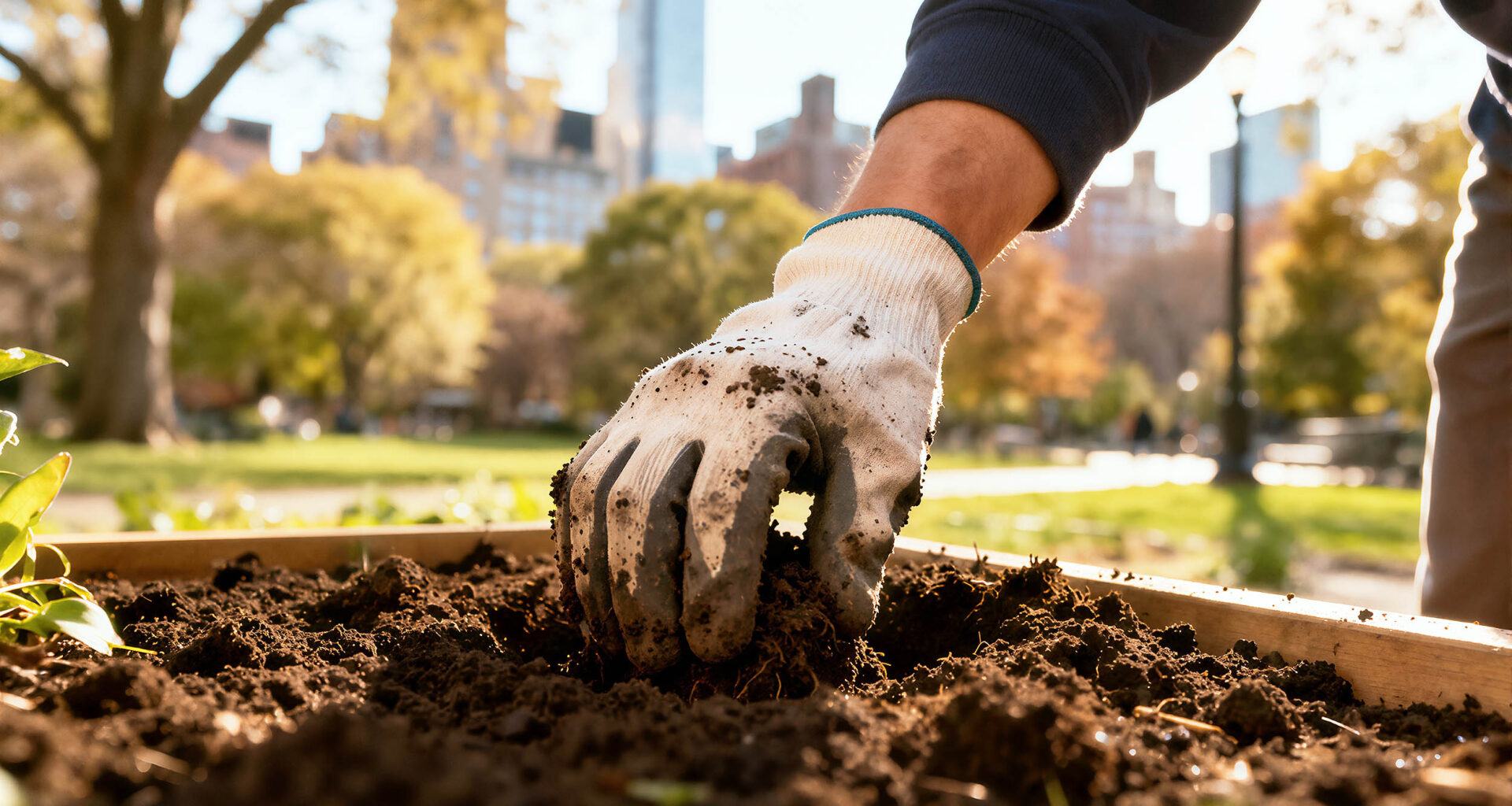
Salt, plastic dust, and rising heat affect city soil health, but the damage stays hidden until the soil’s functions start failing.
When soil stops breathing and soaking up water, streets flood faster and urban plants lose support that keeps neighborhoods livable.

Real streets and parks rarely face one stress at a time, so soil damage can flip when pressures collide.
In a climate chamber at Freie Universität Berlin (FU Berlin), biologist and doctoral student Rebecca Rongstock led the work.
Her research in the Rillig Group focused on how combined urban pressures changed soil health in terms of microbes and substratum structure.
The results suggest that even a helpful factor can become extra strain once several stressors arrive together.
Soil health holds cities together
The setup treated city soil like a place where stress builds in layers, not like a clean baseline.
Researchers ran a study using 140 samples and six stressors that commonly co-occur in cities. Using a subtractive design, removing one factor from a combined background, they compared each missing piece against the full mix.
Because the experiment ran for 6 weeks without plants, the findings fit controlled soils better than living parks.
Soil health often comes down to structure, because structure controls where water and oxygen can move. Stable soil aggregates keep pores open for air and rain.
Microbes and plant roots help glue these crumbs, so traffic and drought can break them faster than expected.
Once pores collapse, runoff rises and city trees struggle, even when the surface still looks like bare dirt.
Microbes and soil health
Hidden microbes keep nutrients moving and organic matter breaking down, which supports plant growth and long-term carbon storage.
In this experiment, enzyme activity, the speed at which microbes run key chemical reactions, served as an early warning signal.
A related paper noted that stacked global pressures can reshape microbial communities and the processes they drive.
When those processes slowed, the soil lost some ability to rebuild structure after stress, leaving damage that lingers.
Heat turns into trouble
Higher temperatures can look like a boost for soil health, because warmer soil often speeds microbial metabolism in controlled conditions.
“Experiments repeatedly show that individual treatments with global change factors, such as higher temperatures, can have positive effects on soils,” says Rongstock.
In the full mix, however, warming sped evaporation, leaving less water and concentrating pollutants that damaged microbes and weakened soil aggregates.
That reversal means heat is not just another stress, because it changes how other chemicals reach living cells.
Salt changes soil balance
De-icing salt builds up in urban soil, and bioswales, planted channels that catch and filter runoff, can carry chloride well past winter.
Saltier soil water pulls moisture out of microbial cells, which can slow growth and reduce the enzymes that build structure.
High salinity, extra dissolved salts in soil water, was tied to microbial change. In the FU Berlin experiment, removing salt from the full stress mix improved most measured soil functions.
Drought alters water entry
Drying soil changes how water enters later, and that matters in cities that depend on soil to absorb storms.
Under drought alone, the soils formed smaller aggregates and showed more water repellency, resisting wetting after drying.
Longer droplet-soak times meant rain could sit on the surface, which can raise runoff during sudden downpours.
With less water to buffer chemicals, small additions of salt or pollutants can hit microbes harder during dry spells.
Plastic and surfactant tensions
Traffic leaves behind tiny fragments that move with dust and runoff, adding a hard-to-track pollutant load.
One recent review summarized tire wear particles, tiny rubber fragments shed from tires, as a growing source of microplastics.
In tests, microplastics and detergent residues showed little harm on their own, even when they fed certain microbes.
That changed once other stressors cut microbial activity, so surfactants, soap-like chemicals that loosen oils and grime, offered no net benefit.
Repairing soil health
Restoration plans often start by tackling the worst-looking single problem, but the study warned that approach can miss the real driver.
When one stressor was removed from the full set, soil properties and microbial processes generally improved in the remaining mix.
That pattern points to practical leverage, because cutting a single input like salt or heat can help soils recover faster.
“A key reason is that we simply don’t know how stressors interact when they occur together,” said Rongstock.
Across these findings, soil trouble came less from any single stress and more from the way stressors stacked.
Better protection will require tests that include living plant-soil systems and policies that reduce overlapping urban pressures at once.
The study is published in Nature.
—–
Like what you read? Subscribe to our newsletter for engaging articles, exclusive content, and the latest updates.
Check us out on EarthSnap, a free app brought to you by Eric Ralls and Earth.com.
—–