

January 26, 2026 — 5:01am
Save
You have reached your maximum number of saved items.
Remove items from your saved list to add more.
Save this article for later
Add articles to your saved list and come back to them anytime.
Got it
AAA
The staggering amount of money thrown at artificial intelligence will remain one of the most important themes for sharemarket investors this year, but there’s a critical question hanging over this spending spree.
Building AI infrastructure, such as data centres and power supplies, will cost more than US$5 trillion ($7.3 trillion) in coming years, according to J.P. Morgan, which is enough to make AI spending a serious influence on economic growth.
 Spending on data centres is exploding thanks to AI.Getty
The investment binge is also helping to drive enormous sharemarket valuations, sparking comparisons with Australia’s mining boom from earlier this century, and of course, the dotcom bubble of the late 1990s and early 2000s.
But all this spending raises a fundamental question for investors: will the tech giants be able to recoup these massive outlays in future profits?
This is significant for just about anyone with superannuation because AI-linked company share prices have been a key contributor to the very healthy recent returns from world sharemarkets (in particular the US) that have underpinned super returns.
Editor’s pick
The bullish case for AI-related stocks is that the technology really is a game-changer, and that a handful of tech companies will be in a prime position to dominate this market and extract massive profits. Nvidia is the superstar case study. The company’s superior microchips, which are in hot demand thanks to AI, have turbocharged its profits and made it the biggest company on Earth.
However, a recent analysis of past technology booms and artificial intelligence by TCorp economists Brian Redican and Emily Perry makes a convincing case that while AI may be transformative, the path ahead for investors could also be “a little rocky.”
Their insights are an important balance to all the hype about AI that will no doubt continue this year.
First, they point to a fundamental lesson of economics: the more abundant something becomes, the cheaper it gets. So, if AI models really are as spectacular as some claim, tech firms all have the incentive to produce these models more cheaply and more efficiently.
An example from history is the cost of providing lighting, which plummeted thanks to light bulbs – a game-changing technology if ever there was one. The price of lighting has plunged over the long term, the economists point out, and the winners have not been companies, but customers.
Sharemarkets were reminded of this risk in the AI sector this time last year, when Chinese start-up Deepseek shocked Wall Street with what appeared to be a much cheaper AI model that was comparable to the world’s leading chatbots. There are bound to be more such bumps in the years to come.
A second big lesson from past technology booms is the risk of overinvestment.
Whenever there’s some whizz-bang new technology, whether that’s railroads, the internet, or AI, businesspeople have every incentive to race like mad to grab market share. But in doing so, they often end up putting in more capital than they should.
There is a live debate about whether that’s precisely what is happening now.
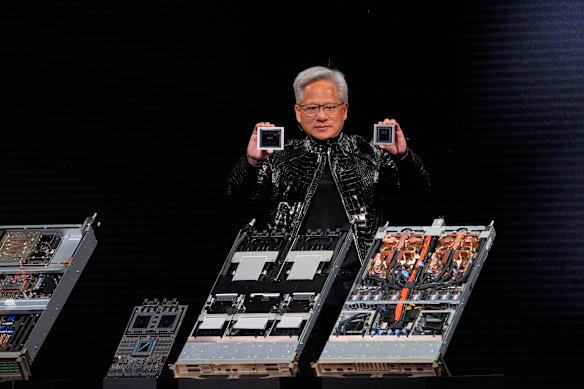 Nvidia founder and CEO Jensen Huang.AP
For example, J.P Morgan analysts have estimated that to get a 10 per cent return on the AI investments they expect between now and 2030, companies will need to make an extra US$650 billion in annual revenue “in perpetuity, which is an astonishingly large number”. That’s equal to an extra US$34.72 a month from every person with an iPhone, they estimate, or an extra US$180 a month from every Netflix subscriber.
Whenever there’s a rush to build physical assets such as data centres, there’s also a risk that the competition between firms drives up costs, such as when miners bid up the price of labour and materials.
HESTA’s chief investment officer, Sonya Sawtell-Rickson, says the obvious example of such constraints on the AI boom is the data centres’ hunger for electricity. She points out that in the US, the AI boom has in some places sent the price of electricity significantly higher, generating pushback from the community.
“There’s a lot of residential retail price increases that are starting to cause increased action with the electricity regulators,” she says.
A third lesson from past tech booms is that the winners aren’t necessarily those who led the charge in building the new infrastructure.
Trent Masters, portfolio manager at Alphinity, says the big winners from the 2000s tech boom were not the telcos laying lots of cables to build out the internet, but those who created something new on top of it. For example, Google’s search, Amazon’s online commerce system, and Apple’s iPhone. He predicts we might see something similar with AI – we just don’t know what that use case is yet.
“I think the pure models end up getting commoditised, but it’s the applications you can build on top of that – that’s where the value ends up accruing,” he says. A final point is that investment booms, however strong they are, inevitably fade.
Whether it’s a lack of electricity or water for data centres, or simply because tech companies decide we’ve got enough data centres, there are plenty of plausible reasons for the breakneck pace of AI investment to slow. If this happens, one would have to imagine it would burst some of the AI euphoria in markets.
Of course, it’s one thing to point out the AI boom has many risks, but if you’re an investor, what do you do about it?
Editor’s pick
Sitting out the AI bonanza isn’t really an option for investment giants like super funds; if they’re not invested in the AI players, they’d risk lagging the market and delivering sub-par returns to members.
HESTA’s Sawtell-Rickson says AI-linked investments are now roughly 20 per cent of global sharemarkets (more in the US) and the “Magnificent Seven” US tech giants have returned about 60 per cent a year over the last three years. While the fund has slightly less AI exposure than the listed market average, she says AI has risen so much that it’s now a “more systemic risk” in the portfolio that needs focus and attention.
Whether you’re a big investor such as Sawtell-Rickson’s HESTA or a humble retail investor, it’s impossible to know how the AI bonanza on sharemarkets will end.
But when you consider the eye-popping sums of money being invested, history and economics suggest that it won’t be smooth sailing the whole way.
Or, as J.P. Morgan’s analysts put it: “Even if everything works, there will be (continued) spectacular winners, and probably some equally spectacular losers as well, given the amount of capital involved and winner takes all nature of portions of the AI ecosystem.”
The Business Briefing newsletter delivers major stories, exclusive coverage and expert opinion. Sign up to get it every weekday morning.
Save
You have reached your maximum number of saved items.
Remove items from your saved list to add more.
 Clancy Yeates is deputy business editor. He has covered banking and financial services, and was previously national business correspondent in the Canberra bureau.Connect via Twitter or email.From our partners