
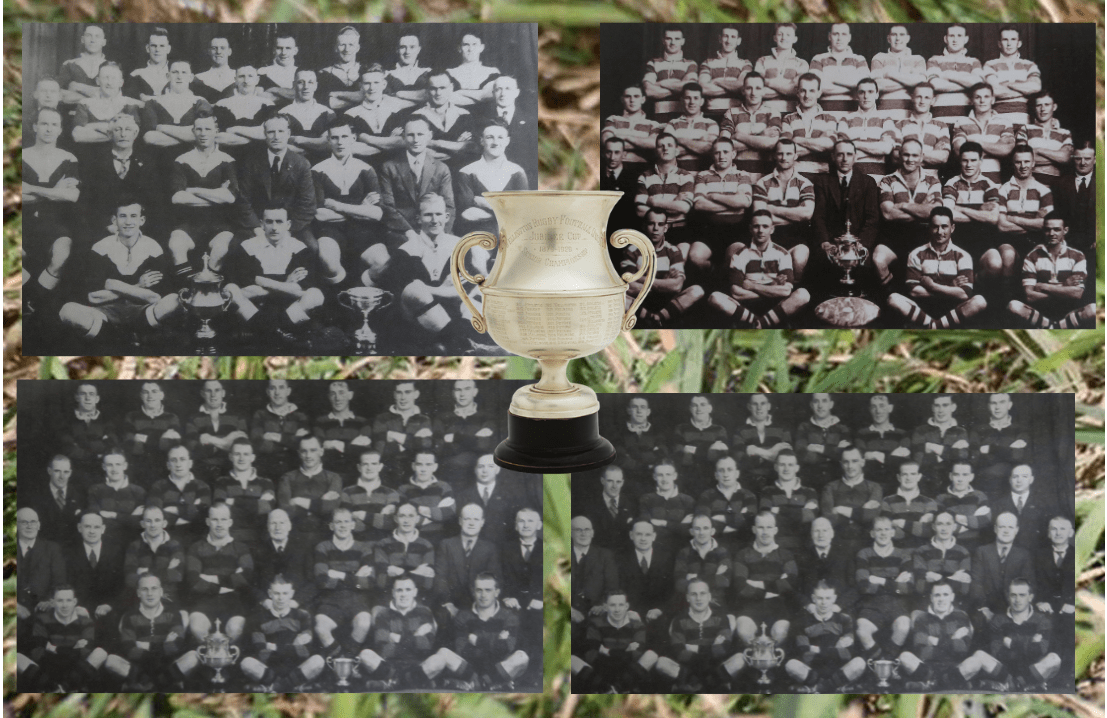
The 20-year period between the two World Wars saw the introduction of “the Jubilee Cup” to Wellington’s senior rugby championship.
But despite the generally accepted narrative of its origin being in 1929, new information obtained by Touchline suggests its true beginnings are shrouded in the dense tobacco-smoke and oft heady beer-fumes of local rugby lore, both in terms of “when” it was first formally acknowledged as the premier trophy in Wellington club rugby, and “who” was responsible for its manufacture.
Touchline genuinely wonders whether in fact the currently accepted history might be an “innocent wheeze,” of more recent fabrication?
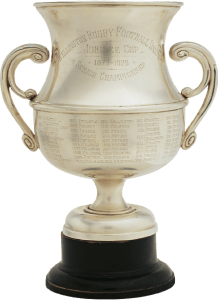 The Jubilee Cup as it stands proudly today.
Following the Great War, in 1919 a local businessman who was a member of the Poneke Football Club (and the Wellington Amateur Athletic Club) by the name of John Swinson, stepped forward to donate a new trophy for the senior rugby championship in Wellington. First won by Poneke in 1919, the trophy was contested annually thereafter, with the “Swinson Cup,” known by all local rugby folk as “the token of Rugby supremacy” in Wellington. We know (from the papers) that it was won by Petone in 1935 (in the club’s 50th year), in front of a crowd of 9,000, against Athletic.
Interestingly, it was noted of the Swinson Cup’s manufacture in 1919 that, “the trophy, which is of unique design, is provided with a special arrangement whereby the colours of the winning club may be inserted”, a description which Touchline feels is spookily reminiscent of the “missing lid” of the current Jubilee Cup, which had the figure of a player with his hands on hips, through which a ribbon of the winning team’s colours was commonly inserted, (as shown in the photos below).
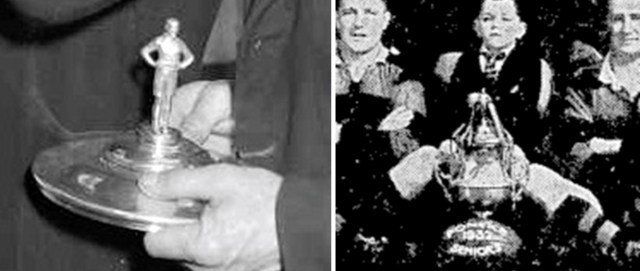 (The Cup’s missing lid – and the trophy lid with “colours” inserted in the close-up grainy photo of the Poneke 1932 team).
Could it be that the Swinson Cup and the Jubilee Cup are in fact the same trophy?
Touchline notes that the period from 1933 to 1938 witnessed a flurry of significant rugby jubilees in the Wellington Rugby Union, with Poneke (1933), Petone (1935) and Oriental (1938) all celebrating 50 years of rugby, while Athletic celebrated its 60th jubilee in 1936. It is noteworthy that three of the abovenamed clubs won the senior championship in their “jubilee year.”
1935 was also the silver jubilee of the reign of King George V, with several sporting codes introducing “Jubilee Cup” trophies at this time, to commemorate the King’s coronation.
The first reference to “the Jubilee Cup” being presented for rugby’s senior championship in the newspapers, (which Touchline observes prominently reported on rugby affairs in this period), was in 1938, the year of Oriental’s 50th jubilee. Notably, there is no contemporary reference to be found of the Wellington Rugby Union ever instituting the trophy in its 50th year, which Touchline would have expected to see widely publicised, given the specific significance of that jubilee.
Based on the circumstantial evidence above, Touchline therefore wonders if today’s Jubilee Cup is in fact the Swinson Cup from 1919, repurposed by the Wellington Rugby Union in the 1930’s to recognise the significant “jubilees” of its premier rugby clubs. Efforts are now underway to identify the silver hallmarks on the Jubilee Cup, which will provide the necessary evidence to prove (or cast a little shade on!) Touchline’s seismic theory.
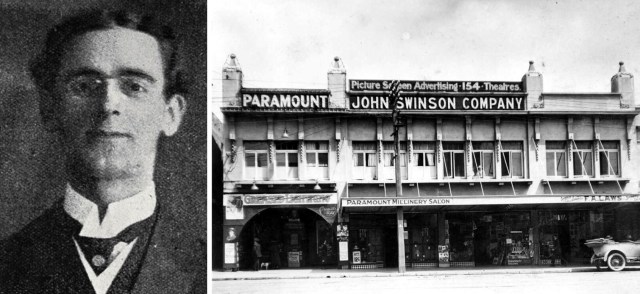 John Swinson, and his office at the Paramount Theatre, Courtenay Place.
As for John Swinson, he arrived in New Zealand from Coventry, England in the early 1900’s. He was the Manager of Chandler & Co. (advertising agents) before going into business on his own account where he introduced advertising to movie theatres across the country.
Swinson was infamously arraigned before the Wellington Supreme Court in 1921 (and acquitted) in connection with the charge against him of having in his possession a glass plate with a photograph negative resembling a £5 Bank of New Zealand note. It was explained that the case arose out of a guessing competition inaugurated by Swinson regarding the first test match against the Springboks that year, rather than any intention to print counterfeit money!
A generous benefactor to Wellington City and to both rugby union and athletics, John Swinson married Ada Taylor from Sudbrook, England in 1911, with whom he raised a son (Ewen Cecil) and a daughter (Gwedolen Carrie) at the family home, 64 Russell Terrace, Berhampore.
Swinson died suddenly on 10 February 1929.
Like this:
Like Loading…
Related
Discover more from ClubRugby.nz
Subscribe to get the latest posts sent to your email.