
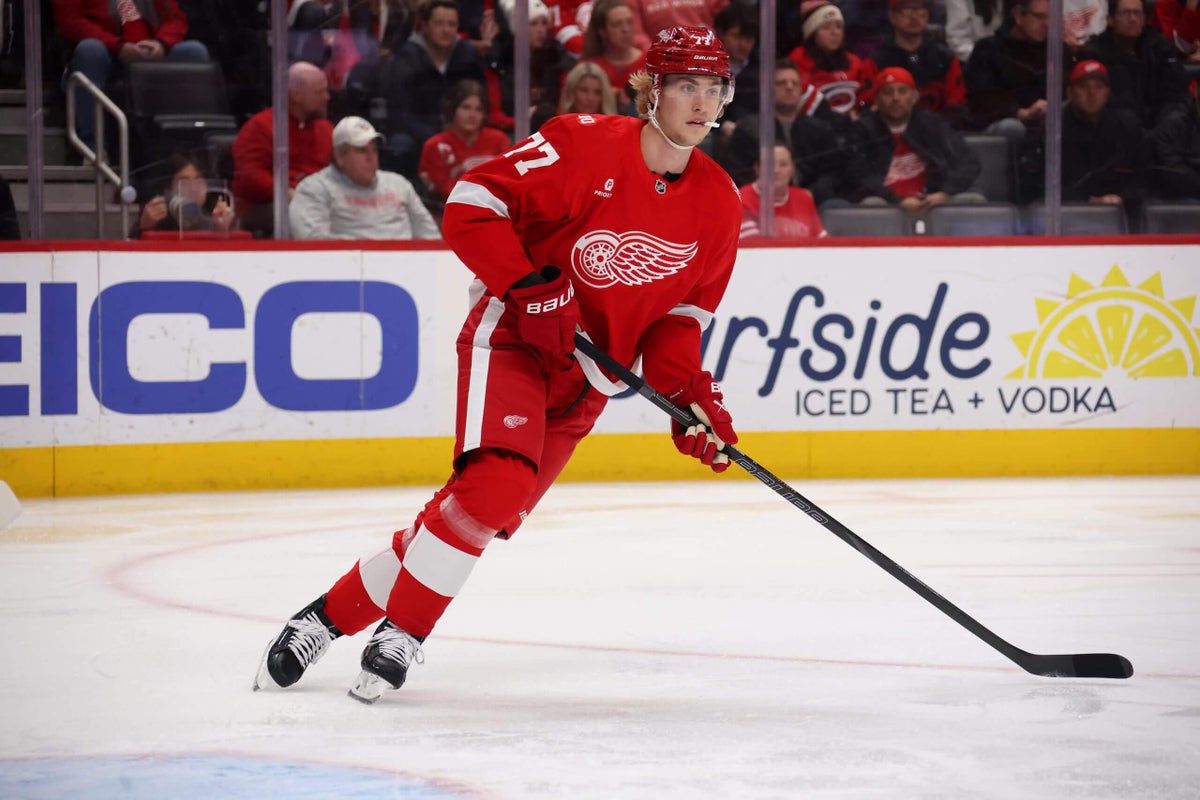
DETROIT — The Detroit Red Wings got some bad news Monday: top-pair defenseman Simon Edvinsson will be out through the Olympic break with an undisclosed injury.
For a team battling at the top of its division and conference, that’s certainly a tough blow, as Edvinsson plays the second-most minutes per game and continues to evolve into one of the Red Wings’ core pieces.
But if there are any silver linings, they are these: first, after missing two games on the team’s recent road trip, Edvinsson may only miss five more games with the 6-foot-6 defender expected back after the looming break; second, the injury comes right as the Red Wings’ depth is starting to arrive in full.
“When you lose players, there’s all the cliches,” head coach Todd McLellan said. “Somebody else steps up, all that type of stuff. It just means that everybody has to pull a little harder and do a little bit more. And if you manage the game properly, you can get through it.”
For much of the last two months, the Red Wings’ depth has been coming along. Detroit’s stars carried the team through the season’s first month or so, but the Red Wings’ surge in December coincided with the emergence of James van Riemsdyk and Andrew Copp as legit secondary contributors (as well as a dominant run from goaltender John Gibson). Other contributors have certainly had their moments throughout the year, as well.
But lately, it’s been much more of a full-lineup push, perhaps most driven by the re-emergence of a pair of second-year players who have recently returned to the form that made them exciting players entering the season.
Perhaps the most notable is Marco Kasper, whose play in the second half of last season was perhaps the most important breakthrough on the team. Kasper first popped playing on the wing with Dylan Larkin and Lucas Raymond shortly after McLellan was hired at Christmas, and then, when injury struck, moved to second-line center and was effective there, too. He entered the season penciled into that top-six role as a result, but after some bad breaks early, went into a prolonged slump. He had just six points through his first 47 games.
Recently, though, Kasper looks much more like the player who warranted such excitement. He now has six points in just his last five games, including a highlight-reel assist in a two-point showing against San Jose, and then a confident goal Saturday on reigning MVP Connor Hellebuyck. He’s back with Larkin and Raymond on the top line, too.
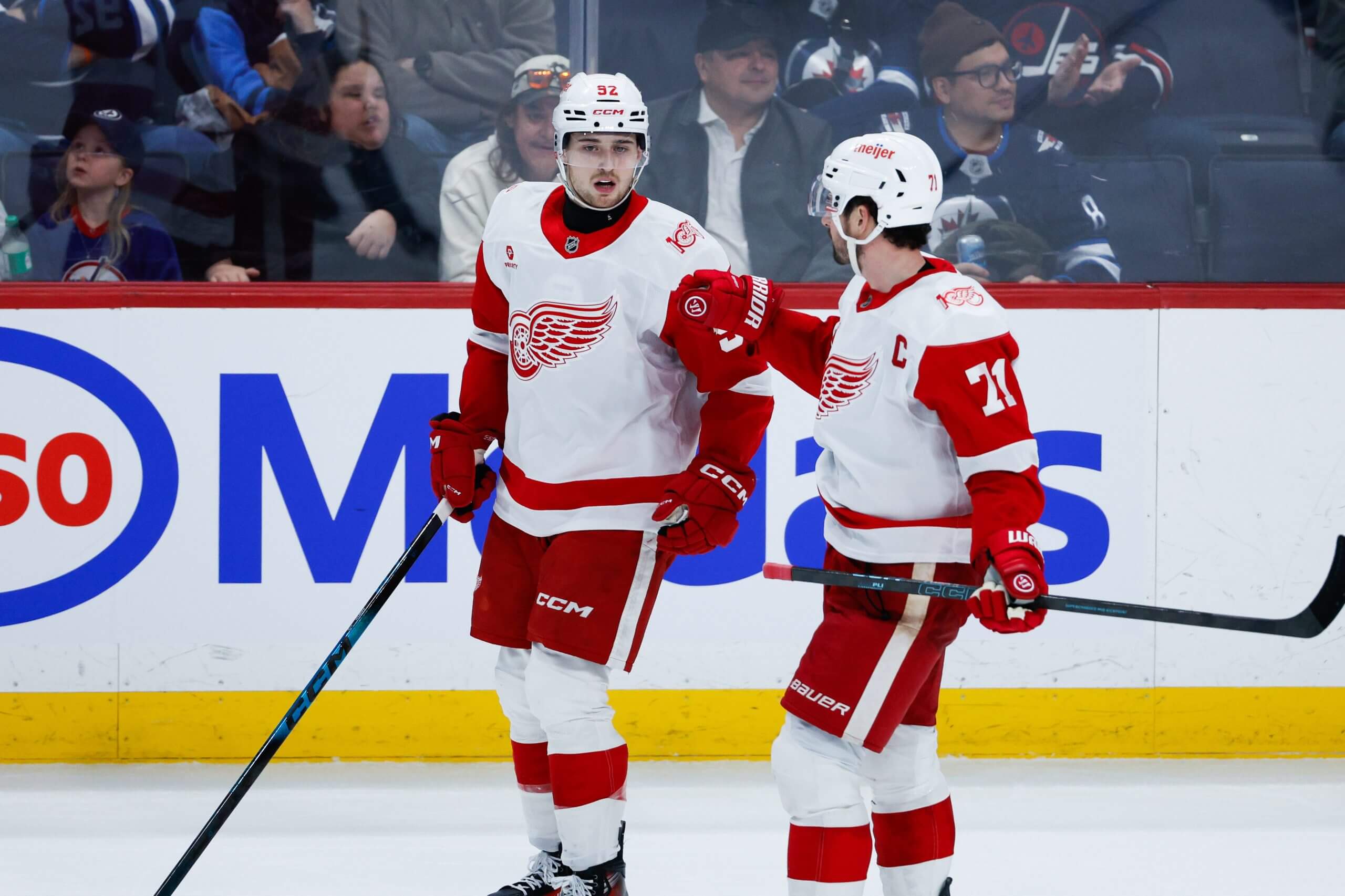
Marco Kasper is back on the top line with Dylan Larkin and Lucas Raymond. (Terrence Lee / Imagn Images)
And it’s not just the points, though they certainly help. Kasper’s play had picked up without the production before this recent run, but the validation those numbers provide does matter, particularly in fostering confidence and reinforcing habits.
“He was playing the right way,” McLellan said. “Everything but the paper, the stat sheet, at the end of the night was pretty damn good for a while. But that tick on the assist or the goal, or whatever it might be, wasn’t there, so the reward for everything he was doing really wasn’t there. He stuck with it … and he’s pushed his way through, and now he had a goal, he gets an assist here and there, but his game hasn’t wavered. And I think he’s figured that out, that if he just plays hockey the way that he can, it’s a real positive for him and for us as a team.”
One big benefit: it has helped Detroit stabilize its lines, which had been in a period of flux in early January. The line of Copp, Alex DeBrincat and Patrick Kane was consistent, but the Red Wings were looking to spark their top line and find more at five-on-five in general. Now Detroit’s lineup looks arguably as good as it has all year, top-to-bottom.
Kasper and Raymond have been hot up top, though Detroit’s first line still probably has another gear to find. The Copp line continues to be effective. J.T. Compher scored a pair of goals Saturday in Winnipeg, with Emmitt Finnie (another surprise contributor) assisting on one, and that pair’s linemate van Riemsdyk tacking on a goal in Minnesota, too.
Even the fourth line, while perhaps not as productive on the stat sheet, has been more noticeable, partly because of a strong run from Elmer Söderblom, who McLellan has said “looks like that player that we need, over and over and over again.” The 6-foot-8 Söderblom has rare size and slick hands to match, and has increasingly managed to pair the two, getting to pucks down low and using his combination of strength and skill to hold onto them to create an advantage.
Put it all together, and the Red Wings have gotten to a rather complete-looking lineup up front, even if in a small sample.
“It’s huge,” van Riemsdyk said. “Over the course of the long season you need different guys chipping in and different opportunities and different times of the year. That’s the mark of a good team. … Especially as it gets tighter and into the playoffs, the top lines are going to get checked against really hard, so it usually comes down to the depth guys being able to contribute in ways too.”
That’s not to say the Red Wings couldn’t still use the right addition up front at the trade deadline, as most contending teams can — especially with the reality of injuries. But it certainly makes it a less urgent need, especially with Detroit having some viable potential reinforcements in AHL Grand Rapids, between rookies Nate Danielson and Michael Brandsegg-Nygård or veteran John Leonard, all of whom have played in Detroit at points this season.
Where the deadline is most interesting for Detroit will be on the blue line, where Edvinsson’s injury is going to give its depth an early test.
If Edvinsson is out only five more games, that span shouldn’t break Detroit one way or another. But the positive, as McLellan alluded to, is that the Red Wings have already had players step up, allowing them to manage so far by taking three out of four points so far in the two games without Edvinsson.
In those games, the workload jump was most noticeable for what had previously been Detroit’s third defense pairing, Albert Johansson and Jacob Bernard-Docker. As with Kasper, that pairing had already been quietly coming along for the past few weeks before Edvinsson’s injury.
Since the start of January, Johansson and Bernard-Docker lead all Red Wings defensemen in five-on-five on-ice expected goal share, with Johansson at a staggering 59.19 percent and Bernard-Docker at 56.67. Their actual goals share is even better, with both north of 80 percent. Those numbers also have come with increased quality of competition in that span, according to hockeystatcards.com, which makes it all the more notable. They each took clear second-pair minutes in the last two games.
And for Johansson, there was already an uptick in usage even before Edvinsson’s injury. He’s now averaging 19:39 per game since Jan. 12.
“I think Albert’s playing his best hockey of the season,” McLellan said last week. “Coming into camp, we counted on him a lot, but this was the time last year when his game really took off, too. Maybe he settles in a little bit more in the second half, I’m not sure, but his legs have been excellent. He’s been able to skate pucks out of trouble and his legs get him to spots where he can break up plays. So he’s been very good.”
Johansson, for his part, said it’s been “a lot of fun” playing those increased minutes, and that he’s felt himself find his game over the last month.
“If you have confidence, you’re not thinking too much, you kind of just go out there and play,” Johansson said. “And I think that starts with playing good defensively, like not giving up goals or scoring chances or whatever it is. … When you’re keeping the puck out of your own net, you get more time to play with the puck and play in the O zone, and I think that kind of shows in my game right now too.”
That’s been clear through the eye test and in the data. And it’s been true for his defense partner as well, with Bernard-Docker looking reliable next to him after being yo-yoed in and out of the lineup for Travis Hamonic early. The consistency of Bernard-Docker’s role could very well be helping him and Johansson of late — though McLellan has changed up the pairs some in Edvinsson’s recent absence.
It still seems entirely possible, and perhaps likely, that the Red Wings will make a move for blue-line reinforcements at the deadline. As Johansson’s ice time has surged, rookie Axel Sandin-Pellikka has seen his minutes go the other direction, playing fewer than 15 minutes in five straight games, and fewer than 10 in three of his last seven.
It’s not unusual for coaches to shelter a rookie from tough, late-game minutes early in their career, but in a playoff series, Detroit is going to want to have some certainty. Maybe that comes in the form of bumping up Johansson (who can play his off hand) or Bernard-Docker. Or maybe it comes via an outside addition to bolster the mix.
In that sense, being without Edvinsson will offer general manager Steve Yzerman a bit of a window into how his current group responds when the demands get harder. And perhaps that’s one more slight silver lining, albeit from a situation the Red Wings surely would have preferred to avoid.
“The fact that we’ve got to shuffle some things around and guys have to play with other partners, and in different situations, that’s not a bad thing for the group,” McLellan said. “They haven’t had a lot of adversity back there, knock on wood, for injuries. So, now we’ve got to deal with it.”
Five games from now, we’ll know how the Red Wings fare in that test. But if there’s any upside, it’s that the trial is arriving at the same time as their depth.