
Save
You have reached your maximum number of saved items.
Remove items from your saved list to add more.
AAA
All of these things happen within a few minutes: a shirtless man riding a skateboard jumps onto a bench and performs a triple somersault; four women in traditional Chinese dresses dance to music blasting from a portable speaker; two Mormons engage in conversation with a man in shorts; strangers – some kitchen staff from the nearby Indonesian restaurant, some in suits – compete at council-provided table tennis tables; about eight government bureaucrats, school students and corporate workers gather around a giant chessboard, appraising each other’s moves; five schoolgirls, some in hijabs and all in Adidas flats, eat ice-cream; and I am approached by a neatly dressed man who invites me to listen to a presentation about God the Mother.
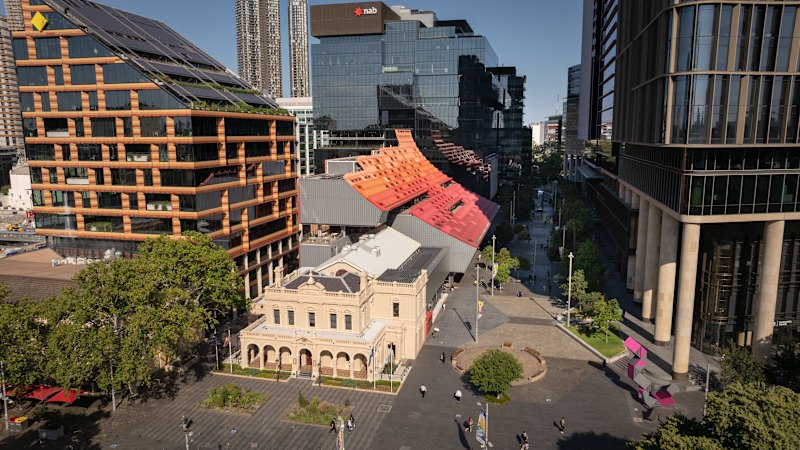
This is a Tuesday afternoon at Parramatta Square, one of the few places in a city as famously divided by class and culture as Sydney that offers a place for many people to dwell.
Parramatta Square opened in 2022 after being built by mega developer Walker, which won the contract to redevelop the precinct. City of Parramatta Council now manages the site.
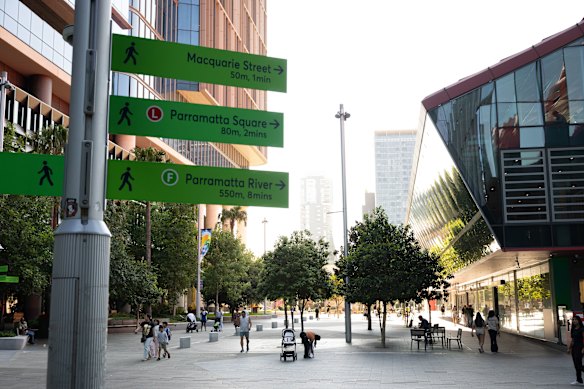 Parramatta Square is a large urban renewal project.Wolter Peeters
“It’s a game-changer,” western Sydney commercial real estate agent Tom Bartlett says. “It’s given a Martin Place to a city which was previously a desert. Before, everything was centred on Westfield, which is OK, but not everyone wants to sit in a food hall.”
What started as an urban renewal project costing $2.7 billion worked – now Parramatta Square is just urban.
On his day off, childcare worker Biwash Ojha is visiting the square with a coffee from 7-Eleven. Having lived around Parramatta for most of his adult life, he has watched the square transform into a place people want to visit.
His parents visited him a month ago. While he was working across several jobs, they visited a nearby park. “But then I brought them to this place,” he says. “When I was at work, they were always here. They’d sit back, relax. It’s a good place. There are a lot of people coming in and out.”
But like any major centre, change is never far away. Food and retail outlets in the precinct are changing, development around the square threatens its primacy as the centre of the city, and leaders are agitating to inject it with more life. It all raises the question: who is Parramatta Square for?
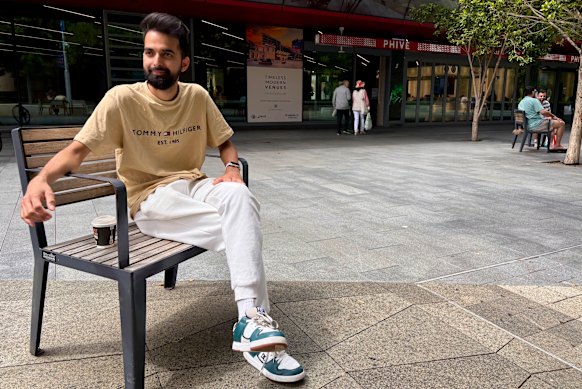 Parramatta local Biwash Ojha relaxes with a coffee at Parramatta Square.Anthony SegaertFrom cafe to chicken shop
It’s a question brought to the fore by an innocent enough change in tenancy: the main cafe that used to occupy space at the base of the public library is being replaced by the cult American chicken shop Wingstop.
At Publique, the bistro-style cafe that spread its Prague chairs along the open sides of the French-designed “public living room”, library visitors and tourists, the down-and-out and university students, would all rub shoulders with the lanyard class of state bureaucrats and corporate officers in nearby buildings.
Wingstop, with 3000 stores worldwide, is unlikely to attract such a crowd. But the change at the square’s flagship venue represents a shift in approach from the council: a daytime-focused venue that mainly attracted people working will turn into a nighttime-focused eatery aimed at young people, especially students.
The transformation of what is effectively western Sydney’s town centre “has the ability to shape daily habits”, said Nicky Morrison, a planning professor at Western Sydney University and director of the Urban Transformations Research Centre.
“It’s not just about a retail space. It’s a civic health environment. What’s sold there really does influence who feels welcome in the space.”
But Wingstop will be able to do what Publique never managed: stay open late, and on weekends. When the office workers leave and university students go home, Parramatta Square turns eerie. On weekends, the library is often the only place open during the day.
When the corporates leave
The council has turned to various measures to try to “activate” the space at different times of day. It partners with Walker, which still manages the office towers, for events during the year, including Christmas markets, Lunar New Year celebrations, and New Year’s Eve fireworks off the top of the tallest building in the precinct.
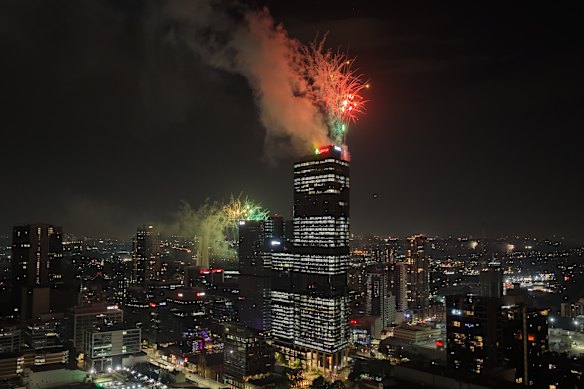 Fireworks erupt off the tower of 6-8 Parramatta Square on New Year’s Eve, 2025.Walker
But as it attempted to expand the hours of its attraction, it ran into a problem: Parramatta Square at night is exceptionally dark, particularly where the square meets the old Anglican cathedral on the western edge.
Council staff last year said the darkness had led to an increase in “anti-social and illegal activity”. “Fairy lights are being installed at key locations of the St John’s Cathedral site as an interim measure to help address these issues,” staff reported.
The city’s long-term strategic plan envisages the Parramatta CBD as the “Headquarters District”, “the place to be – day or night”, “welcoming to everyone as the home of nightlife, arts, shopping, food and festivals”. For that to happen, the centre of the district needs to be safe and bright.
The council is evaluating two tenders from lighting companies that seek to address the darkness. Confidential documents seen by this masthead show plans by consultants Arup and independent lighting agency Isambard Studio to create a series of installations throughout the square to brighten pathways and corners.
But a wind tunnel flows through the square, which council staff last year identified as a “significant and ongoing issue” for the precinct.
“Any installation requires engineering certification to demonstrate suitability for the public domain,” staff wrote.
Metro development threatens supremacy
Zoom out beyond the three-hectare site, and you’ll get a glimpse of the forces that will change how we experience the square.
To the west, land owned by St John’s Cathedral was last year rezoned to allow for the multi-storey development of church premises, with more than 2500 square metres of public space.
And to the north, machinery is heaving around the site of the future Metro West station precinct, which will practically double the space in the area, with four towers stretching up to 38 storeys.
Among the towers will be swathes of new public space, also forming part of the new Civic Link strip to connect the CBD to the river.
But there can be too much of a good thing. Plazas can feel “empty and lonely” if they are too large and ignore human scale, says Business Western Sydney boss David Borger, who has been campaigning for entertainment venues to be placed on the site. “Parramatta Square is very big. Do you want something as big as that again?”
But for now, at least, Parramatta Square is buzzing. Maher Santina is watching his two daughters, aged four and two, glide around the square on balance bikes.
“They asked to play here,” he says. The children enjoy the fountain near the cathedral, as well as the Wednesday markets and visits to the library. “They don’t want to go home.”
The Sydney Morning Herald has a bureau in the heart of Parramatta. Email parramatta@smh.com.au with news tips.