
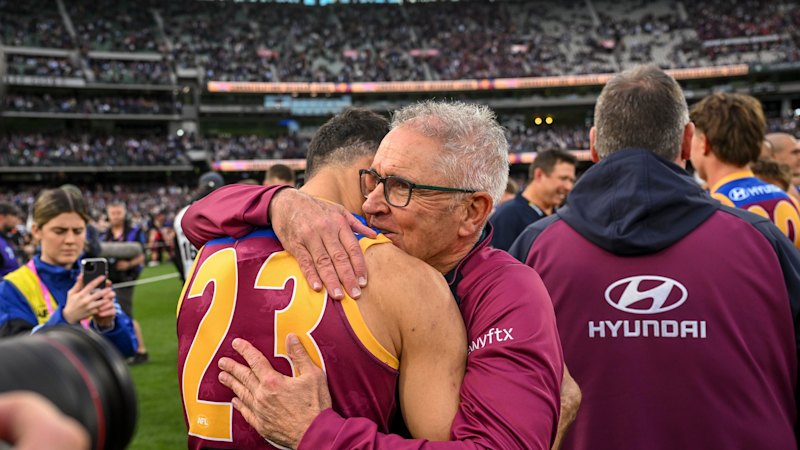
Brisbane Lions coach Chris Fagan has given a detailed presentation to the AFL Commission in which he attributed the club’s rise and success to a series of measures in club and culture building, rather than AFL assistance via father-sons and the Lions’ academy set-up.
Fagan’s presentation, given at the traditional meeting with the AFL Commission by the premiership coach in the weeks after the season, went over what the Lions had to repair within their club to turn themselves around from the nadir of 2016 and 2017, according to multiple sources familiar with his meeting with the AFL brass.
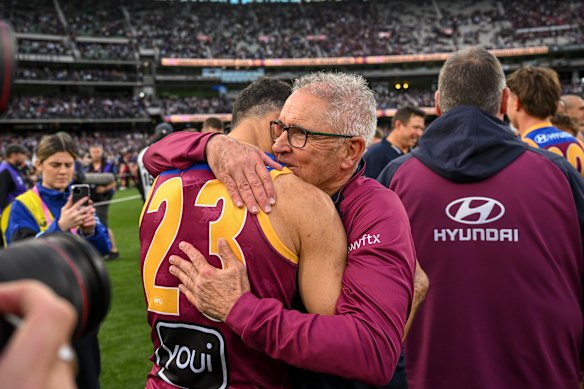
Chris Fagan hugs his star small forward, Charlie Cameron.Credit: Eddie Jim
The back-to-back premiership coach directly addressed what he termed “the narrative” that the Lions’ recent success after a period at the bottom of the ladder was heavily due to academy talent and star father-son recruits.
He told the commission – and handed each of them a written summary – that contrasted the prevailing view of some at rival clubs on keys to their success, which included both how the list was constructed, and the environment improved to one in which players flourished.
These factors that had been redressed or improved included their culture, player leadership and their pride and sense of belonging. It also included mindset, drafting quality youngsters and hiring key staff, the retention of players, player development, training facilities and becoming attractive to players from other clubs.
Fagan defended the Lions’ access to top-10 draft pick and academy player Daniel Annable as a rarity, noting that they had just three top-10 picks in their 2024 premiership team, and just four in the 2025 team that shredded Geelong. He said this was the only time the Lions had access to an academy recruit drafted in the top 10.
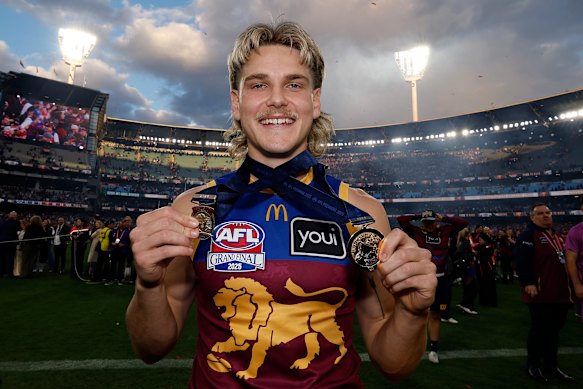
Father-son Lion Will Ashcroft holds his Norm Smith Medal and his premiership medal after the 2025 flag win.Credit: Getty Images
Annable was the fifth top-10 draftee on their playing list, compared to Gold Coast’s 12, Essendon’s 10, North Melbourne, GWS and Richmond’s nine and St Kilda’s eight. Only Collingwood, Geelong, Hawthorn, Melbourne, Sydney and West Coast had fewer top-10 picks (inclusive of bids for players tied to clubs).
Fagan also cautioned against the AFL making it harder for Queensland and NSW teams to bring in talent through their academies, saying they had a significant impact in making Queensland the state with the second-highest participation rate, behind Victoria, for Australian rules football – an outcome he told the AFL was once unthinkable.