
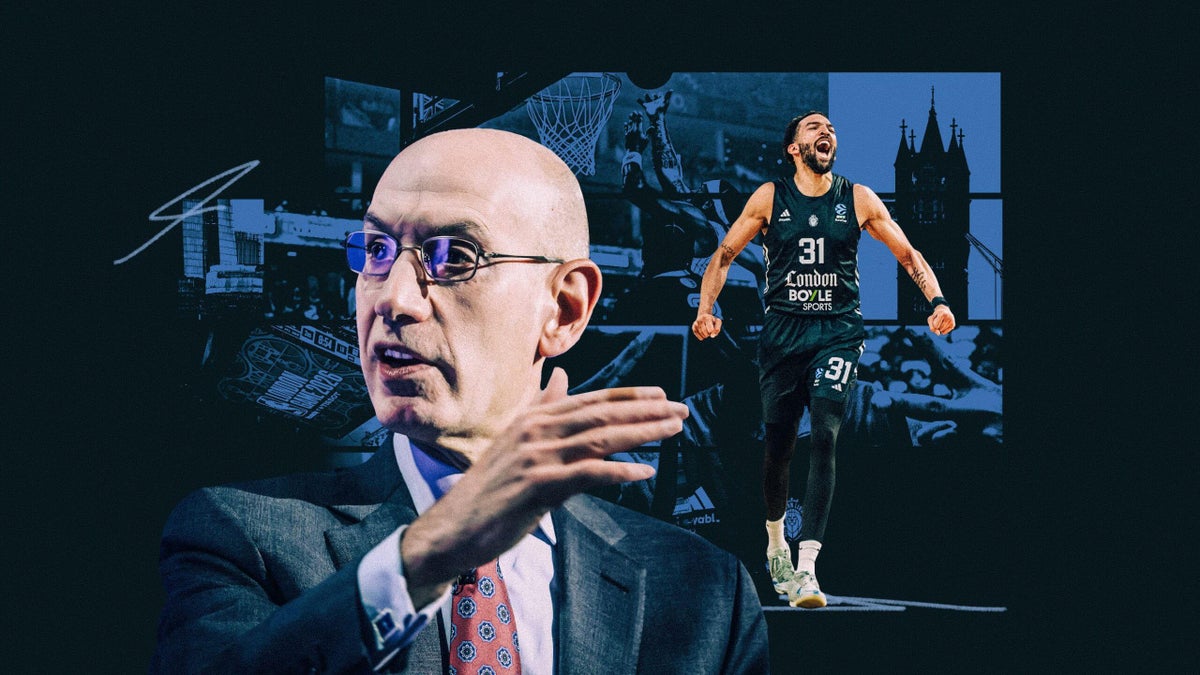
LONDON — Lenz Balan was born to Haitian parents in Brookline, Mass., grew up an hour away in Brockton, attended Bowdoin College on an academic and leadership scholarship, and then went into finance, doing well enough to afford a place in charming Notting Hill.
An “absurd optimist” by his own account who said getting into Bowdoin was the “best thing that ever happened” to him, Balan, 44, credits his outlook on life to his dad who “left his own country to do stuff.” Balan also says “you wouldn’t be involved in British basketball unless you’re the right kind of crazy.”
We met on a rainy, cool Wednesday in January on the far east side of London so Balan could show me that last part, first hand.
Balan is the president, chief executive and beating heart for the London Lions, the city’s lone men’s pro basketball team. It was three days after the NBA held a game in the city, where the Memphis Grizzlies beat the Orlando Magic, and we were going to watch his team play Ratiopharm Ulm in a second-division international competition the Lions needed to win to keep their playoff hopes alive.
Balan was dressed for the part: Dark suit. Knitted tie in a Windsor knot. Black, shiny wing tip shoes and a statement piece for a watch. His passion for his job, and his team, was evident as soon as we walked through the arena doors.
We were greeted by an usher whom he knew, and they hugged. Then, he said hello to the team physiotherapist whose birthday he knew was that day. Next, he asked the marketing intern — a fellow Bowdoin graduate — how an afternoon pickup game went. Next to the concession stand, where we were going to dine on some chicken tenders with hot or teriyaki sauce in little plastic cups, was the marketing expert Balan hired. The two of them host the Lions’ team podcast together. After the fans had been let in, about 60 minutes before tip-off, one of Balan’s 700 season-ticket holders came down from the stands to give him a proper Lions scarf, like the ones all the soccer fans wear for their favorite Premier League teams.
And, of course, he knew every player well enough for a hand slap and bro hug.
Balan also knew, as we walked onto the court, that when he looked up into the rafters there would be a big, empty space where the arena’s Jumbotron scoreboard used to be.

The Lions’ Aaryn Rian drives with the ball against Turk Telekom earlier this year. The Lions are London’s only men’s professional basketball team, but that could change when the NBA comes to town. (Metin Aktas / Anadolu via Getty)
The Lions are merely a tenant at Copper Box Arena, a 6,000-seat gym with red, white, yellow and green seats that was built for the 2012 Olympics. The biggest expense out of the team’s roughly $10-million budget is not the players’ salaries, but the rent. Those rent checks couldn’t keep arena operators from taking the Jumbotron down the day before the Lions’ game, instead of waiting until the day after, when there would have been two days to install the replacement before the next home match.
The prospect of no big video scoreboard hanging over the court was frustrating for Balan on many levels. For one, Balan is trying to build something with the Lions, to catch the attention of the nine million people who live in London, and maybe, just maybe, the attention of the NBA. This was not the week for the single largest piece of the arena to just be … missing. But the other annoying part to Balan was, at the most important parts of the game, there was no real way for him to see a replay.
With about five minutes gone in the third quarter of a close game, Tarik Phillip — a Brooklyn-born West Virginia alum — barreled down the lane, cocked the ball behind his head with his right hand as he soared to the rim, and dunked it over a sea of opponents. You’ll probably never see it, but it was one of the dunks of the year, in any league, on any continent. Balan, jumping for joy from his seat underneath the Lions’ basket, was too far away from either of the much smaller scoreboards at either end of the court, with grainy pictures, to see the dunk again.
Similarly, when Deane Williams, of Augusta University, finished off an excellent drive with a basket and foul to tie the game, Balan jumped so high he nearly cleared the barricades they put under the baskets in Europe. The pictures on the smaller boards simply weren’t big enough, or clear enough, for him to relive the play. And when an Ulm player’s shot banked in just as the final buzzer sounded, handing the Lions a devastating defeat, Balan had no chance to see a replay to know for himself whether the shot was taken in time (it was).
“It’s very difficult to do a lot of things that you need to do to make the sport successful (in London),” Balan had told me much earlier in the day. The words seemed prescient in the moment.
“And in order for it to work, the sport needs a catalyst,” Balan said. “I think the NBA and Euroleague’s interest in the U.K. market is going to be a catalyst.”
As far as showcases go, this was just the wrong night for the Lions. The scoreboard was missing, which meant the loudspeakers in the rafters weren’t on, either, because they had to be unplugged to get the scoreboard down. Single speakers were placed on either end of the court as temporary replacements. There were 2,000 fans in the seats, which meant there were double the amount of empty yellow and red and green and blue chairs than there were people sitting in them. And the devastating loss.
On the other hand, the crowd that showed up was into it. The fans chanted “Lon-don Li-ons” on command, clapped in rhythm, and blew into those horns you hear blaring through your TVs during the soccer World Cup. Two or three times near the end of the game, Lions coach Tautvydas Sabonis (yes, brother of NBA star Domantas Sabonis and son of former NBA great Arvydas Sabonis) egged on the fans during Ulm free throws, and they responded by screaming at the top of their lungs. Cheerleaders threw T-shirts into the stands. It cost patrons between $13 and $40 for a seat, compared to the $400 tickets for the Grizzlies-Magic game in London were going for on the secondary market.
“I loved it,” said Nick Brown, who lives just outside of London and attended his first Lions game that night. He wore an NBA sweatshirt and Golden State Warriors hat. “I just think the quality of the players, sitting courtside for this price, it was a great time.”
Well, a “great time” is certainly what Adam Silver has in mind for NBA Europe in London. But otherwise, his plans for the British capital are likely much, much bigger than the Lions.
Silver, the NBA commissioner, is working to stand up a new league in Europe through the deep pockets of sovereign wealth funds in the Middle East, traditional investment firms in the U.S. and Europe, powerhouse European soccer clubs, and a lucrative media rights deal. To begin with, it will be a 16-team league, with 12 teams holding permanent licenses and the other four spots open to virtually any pro team on the continent that can win enough to qualify.
The NBA is targeting London, Rome, Paris, Milan, Berlin, Munich, Barcelona, Madrid, Athens, Istanbul, Manchester (England) and Lyon (France) for cities with licensed, permanent teams.
There are legitimate pro teams in each of those cities already, other than Rome, but not all of those teams may apply for a license. Two high-ranking basketball officials, one with the NBA in the U.S. and another in Europe, said the NBA wants “to start with a clean slate” in London, where it could cost a new team more than $1 billion to obtain a license.
“Just walking the streets here and being in the hotels, I hear from people all the time saying, ‘I’m sleep deprived following your league,’ (in the U.S.),” Silver told The Athletic during an interview in London, prior to the Memphis Grizzlies-Orlando Magic game at London’s O2 Arena.
“There are more people approaching us and saying, ‘I’d love to have the London franchise,’ and I think it’s not just because it’s such an attractive market, but because there’s no top-tier basketball team right now,” Silver continued. “So, there’s lots of groups seeing an opportunity to create a new brand here.”
For the NBA, the London discussion is one of the sheer size, wealth and untapped basketball potential of the market. There are numerous potential suitors. Soccer powerhouses like Arsenal or Chelsea could create a team. The Saudi Arabia Public Investment Fund could do it. As could investment firms like Sixth Street.
“The NBA’s ambitions to expand into Europe represent a massive opportunity for the U.K.,” said Lisa Nandy, secretary for the Department for Culture, Media and Sport in the U.K. “Franchises could deliver billions of pounds in economic growth and create jobs, but just as importantly, they would bring unforgettable moments for fans right here on home soil. We’re excited to work with the NBA as plans progress.”
The new London team, like most teams obtaining a license for NBA Europe, would need a new arena. To begin with, Silver wants large, NBA-style venues for his new league. The O2 in London certainly is one, built in 2007, with 20,000 seats, it is easily the largest indoor venue in the United Kingdom and among the largest in Europe, but is scheduled years in advance and doesn’t have enough vacant dates for a pro basketball team to play all of its home games there. Also, Silver won’t want any disappearing Jumbotrons before league games. Where possible, he would want the teams to own their arenas.
Both the British government and London Mayor Sadiq Khan’s administration have eagerly struck partnerships with the NBA in recent years for funding and to otherwise grow the sport of basketball. The two governments have pledged millions — the NBA matched the British government’s allocation with $5 million of its own — for infrastructure and to create more leagues and clinics for children to learn the game. Khan also created a taskforce to identify the issues holding basketball back in London.
According to recent government surveys, more than 220,000 children play basketball in London, making it the fastest-growing sport in the city. Nationally in the United Kingdom, more than 1.5 million people (including adults) play the sport.
“You have probably the most growth potential of any other European city,” said Nadeem Javaid, director for global relations and communities in the Khan administration and chair of Khan’s basketball taskforce. “With the right investment, and with the right team, I think you’ve got a huge potential to begin to make London’s team this massive global brand. We would love for kids, in cities like New York and Madrid and Paris, to be wearing London jerseys.”
Javaid also said part of Khan’s growth agenda is adding at least one more arena, not only for basketball but for concerts too. The mayor’s original plan for the taskforce, which was created following a meeting he had with NBA deputy commissioner Mark Tatum in 2024, was to bring NBA games back to London.
Now that that’s happened, the taskforce is pivoting to NBA Europe, because, as everyone seems to think, the opportunity is ripe in foggy Londontown, where, to be fair, up until now professional basketball has almost never worked.
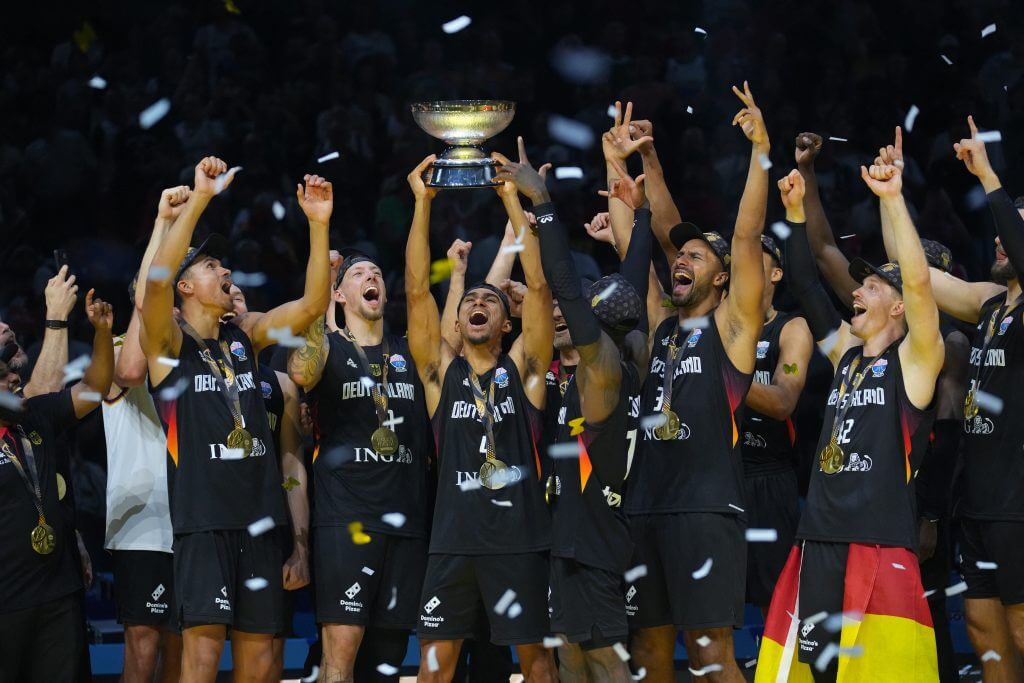
The Germans, shown here winning the 2025 FIBA EuroBasket, are great at basketball. So are the Serbians and the Spanish. The British? Not so much. But two new NBA Europe teams could spur the interest and investment needed to grow the sport in the U.K. (Gints Ivuskans / AFP via Getty Images)
The Germans are great at the game. The French. Serbians. Spanish and Greeks, too. The British are not.
In each of those basketball countries, and more spread throughout the continent, there are thriving pro clubs that are either subsidiaries of massive soccer teams, receive government funding, or both.
Those teams take the money from wherever it comes and use it, in part, to fund expansive basketball academies for teenagers and younger children. This is the how the European “pipeline” has been built, and it is the lifeblood of the infiltration of the NBA by European stars and role players alike. Children are taught at a young age by paid coaches how to play correctly, and the more talented ones graduate to elite-level teams for teenagers who eventually become “pros.” There are tiers to the pro system in Europe, but most of the top players in these countries are products of the academy system.
That pipeline never made it to the U.K.
The Premier League soccer giants in England stick to their own sport, and the British government historically prioritized public funding for sports with the best chance for Olympic gold medals. From 2009 through 2021, basketball received the 12th-most government funding of any sport in England, virtually even with table tennis and well behind badminton and lawn tennis. The disparity was even greater at the Olympic level for the 2020 Games cycle (played in 2021 in Tokyo); the British basketball team received just $33,000 from the pool used to fund elite sports. Rowing received about 400 times more than basketball during the same cycle.
“Basketball has been chronically underfunded for many, many years,” Javaid said. “You have lots of kids play basketball in schools and parks, and then around 12-years old, they kind of just cut off. And the reason is they don’t have access to courts. They don’t have access to facilities that have access to coaches. And there is not an academy or a pathway.”
The people of London also didn’t have their own basketball team to root for until 2012, and in the 14 years since, it hasn’t always gone so well. The team was previously located in Milton Keynes, a city about 55 miles northwest of London. The former owner wanted to move the Lions elsewhere but couldn’t find a location. The 2012 Olympics were ongoing, which raised the profile of basketball for a short time in the city, and the Lions found a vacancy at Copper Box Arena, which had been built for handball, and began play there that fall. The first season in London, then-owner Vince Macauley had to coach the team; the team’s former coach elected to stay in Milton Keynes and coach at the college academy there. The Lions played in general obscurity for years, with as few as 200 people showing up for games. An internal financial document reviewed by The Athletic showed team revenues for the Lions in 2017 were $213,000.
In 2020, Miami-based investment firm 777 Partners, of which Balan was a member, bought the team from Macauley for what amounted to “operating costs,” Balan said.
The private equity outfit, better known at the time for scooping up stakes in a patchwork of European soccer clubs, paid about $9.5 million for a 45-percent stake in the British Basketball League in late 2021. The season before, an internal document showed, the league’s entire budget was for about $1.36 million.
For a brief period, it looked like British basketball had secured a level of outside capital rare in its domestic history. The Lions were competitive at home and even made strides in Europe, reaching the semifinals for a second-division international competition called EuroCup. But behind the scenes, trouble was brewing. Financial filings revealed the Lions were heavily reliant on 777 for cash injections and there were late payments within the league — including tens of thousands owed that put operational stability at risk.
By the middle of 2024, the British Basketball Federation had lost confidence in the league’s finances and terminated its operating license, effectively ending the competition as it stood. The collapse was widely linked to 777’s broader financial woes — a swirl of missed payments, lawsuits and, eventually, fraud allegations against the firm’s co-founders back in the U.S. that would overshadow the entire enterprise.
The Lions were teetering on bankruptcy. Balan, who was not swept up in 777’s alleged fraud, was searching for an investor to keep the team from shutting down, and found one in Lithuanian tech firm Tesonet, which retained Balan.
“There were a lot of tears that summer,” Balan said. “Tesonet took a risk on the club and on me, and they saved us.”
After a near-death experience two years ago, in one of the largest sports cities (and media markets) in the world, one could understand why the Lions may not be top of mind for Silver’s new league.
But the Lions are trying to get back on track. The team started an academic and basketball academy for students in London’s central city with New City College, with the hope that it one day mirrors the academies in places like Berlin and Madrid.
The Lions want to build a new arena of their own and released results of a feasibility study that showed, to no surprise, it would be a good idea to add more venues. Balan said the Lions, to reach their goals, need an arena with at least 12,000 seats.
Also, Balan is on the London mayor’s basketball taskforce — which shows he has the support of a city that’s trying to grow its footprint in the sport, exponentially.
“My hope is what we are doing in London increases the probability that (pro basketball) is more successful here,” Balan said. “I believe the London Lions have a reason to exist.”
The likelihood of an NBA Europe, and of the league featuring a new team in London, is not an existential threat to the Lions. Or it shouldn’t be.
Europe’s current international league, the EuroLeague, and its second division, the EuroCup, intend to remain in the event Silver’s league takes shape. The Lions, currently a EuroCup team, could become an attractive partner for a EuroLeague license when the NBA moves into the market.
Also, and this is true not only for the Lions but for any European pro team that won’t have an NBA Europe license, they could still qualify for NBA Europe each year by performing well in a domestic league (in the Lions’ case, the Super Basketball League, which replaced the BBL after 777’s troubles).
And in those domestic leagues, including the one in the U.K., there will be games featuring NBA Europe teams (like the planned new teams for London and Manchester) against existing teams, which should drum up more interest for the clubs that have been around longer but haven’t generated as large of a following as they would like.
“All I want to do is have a good relationship with (NBA Europe and the EuroLeague) and be a part of convincing everybody that you should be excited about London basketball,” Balan said.
Currently, the EuroLeague does not have any licensed teams in the United Kingdom. League officials have said they hope to one day partner with the London Lions, but the Lions weren’t ready for that jump, yet.
Maybe the new arena, if it gets built, would do the trick. Or Balan entices enough investors to grow the Lions’ finances. Or he negotiates a local TV or streaming package that is too good for the EuroLeague to ignore.
Or, perhaps, the NBA Europe coming to London is the “catalyst” Balan predicted, and it rises the Lions’ ship — even if they aren’t in the new league.
“If I’m a part doing that and the Lions are a part of doing that, that’ll be great because I just believe at the end of the day, one way or the other, we’re going to be in a top-tier European club.”