
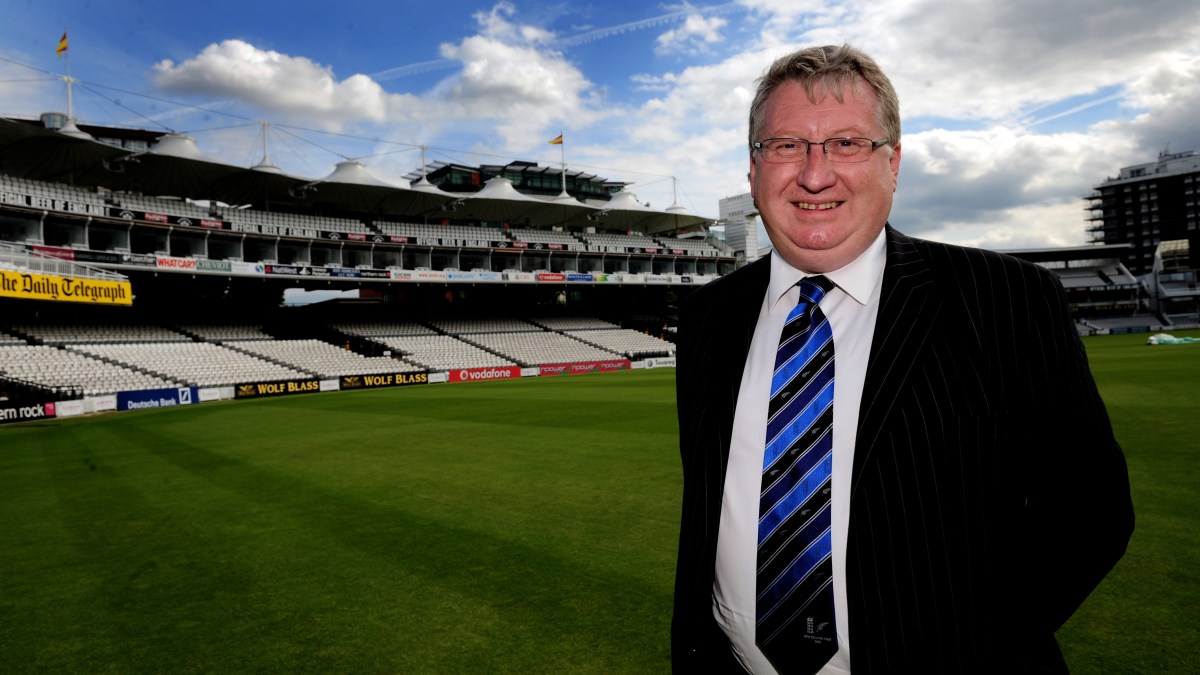
David Collier’s idea of a holiday in his decade as chief executive of the England and Wales Cricket Board (ECB) — a position that attracted perennial criticism from county clubs, the media and any number of retired players — was to take up an unpaid administrative role in a different sport. He astonished his chairman, Giles Clarke, by telling him in 2010 he would be the tournament director of hockey matches at the forthcoming Commonwealth Games in Delhi.
Collier had been a referee for international hockey matches and an assessor of the sport’s umpires and was to become the first chief executive of the Rugby League International Federation. Cricket, though, remained his prime interest. He ran three county clubs before joining the ECB in 2004, when he was confronted with various taxing off-field negotiations. He and Clarke, who succeeded David Morgan as chairman of the ECB in 2007, had to contend with the best players being attracted to the riches of the newly formed Indian Premier League (IPL), with competition for the staging of Test matches and with criticism over coverage of them no longer being on terrestrial television.
Sky, which took over live coverage of Test cricket in England in 2006, was praised for its innovation, commentary and significant financial input. It was a groundbreaking move, though it meant viewers without access to satellite television could only watch highlights. Collier’s view was that there was no credible alternative and that the grassroots, including recreational, women’s and disability cricket, would benefit as much as the leading players as a consequence. And he believed that the most important factor in promoting interest in cricket generally, and in inspiring the next generation of cricketers, was the “success of the England team”.
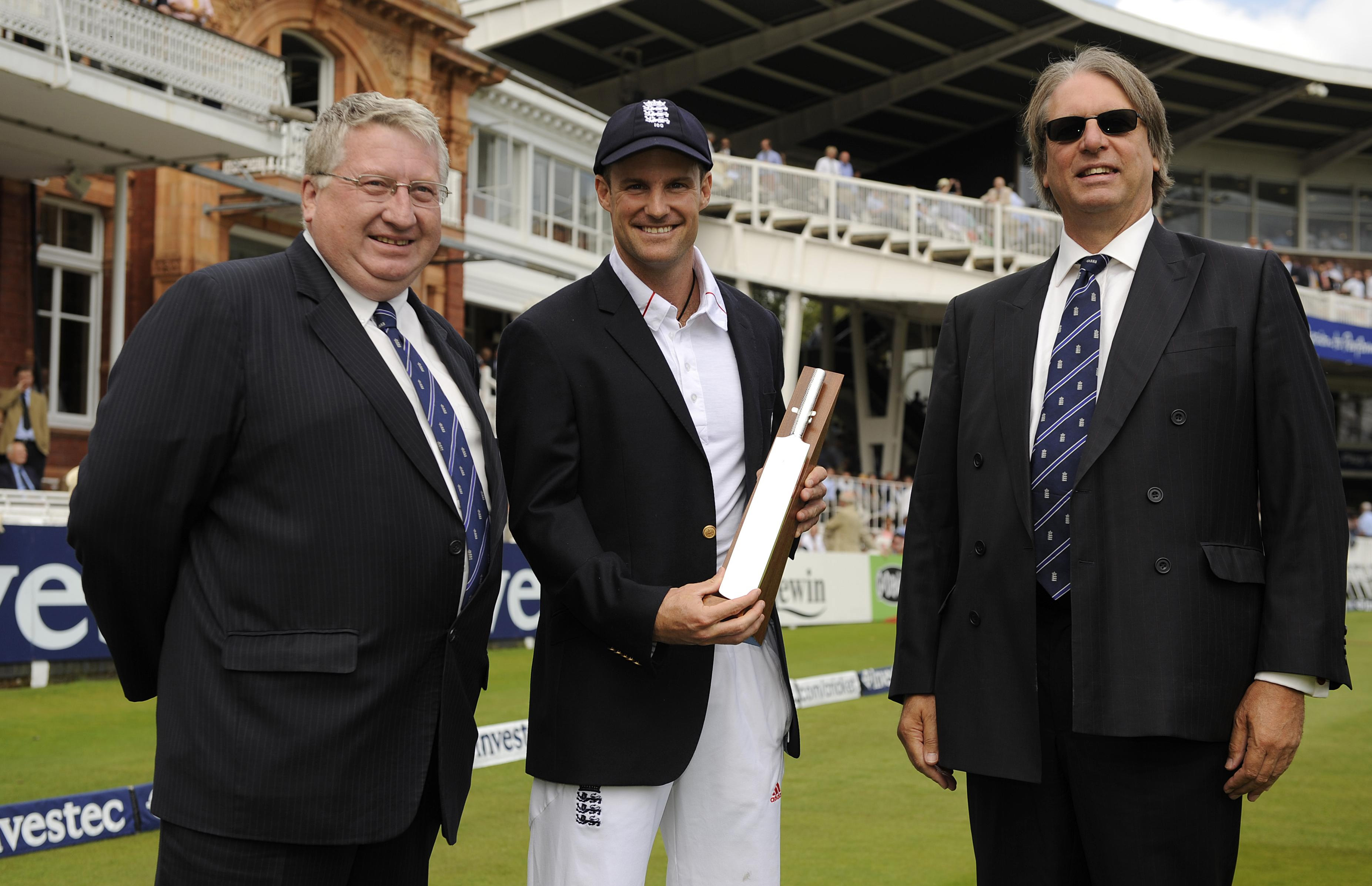
Collier and the ECB chairman Giles Clarke, right, presenting the England captain Andrew Strauss with a silver bat to celebrate his 100th Test match, in 2012
PA
An emollient character compared with Clarke, Collier was increasingly concerned about the growth of franchise cricket overseas, which would affect the availability of the best England players. The chief executive and chairman decided in 2008 that salvation lay with Allen Stanford, a brash Texan businessman who had provided substantial funds for the game in the West Indies.
Stanford appeared to possess further funds to give England cricketers the rewards they desired and took to be their right to earn. To the dismay of Keith Bradshaw, Collier’s opposite number at Marylebone Cricket Club (MCC), Stanford’s helicopter was permitted to land at Lord’s to herald a limited overs tournament in Antigua culminating in a $20 million winner-takes-all match involving West Indies and England players. Here was razzamatazz to rival the IPL. MCC owned the ground and was the ECB’s landlord, yet was overridden.
The following year a further planned tournament in England had to be called off when Stanford was found to be running a Ponzi scheme, was charged with an $8 billion fraud and jailed for 110 years. Opprobrium was heaped on Collier and Clarke, both of whom managed to stave off vociferous calls to resign. “It was a very difficult time for my father,” Simon Collier said. “He had carried out due diligence on Stanford, whose group of companies invested in other sports as well as cricket.
“Clearly he regretted how it turned out. He felt he couldn’t have known what the FBI knew and the nature of the early stages of franchise cricket was a threat to the ECB. Dad would say Stanford was a brash Texan but in his time in the United States he’d come across lots of similar characters and did not see that as particularly problematic in itself — he knew how to work with them on a personal level.”
MCC’s relationship with the ECB was further complicated in that the club was dependent on the governing body for Test match allocation at Lord’s. This was in inverse proportion to its status within the ground. The office of the club’s chief executive looked out over the square from a prime position in the Victorian pavilion whereas the ECB’s modern offices were hidden away below the salt inside Wellington Road and beyond the Nursery End.
“There is no doubting that David Collier works hard but I thought Tests would be allotted to Lord’s as a matter of course,” Bradshaw wrote in his autobiography. “There was no question in my mind — nor, I thought, anybody else’s — that this was where cricketers from overseas wanted to play. I had to negotiate staging rights with David on our own square.
“If Lord’s was ever not to hold an Ashes Test, comparisons would be made of the Melbourne Cup being run in Hobart or the Wimbledon final being played at Eastbourne. The bidding system for Test cricket was at the core of this problem. Competing bids drove up the cost of staging a Test artificially. The system was great for the ECB, whose revenues went up.”
Nonetheless, MCC continued to hold regular Test matches, including against Australia, in Collier’s time running the game.
David Gordon Collier was the son of John Collier, who became managing director of the family’s small shoe-making business, and his wife, Pat (née Healy). He was educated in Loughborough, at the grammar school and then the university, where he studied sports science and recreational management. He captained British Universities at hockey and, as a medium-pace bowler, Combined Universities at cricket. He also represented Leicestershire second XI and Shropshire — once playing against Hampshire second XI in Southampton, which provided him with background information when the club strove to stage Test matches on a new ground three decades later.
Collier’s first position within cricket administration was as assistant to Peter Edwards, the highly regarded chief executive of Essex. He then became chief executive of Gloucestershire before determining that he wanted a broader understanding of business. In 1988 he moved, with his young family, to Dallas to work for American Airlines. It was there that he encountered prototype Allen Stanfords. The firm sponsored the Dallas Cowboys, the American football team, which appointed him a director. He then became managing director of Servisair plc, an aircraft ground handling company.
Always intent on returning to cricket administration, Collier became chief executive of Leicestershire in 1997 and they were county champions the following year — a notable achievement given their limited resources — and then Nottinghamshire before succeeding Tim Lamb at the ECB. Other challenges he had to contend with during his time in post included the growing number of county clubs that wanted to stage international matches.
Prominent among these were Hampshire, whose chairman, Rod Bransgrove, repeatedly clashed with him, not least when he called upon him and Clarke to resign from the ECB after the Stanford debacle. He also felt that a modern stadium such as the Rose Bowl that met all the requirements for staging Test cricket should be judged on the same footing as the traditional grounds. “The situation was not totally ideal in that there had been a major shake-up from there being only six Test grounds,” Collier said.
“I don’t think the game would have been looked at kindly if it had lost its history. But you lose clubs like Hampshire and Essex at your peril, for they are the real heartbeat of the game. Mike Turner, chief executive of Leicestershire before me, saw early on the benefit of staging international cricket as a marketing tool. Rod Bransgrove was totally wrong in thinking there was criticism of him [within the ECB] for being in cricket for money and not for the good of the game.
“The huge issue was that as the old model of allocating Tests through a basis of rotation of grounds was outdated, competition should form a part of the awarding of matches. There was an awareness among counties of the value of having international cricket in their portfolio. It was a watershed.”
Nonetheless, Collier always retained his courteousness, generally left public pronouncements to Clarke (who declared that “David was totally dependable, day and night”) and was able to reflect after his ten years in charge that England had won four Ashes series against Australia, including a memorable one in 2005 and, away from home, in 2010-11.
His wife, Jennifer (née Pendleton), a teacher whom he met on her first day at Loughborough University when he was beginning his second year, predeceased him last year. He is survived by their children: Simon, a lawyer; Zoe, a senior director at an AI tech company; and Mark, a teacher who lives in South Australia and who, when at Oakham School in Rutland, opened the attack with Stuart Broad, an England fast bowler in the making. The two families became close friends.
Collier, who when working at Lord’s lived in nearby Pinner, was a non-executive director of Great Britain Hockey. He was awarded the Sydney Friskin prize for services to the sport, the award named after the Times hockey correspondent. In retirement he became chairman of Lord’s Taverners and president of the Club Cricket Conference. His final years were spent living near Hampton Court, Surrey. He lost his sight in one eye but generally was still able to maintain a normal life.
Lord Clarke of Nottingham (Kenneth Clarke), the former chancellor and supporter of Nottinghamshire, told The Times in 2005: “The club has had to put up with my advice occasionally, but the way David Collier ran it was quite out of keeping with most sports administrators. He would be a very good executive in any walk of life.”
David Collier OBE, cricket administrator, was born on April 22, 1955. He died of a suspected heart attack on January 12, 2026, aged 70