
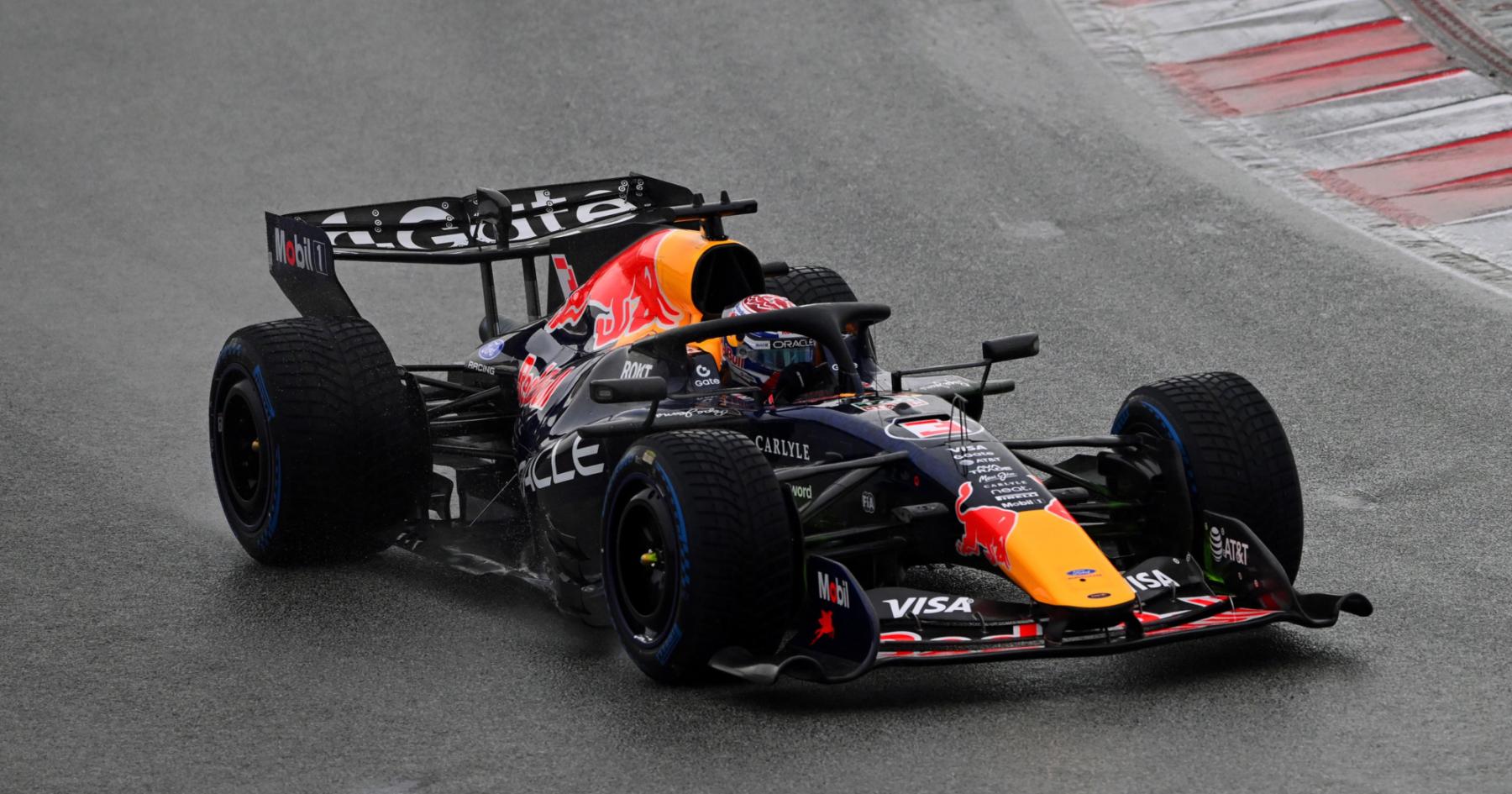
Red Bull’s absence from Wednesday’s pre-season test running provided a rare opportunity to scrutinise the RB22’s aerodynamic philosophy, highlighting that the Milton Keynes-based squad has again pushed boundaries with its unconventional approach.
Two standout features demonstrate just how aggressively Red Bull has interpreted the 2026 regulations. The crash structures flanking the cockpit sit prominently atop the sidepods, with their extremities extending well beyond the bodywork profile.
This radical positioning allows Red Bull to maintain remarkably compact sidepods, maximising airflow towards the car’s rear sections where crucial downforce is generated. It’s classic Red Bull engineering: finding performance gains where others see regulatory constraints.
The second notable element mirrors Mercedes’ approach: a pronounced slot carved into the diffuser’s lateral section. This wide aperture in the vertical sidewall directs airflow through a critical aerodynamic zone, suggesting both teams have identified similar performance opportunities.
That Red Bull and Mercedes have converged on comparable solutions isn’t surprising. Advanced computational fluid dynamics and wind tunnel correlation now allow teams to optimise every millimetre of bodywork, often leading to similar conclusions despite different starting philosophies.
Red Bull’s adoption of this diffuser concept also dispels any notion of regulatory grey areas. The solution makes aerodynamic sense, particularly with the return of rake adjustments that disappeared from earlier ground-effect machines.
McLaren has similarly embraced pronounced rake angles rather than the minimal approach initially anticipated for the 2026 cars. The MCL40 machine suggests teams are converging on higher rake philosophies as the optimal aerodynamic configuration.
The technical direction validates Red Bull’s reputation for never choosing conservative solutions when radical alternatives offer performance advantages.