
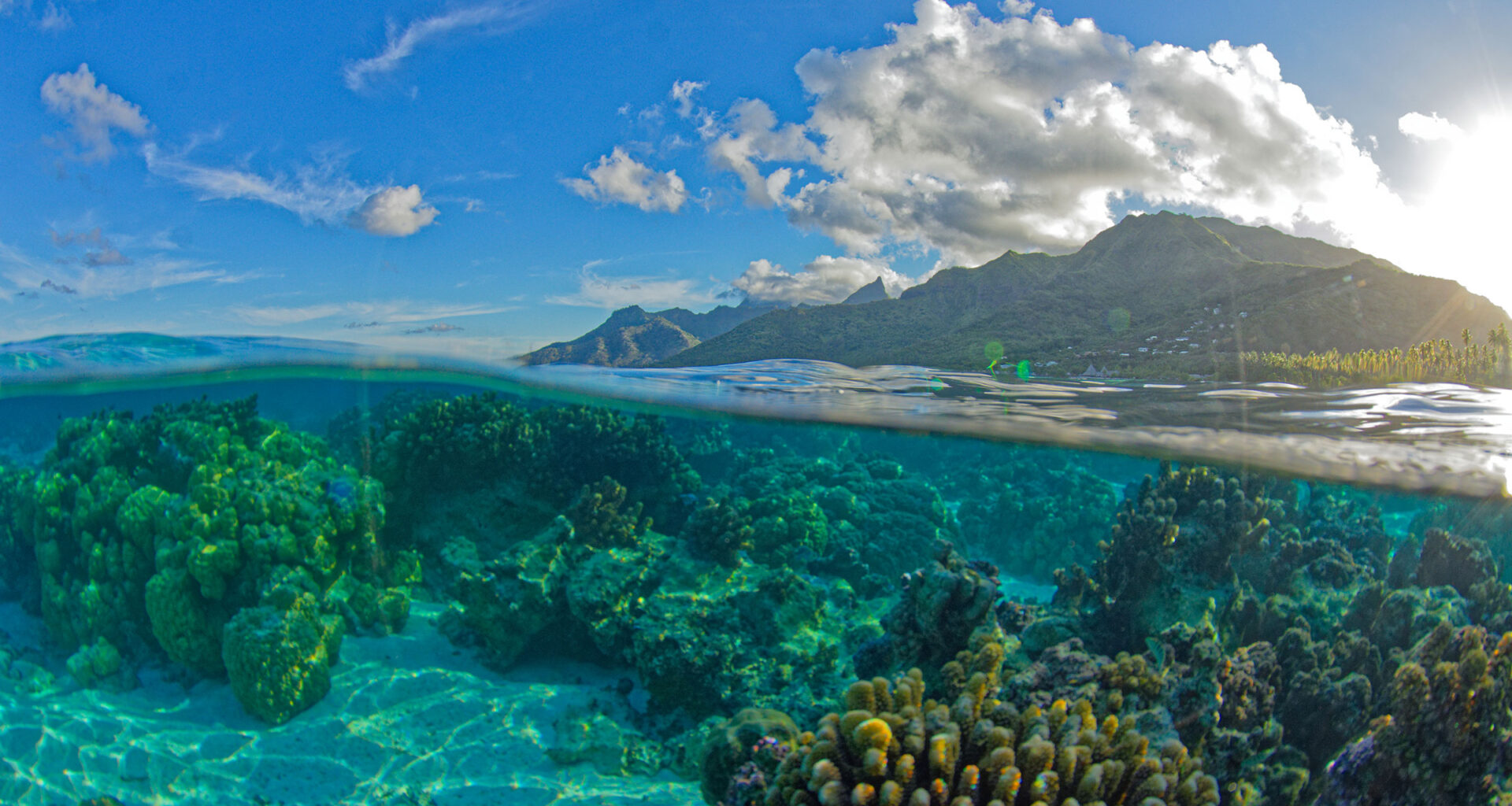
Kai Kopecky’s doctoral advisors were not particularly keen on his plan. In 2019, Kopecky, then a graduate student at the University of California, Santa Barbara, wanted to knock whole dead corals off the seafloor with a hammer and chisel.
A mass bleaching event had just wiped out more than 50 percent of the corals from a reef near Pao Pao Bay on the north shore of Moorea, an island in French Polynesia, and Kopecky wanted to see what effect those skeletons would have on the reef’s recovery. Typically, scientists believe that the complex three-dimensional structure of corals—even dead ones—helps new coral polyps recolonize a degraded reef. But is a whole graveyard of coral corpses similarly helpful? Kopecky wanted to find out. To his elders, though, chiseling dead corals from an already damaged reef seemed rash.
When Kopecky went ahead and cleared coral skeletons from that bleached reef and tracked the results, however, what he discovered was as novel as it was clear: Dead corals can actually be terrible for living ones. As marine heat waves increase in number and intensity, coral reefs around the world bleach and decay. Kopecky’s findings hint at a potentially overlooked tactic to help these struggling reefs recover.
Kopecky, who is now an ecologist at the University of Colorado Boulder, had first visited Moorea in 2018, before the bleaching event. At the time, the coral reef was vibrant and teeming with life, despite having been all but annihilated by a vicious tropical cyclone in 2010. On that trip, Kopecky says, scientists regaled him with tales of the reef’s near destruction. “They called it a parking lot,” he says. And yet, the reef had bounced back in less than a decade.
“I’d seen a few coral reefs at that point, but this was the most stunning,” Kopecky says. “You couldn’t even see the reef below the coral heads, or in between them.”
When Moorea’s reefs were ravaged again just one year after Kopecky’s visit, it was extreme heat—not pounding wind and waves—that brought the corals to their knees. Yet unlike in 2010, when the tropical cyclone had stripped the reefs bare, the marine heat wave left the reefs littered with dead corals. It was as Kopecky pored over photos of the destruction that he was struck with the question of how new polyps would fare in this wasteland.
So, despite his advisors’ misgivings, Kopecky returned to Pao Pao Bay, donned scuba gear, and dove to the reef with a bag of hammers and chisels. He marked off 20 plots of heat-battered reef. Half of the plots he left alone to recover naturally. In the other half, he carefully tapped his chisel at the base of each dead coral head to pop the whole skeleton off and remove the debris. “Sometimes the simplest tools are the best,” he says.
Over the next four years, Kopecky visited Moorea several more times, spending hours a day in the water taking hundreds of photos of each plot. With collaborators, Kopecky generated highly detailed three-dimensional images of the reef, and trained an artificial intelligence model to track how it changed over time.
Analyzing the data, Kopecky found that where he’d removed the coral skeletons the amount of living coral was 1.6 times higher, and there was half as much seaweed. Where the dead corals were left intact, however, the sharp skeletons prevented fish from eating developing seaweed. Because seaweed competes with corals for space and resources, it slowed coral recovery in the places it was able to grow freely.