
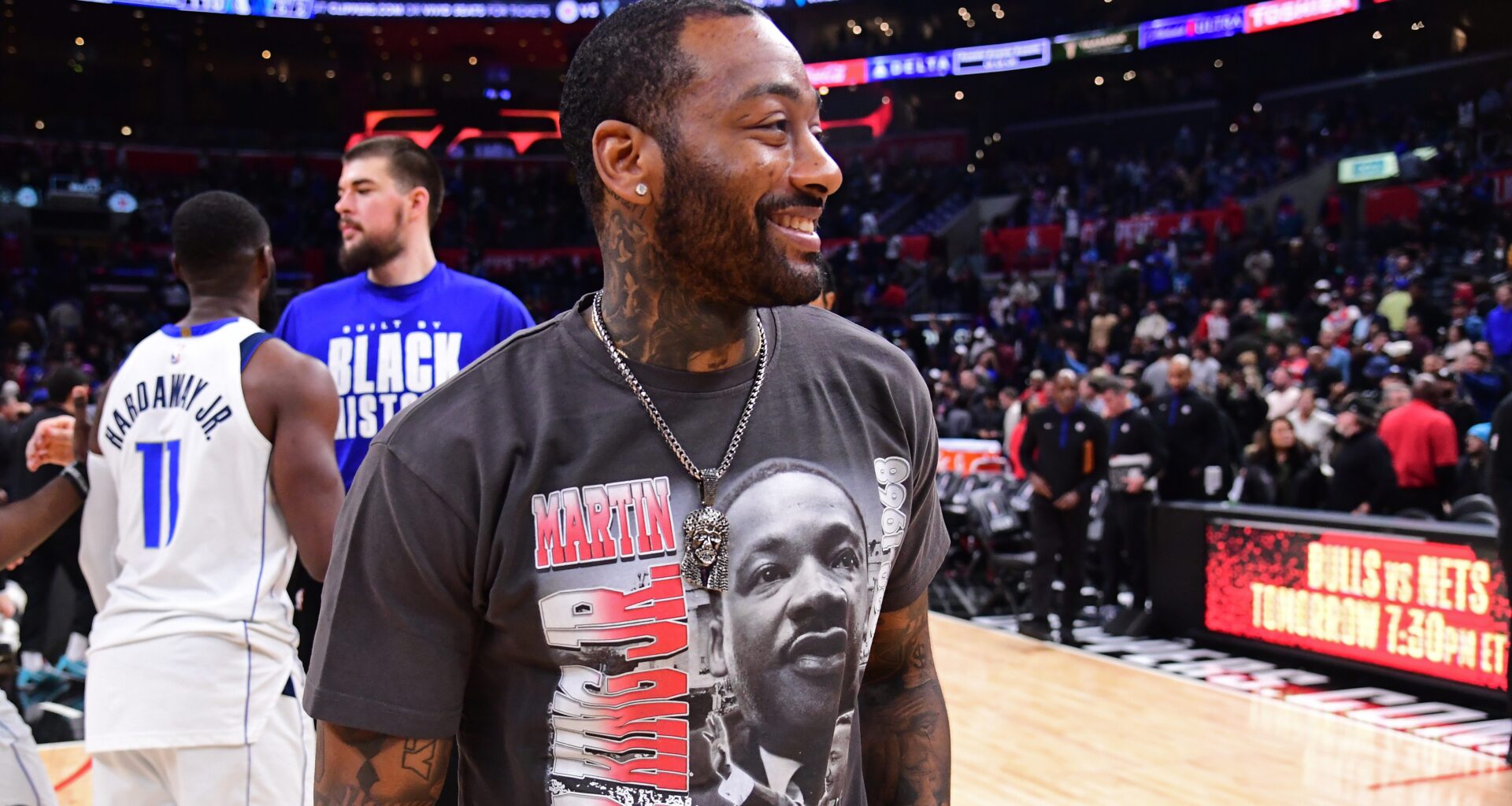
A reputation has a way of sticking with you, no matter how much time and circumstances have changed. You never get a second chance at a first impression, sure, but at some point you should be allowed the grace of maturation.
When it comes to former NBA guard John Wall, many things are true. The No. 1 overall pick of the Washington Wizards from the 2010 draft was an athletic marvel: blistering speed mixed with fearless athleticism. He was also temperamental and didn’t always make the decisions befitting the face of a franchise.
Outside of the Washington area, Wall was saddled with one of those unfortunate labels like mercurial. But inside this tri-state area, he had a different reputation. For as complicated as Wall appeared from afar, he was a man of the people in Washington, good on any block he chose to visit. He became a part of the community, lending his time and resources to a city full of Black people who long ago were abandoned.
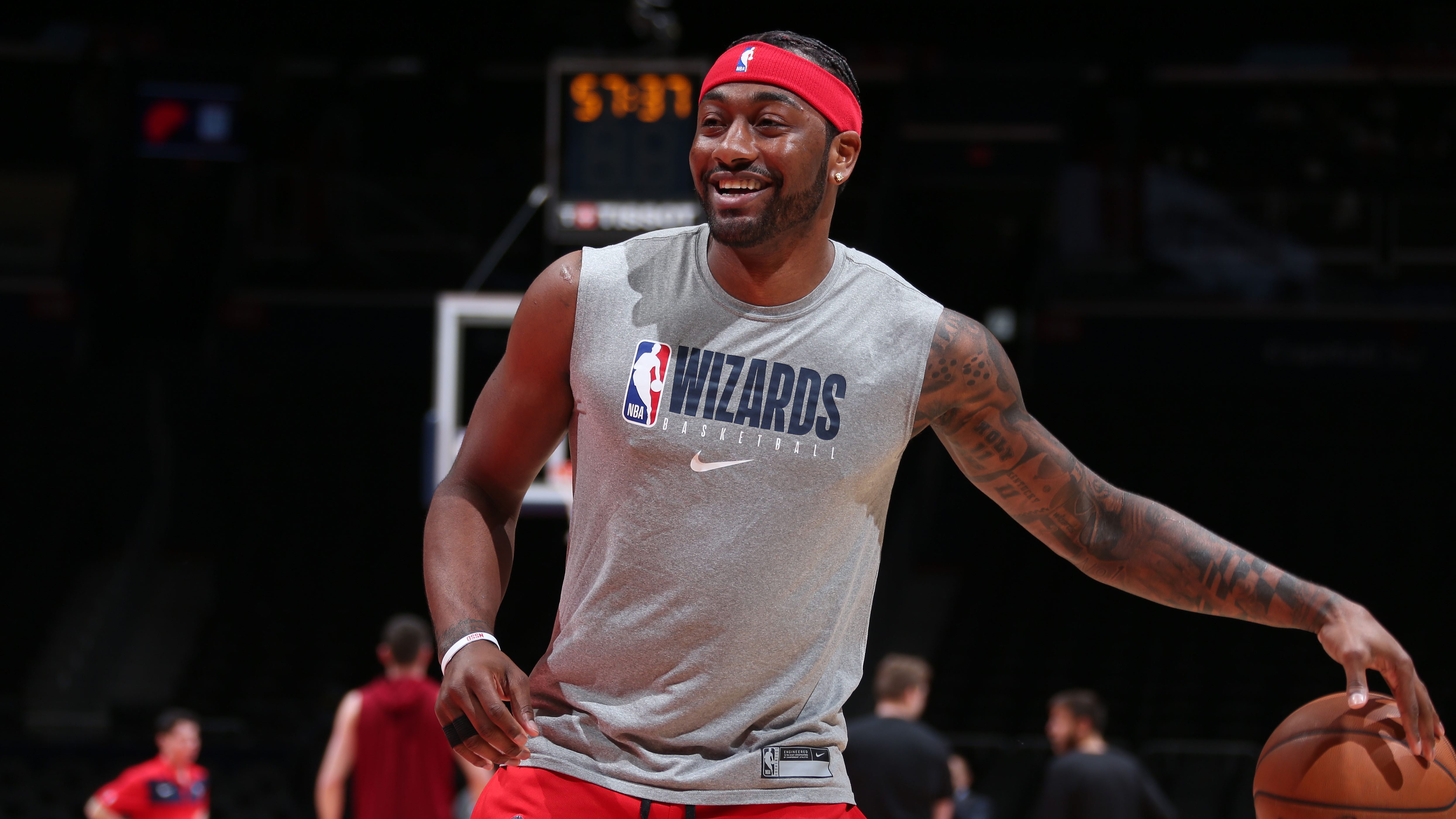 John Wall on helping Washington residents with rent assistance: ‘I come from that type of environment’ – AndscapeRead now
The Wizards will honor Wall on Jan. 29 with a celebration after the five-time All-Star announced his retirement in August. There will be a Wall bobblehead giveaway, and the scoring table he stood on after hitting a game-winning 3-pointer against the Boston Celtics during the 2016 playoffs will be on display.
While the Wizards’ celebration is about John Wall the basketball player, it’s even more about John Wall the man.
The man who saw a reflection of himself in Washington and embraced it.
“I’m glad to get the recognition and be drafted by the Wizards and get the appreciation from the fans that watched me grow from a young boy into a man,” Wall, 35, told Andscape last week. “But that community really made me. They always showed up and showed me love, and no matter what I’m going to do the same for them.”
When Wall was born in 1990 in Raleigh, North Carolina, he entered a world of chaos. His father, John Wall Sr., went to prison a year after Wall was born, and his mother, Frances Pulley, had to go above and beyond to keep the lights on for Wall and his three siblings. Wall started to spiral after his father died from cancer when Wall was 9. He blew up at teammates and coaches, got into fights, and stole cars.
“Crazy J was a bad kid that did everything,” Wall, referring to his old nickname, told Andscape in 2015.
But when Wall realized his mother was working multiple jobs to help pay for his basketball dreams while they lived in Section 8 housing, he decided to turn his life around and eventually dedicate himself to helping others.
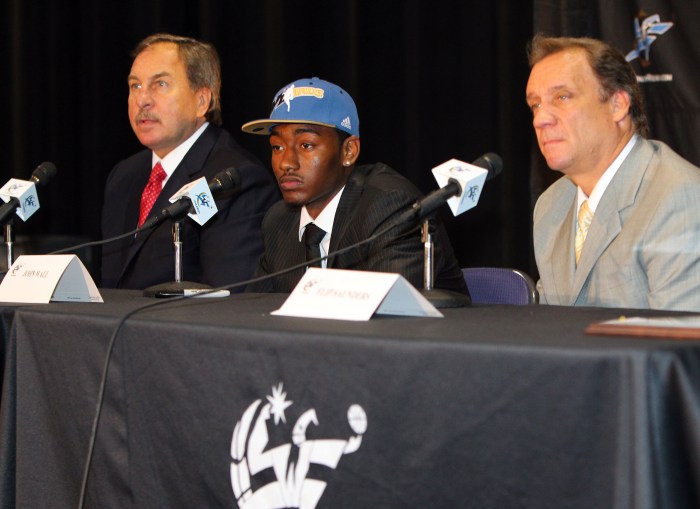 Left to right: Washington Wizards president Ernie Grunfeld, draft pick John Wall, and head coach Flip Saunders during a news conference on June 25, 2010 at the Verizon Center in Washington, D.C.
Ned Dishman/NBAE via Getty Images
Wall was All-America at Kentucky during his lone season (2009-10), and he was later taken first overall in the 2010 NBA draft by the Wizards. He quickly endeared himself to the Washington community, and it wasn’t just because he hit the Dougie, his signature dance.
Wall went where the people were and aimed to make a difference. Through the local Boys & Girls Club of America, he sponsored community service programming for boys. He provided prom suits for high school seniors who couldn’t afford them. He dedicated his time to a leukemia and lymphoma organization after a local 5-year-old he’d befriended — DaMiyah Telemaque-Nelson — lost her battle with Burkitt’s lymphoma. During the early days of the coronavirus pandemic, Wall raised $500,000 to provide rent assistance to one of the city’s most impoverished neighborhoods.
Related Story Behind 76ers star Tyrese Maxey’s path to a signature shoe with New Balance – AndscapeRead now
In September 2015, he donated $400,000 to Bright Beginnings, a Head Start and Early Head Start organization serving families facing homelessness. The money enabled the non-profit to build a $10.5 million learning center in southeast Washington. It was the largest individual contribution the organization had ever received.
Bright Beginnings services families in Wards 7 and 8, which face some of the highest rates of unemployment, low-income wages and crime, according to Erin Fisher, the organization’s chief executive.
“Most of our children have experienced some type of trauma that they bring with them already into the center,” Fisher said.
When Bright Beginnings was founded in 1990, it was in northwest Washington, which was experiencing high levels of homelessness. But as the area has changed over the decades, there was greater need in the southeast. The new Bright Beginnings building, which opened in 2018, is 19,000-square feet, houses 14 classrooms, and serves 150 children. There’s also a family component to Bright Beginnings that assists with job placement, securing housing and continuing education for parents and caretakers.
“[Wall’s] desire to actually understand the things people are facing and want to get out and interact with people, it means something to the city,” Fisher said. “Our city loves him.”
The city loves Wall, from the community to the courts.
Washington is a basketball-loving city, and that’s no better illustrated than the Goodman League. The summer basketball league started in 1977 as a neighborhood initiative to provide a space for Black people to have fun.
Miles Rawls took over the organization in 1996 and morphed it into a cultural artifact. All the best ballers of all levels — youth, high school, college, the pros — hooped at Goodman. Then-Wizards guards Gilbert Arenas and Bradley Beal have played on Goodman’s concrete and blacktop courts. Shaquille O’Neal once made an appearance but didn’t play. Back when they were in high school, future NBA players Kevin Durant and Michael Beasley were busting grown men’s a—s during summer nights.
Related Story Bam Adebayo receives NBA Cares Community Assist Award – AndscapeRead now
The Goodman League is something like Switzerland. No matter the crime and violence that take place on the streets, it’s all nipped in the bud “inside da gates.”
“When I used to look around, it was like, ‘Now I know damn well this hood beefing with that hood,’ but they sitting right next to each other — drinking, smoking, watching the games, fellowshipping. It was amazing,” Rawls said. “I was looking for that to blow up any given day. But it was always peace and love.”
Due to it raining every time he tried to play on the outside court, Wall never actually laced up at the Goodman League. He did play for the league during the 2011 NBA lockout, when they faced NBA stars from California’s Drew League. But regardless, Wall made regular appearances at Goodman, and he hosted backpack and toy drives at the Barry Farm Recreation Center, which houses Goodman. Rawls always had a cold beer waiting under Wall’s mother’s seat when she attended.
“Anything I did, community wise, I’d hit him up and he never hesitated. … He was in the community,” Rawls said. “You watch on the 29th at the bobblehead thing; the town still loves him. He could go anywhere, didn’t need no security. Same thing with [Arenas] because they weren’t fake. If you doing that fake stuff, then the city don’t embrace you. But they were showing up in the community, showing love.”
For Wall, showing his face at the Goodman League was about letting the community know that he was theirs and that, despite his fame and fortune, he was one of them.
“That’s how you get the respect throughout the community,” Wall said. “That’s how you get the respect throughout the city.”
His desire to help comes from both his experiences growing up poor in Raleigh and the lessons his mother taught him. Pulley, who was 58 when she died from cancer in 2019, would tell her son that it’s not about being just a great basketball player, but about being known as a better person.
“I’ve always wanted to have an opportunity where I wish I could have talked to my favorite basketball player, or got to go to a camp, or do all these types of things,” Wall said. “When I was young, we just didn’t have access to it and didn’t have the money to be able to afford it.
“So for me, I’ve always been like, ‘OK, I’m going to give out free camps. … I’m going to make sure kids have backpacks, school supplies … or some clothes or some shoes to go back to school. If you take one burden off a parent’s back, they’re like, ‘OK, I can handle this other burden.’ ”
This side of Wall wasn’t always apparent. The aforementioned Dougie became a whole news cycle. His partying habits made national news. And there was that unflattering Team USA mini camp photo, which went viral in July 2018. He appeared tired-looking and was the subject of internet jokes.
But as Wall tells me, he’s still human. The immaturity of his youth didn’t completely define him. Whether through the hundreds of thousands he donated or the countless hours he volunteered, Wall always tried to do what he felt was right.
As he journeys into a media career that includes analyst jobs with the Wizards, NBATV and Amazon Prime, Wall hasn’t lost sight of what’s most important: both the good and the bad.
“The people in D.C. know me, and love me, and support me for the effort I gave on the court, but most importantly, [for] the same effort and time I gave in the community,” Wall said. “And as long as I got that, that’s all that really matters to me.”
Martenzie Johnson is a senior writer for Andscape. His favorite cinematic moment is when Django said, “Y’all want to see somethin?”