
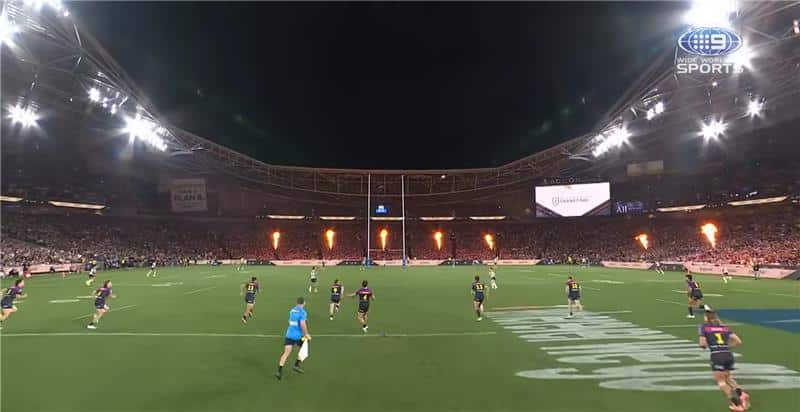
 The NRL’s proposed kick-off rule will allow teams that concede a try to choose whether they kick or receive. Screenshot: NRL ON NINE/YOUTUBE.
The NRL’s proposed kick-off rule – allowing teams that concede a try to choose whether they kick or receive – has been framed as a way to keep games competitive and exciting.
The intention is understandable. The league wants to avoid one-sided contests and keep fans engaged for longer.
But in trying to smooth out the game’s rough edges, the rule risks undermining something far more important than excitement: the dignity of struggle.
Rugby league has always operated on a simple, honest logic. Pressure creates opportunity. Mistakes carry consequences. Effort, over time, is rewarded. That natural order gives the game its meaning.
Teams know that if they fail to complete sets, miss tackles, or lose discipline, they will pay for it. Likewise, when they build pressure, defend resolutely, and execute under fatigue, they earn the right to control the contest.
This proposed rule disrupts that balance. By allowing the conceding team to immediately regain control after a mistake, it softens the relationship between failure and consequence. It interferes with the rhythm of reward that teams work tirelessly to create.
The result is not a fairer game, but a flatter one – a contest where pressure is muted and achievement is diluted.
Pressure in rugby league is not confined to the final minutes of a match. It exists in every set, every defensive line, every repeat effort when fatigue sets in.
It is the constant presence of consequence that gives those moments weight. Remove that, and the struggle loses its dignity.
This understanding of struggle is deeply compatible with the Christian view of the human person.
Our faith does not present difficulty as something to be eliminated at all costs, but as something that can shape us when faced honestly. Growth, whether spiritual or personal, is rarely formed in comfort.
The cross stands as the clearest reminder that difficulty is not pointless. It reminds us that perseverance, sacrifice, and fidelity under pressure are not signs of failure, but pathways to transformation. Shortcuts may reduce discomfort, but they rarely produce depth.
In the same way, rugby league is formative by nature. It reveals who teams are under pressure. It teaches patience, resilience, and accountability.
When the natural link between failure and consequence is maintained, teams are formed through the process, not rescued from it.
The NRL may argue that the rule will keep games closer and more exciting. But excitement, like meaning, cannot be manufactured. It emerges when effort matters, when pressure is real, and when outcomes reflect what has been invested.
This does not mean the league should ignore imbalance or refuse to evolve. But there is a difference between refining the game and insulating teams from the very pressures that shape them. A contest that constantly intervenes to soften struggle risks losing its honesty.
Rugby league resonates because it reflects something deeply human: that effort matters, that failure teaches, and that reward is meaningful precisely because it is earned.
Struggle is not a flaw in the game. It is part of what gives it dignity – on the field, and beyond it.