
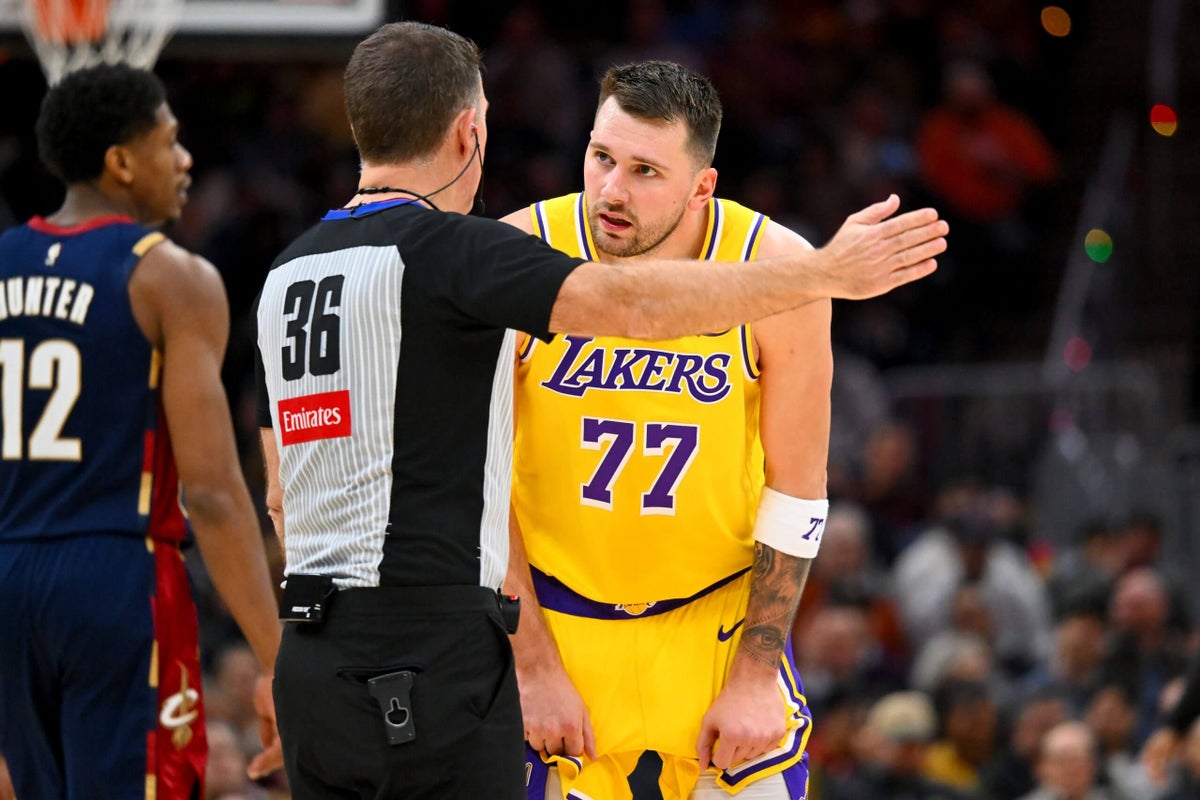
The NBA and Cleveland Cavaliers will meet to discuss changes to the unique, arguably dangerous court design inside Rocket Arena after Los Angeles Lakers star Luka Dončić narrowly avoided serious injury on Wednesday night, The Athletic has learned.
“While improvements have been made to the arena floor over the years to address this issue, the NBA and the Cavaliers are revisiting the situation given the incident last night,” a league spokesperson said Thursday night.
Dončić is questionable for the Lakers’ game in Washington on Friday with left ankle soreness after he fell off the side of Cleveland’s court, which is about 10 inches above the rubber mat covering the hockey rink inside Rocket Arena. The Cavs have the only “raised” court in the NBA, with a gap between the floor and the ice, that is dangerous because the “floor” seats are positioned on the rubber covering the ice — which creates the opening Dončić fell into.
On Thursday, the Lakers became at least the second visiting team to formally complain to the league, following the Miami Heat’s complaint in November 2023. Then, Dru Smith landed awkwardly in that same gap and sprained a ligament in his right knee, costing him the rest of his season. There have been no other known injuries suffered due to the gap in the 31 years of games at the arena.
The National Basketball Players Association raised concerns with the NBA about the Cleveland court when Smith was hurt and is in discussions with the league again after the Dončić incident over what it believes is a “safety issue.” Lakers coach JJ Redick called it a “safety hazard” on Wednesday. Heat coach Erik Spoelstra said the same two-plus years ago. Lakers star LeBron James, who played on it for 11 seasons over two tenures with the Cavaliers, said something ought to be done.
The discussions Thursday between the league and the Cavs were taken up mutually, a league spokesperson said. Earlier Thursday, a Cavs spokesman told The Athletic, “The basketball court layout and design at Rocket Arena is fully compliant with NBA rules and has been in place for [20-plus] years, with ongoing collaboration and regular evaluation between our organization, the league and independent flooring experts to support player safety and performance. We constantly evaluate every aspect of the arena to ensure the highest standards of fan experience are achieved and (the) safest environment for players, team members, performers and guests is maintained.”
Rocket Arena has had many names since it opened in 1995, but has had only one basic design for how the basketball court fits over the hockey ice. The playing surface is elevated from the rubber substance that covers the hockey ice by a wooden structure (think box springs, without the springs). The fans’ seats, the most expensive in the building, are so far beneath the court that they can easily rest their beers on the rubber mats and not worry about them being spilled by players.
Almost no one ever falls into it and gets hurt. There has been one major injury, Smith’s, and one high-profile near-miss with Dončić that anyone can recall in about 1,300 regular-season games, not to mention preseason and postseason games. Then again, in another situation, all it took was one star — Paul George, in Las Vegas for a USA Basketball scrimmage in 2014 — breaking his leg by crashing into a stanchion that was too close to the court for the NBA to make sure no stanchion was that close again.
Cleveland may not be the only city in the NBA with its court on a box structure. The Washington Wizards’ court, for instance, is also elevated from the hockey rink. But the differences are that the floor seats at Capital One Arena in Washington are on the court, and the court isn’t nearly as elevated above the hockey rink as it is in Cleveland. No player could realistically step off the side of the court, because patrons are in the way.
There are also several arenas in which the court sits on top of the rubber — or so close to it that no one could tell there’s a gap. Doing so leaves open the possibility of the ice melting through the rubber and soaking the court. It happened this month in Chicago when the Bulls’ game against the Miami Heat was postponed because of condensation on the court.
The Cavs, the NBA and the players’ association also understand that fixing the court to remove the gap is not necessarily an easy exercise, in no small part because it was designed and built in the early 1990s. The Cavs could theoretically reduce the size of the wood blocks upon which the court sits, add small ramps (rubber, likely, for forgiveness) from the court to the hockey rink to mitigate the drop, and put sturdier cup holders onto the floor seats since the fans would lose the natural border protection of the floor gap for their beverages.
Cleveland could widen the court, likely more expensive than the above option, and put the floor seats on top of it. Or, they could get rid of the box under the court altogether, but make sure the building stays cold enough to keep the ice from melting.
Other potential fixes might exist, along with accompanying complications. The fix may also be hard to implement during the season, which for the Cavs could last deep into the playoffs.
As for Dončić, he returned to the game on Wednesday after limping to the locker room and finished with 29 points. Afterwards, he said, “It wasn’t a great feeling, and, looking back at the video, I think I got a little bit lucky.”
The Athletic’s Dan Woike contributed to this report.