
It’s relatively rare that new display technologies come along in the TV world. The cathode ray tube was dominant for ages, even if it switched to color early on. The next big leaps were LCD, then OLED. In more recent years we’ve seen developments like mini-LED and quantum dot technology.
In 2026, there are not one but two major technologies poised to gain traction. In this piece I’m going to focus on RGB mini-LED, sometimes known as Micro RGB or RGB LED. It’s probably the most significant of the pair, since it should fall closer to the realm of affordability once sizes start to come down. There are a few things you need to know, though, before you start putting aside cash.
RGB mini-LED is not the same as MicroLED
Don’t do what Donny Don’t does
Credit: Samsung
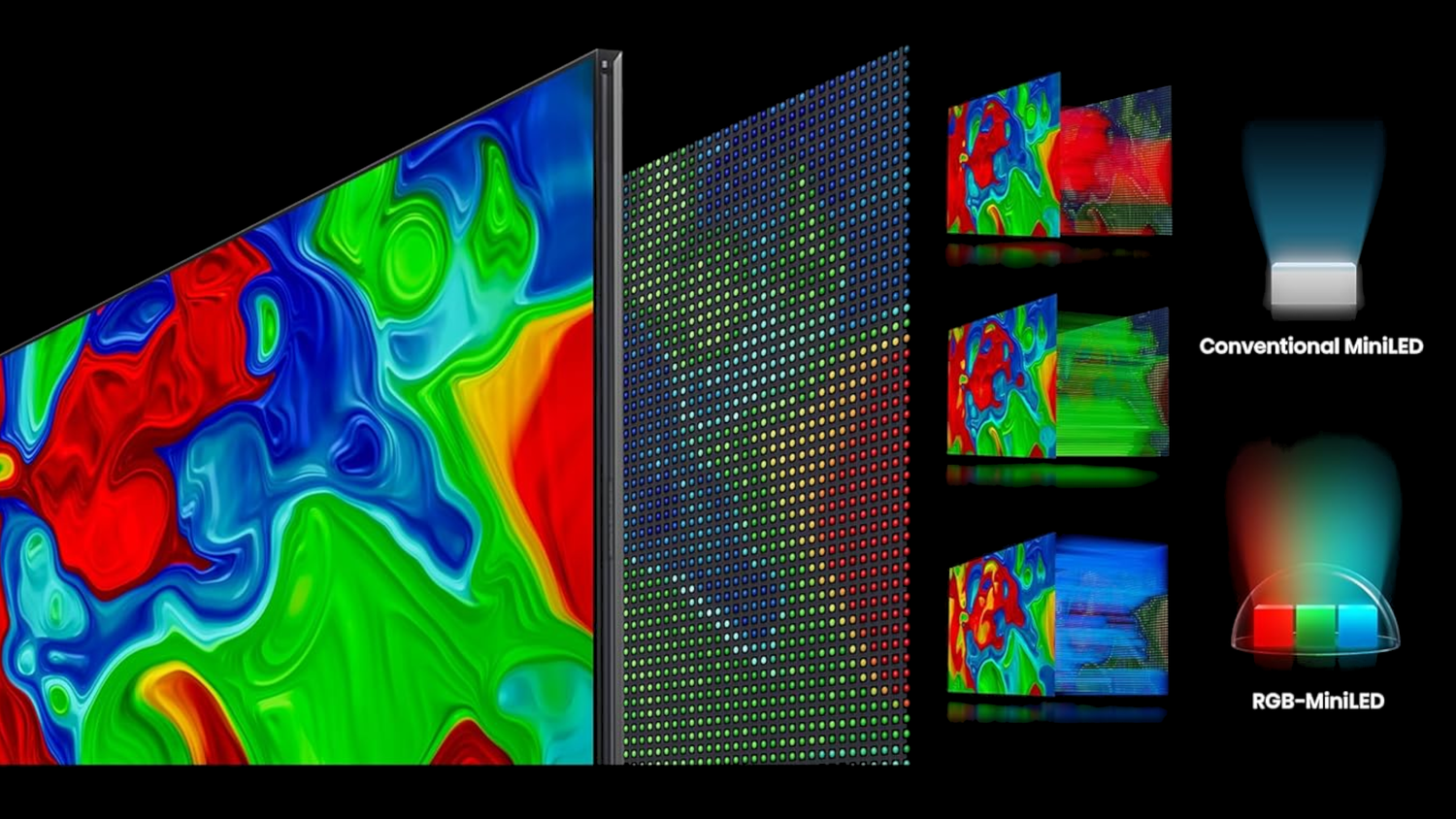
This is, unfortunately, an extremely easy mistake to make. I’ve had to catch myself occasionally before an article went out for publication. Apart from the fact that they both have “LED” in their name, Samsung’s version of the tech is branded Micro RGB — it’s like the company wants customers to mix things up.
In reality, RGB mini-LED and MicroLED are very different technologies. The former is largely an evolution of the mini-LED’s you’re used to, just with filtered backlights replaced by separate red, green, and blue LEDs. MicroLED takes things to the next level — every single pixel is an LED. That might seem like overkill, but it’s what’s necessary to challenge OLED when it comes to contrast. Unlike OLED, most LCDs — including RGB mini-LED TVs — can’t achieve pure black, since their backlights need to remain on to some degree. That goes out the window with MicroLED, which even goes one better by using all-synthetic material instead of organics, which are prone to problems like burn-in.
Because it’s less complex, RGB mini-LED is liable to become more affordable, more quickly, as I mentioned in my intro. It’s hard to tell just how quickly, though. Samsung’s one available set is a 115-inch model priced at a whopping $30,000, and even Hisense’s 100-inch unit is $10,000. Prices should drop not just along new sizes, but as companies like Hisense, Samsung, and LG continue rolling out new models — yet “affordable” could still translate to a few thousand dollars. I wouldn’t be surprised if it takes until 2027 or 2028 for sub-$1,000 units to appear.
It may replace OLED for a lot of high-end shoppers
Contrast only counts for so much
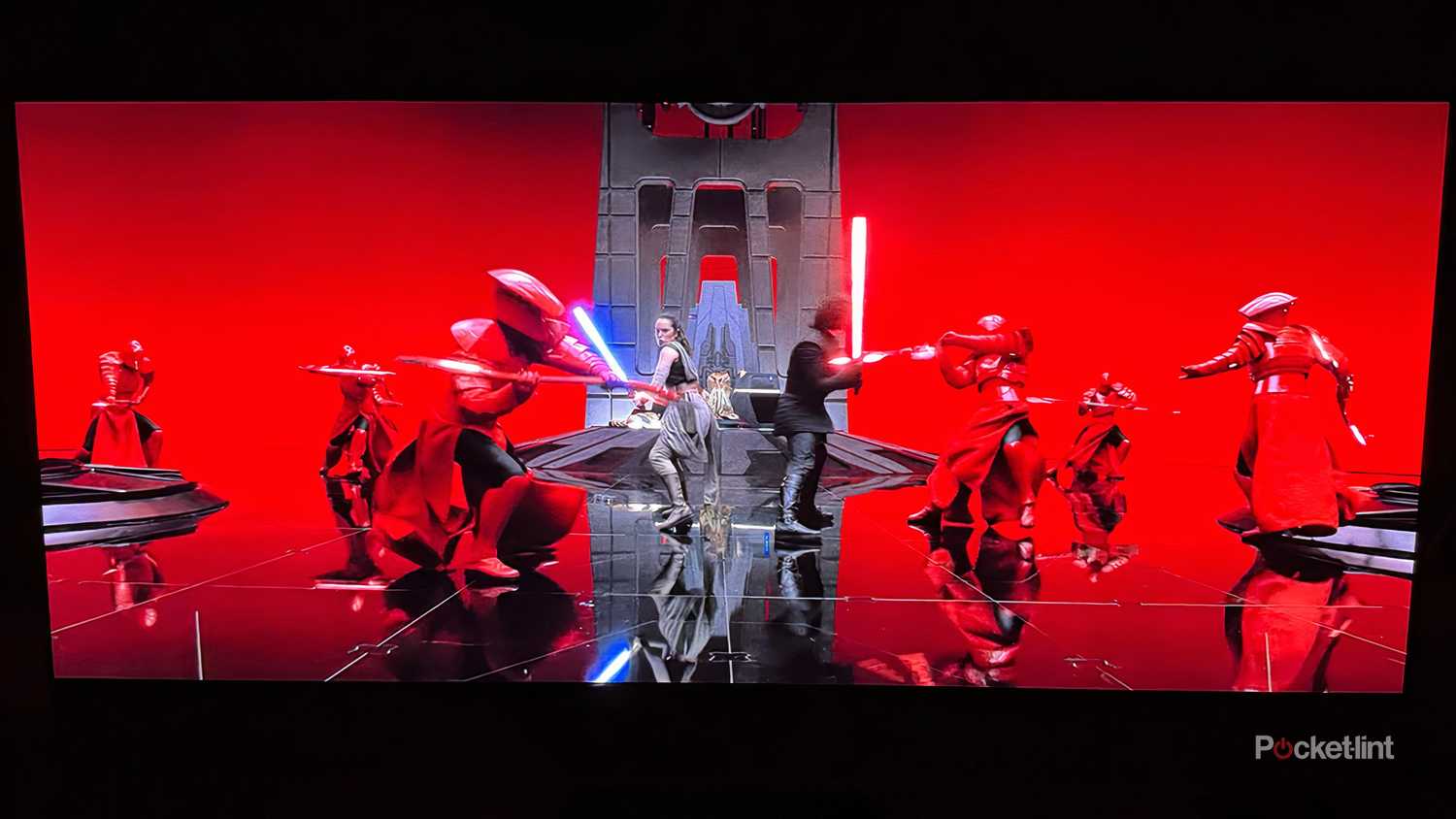
It’s true that until MicroLED takes off, OLED will remain the king of contrast. Its pixels are self-illuminated, meaning they can shut off completely. In fact this contributes not just to perfect contrast, but improved color representation, since there’s no chance of colors “bleeding” into each other.
Something that surprised me when I first heard about RGB mini-LED is that while its contrast still isn’t at OLED levels, it’s actually superior for colors. Whereas some OLEDs can cover most of the BT.2020 color gamut, Samsung claims that its current RGB mini-LED set can hit the 100% mark. That’s unprecedented. For enthusiasts who want to know they’re seeing the best possible version of a movie, trading off a little contrast might be acceptable.
On top of this, the tech retains the same advantage mini-LED has always had over OLED: brightness. The full-screen brightness on OLED sets tends to be low enough that they’re best viewed in a dimmed room. RGB mini-LED can be so intense that it’s not only usable in direct sunlight, but powerful enough to outshine the sun. Hisense’s 100UX is rated up to 5,000 nits in normal conditions, with a peak of 8,000. For a frame of reference, my Apple Watch Ultra 2 is perfectly readable outdoors at 3,000 nits.
It’s not just about watching a TV under diverse lighting conditions, either. Higher brightness tends to yield more vibrant colors. So wealthy shoppers wanting to impress their guests may soon decide that OLED is passé.
It’s smart to confirm Dolby Vision 2 or HDR10+ Advanced support
Don’t experience half of the future
Credit: Pocket-lint / Dolby
Something I tell people is that if they’re already in the market to buy a QLED, OLED, or conventional mini-LED TV, there’s no need to wait for one with one of the two new HDR standards, Dolby Vision 2 and HDR10+ Advanced. It’s going to take a while for a reasonable number of models to reach stores, and more importantly, for remastered content to reach streaming services. Most movies and shows will remain in Vision 1 and HDR10+ for the foreseeable future.
That equation changes when you swap in RGB mini-LED. It’s not that other panel types won’t benefit from the new standards’ expanded metadata, and other enhancements, such as improved shadow detail. Rather, the issue is that if you’re going to spend several thousand dollars on the best possible image quality, it doesn’t make sense to sacrifice standards that will maximize that quality, at least if you intend to keep your TV around for a couple of years. Indeed, one of the focal points of both standards is exploiting the new generation of super-bright displays. Spending on RGB mini-LED without this tech in the cards is like buying an EV that gets over 400 miles, but only if you drive at a snail’s pace.
The good news here is that if a TV doesn’t have Vision 2 or HDR10+ out of the gate, an upgrade may be possible via an over-the-air software update. Be sure to check with the manufacturer, however. A TV’s processor needs to be compatible, and regardless, you can’t assume that a company will update as many old devices as possible. You should buy a product for what it can do today — not what might happen down the road. Just ask anyone who bought an iPhone 16 for Apple Intelligence.
RGB mini-LED isn’t the endgame
Neither is MicroLED, for that matter

Credit: Lionsgate
It’s probably less common these days, but something you’ll still run into from time to time is that person who — consciously or subconsciously — thinks that if they buy something with technology X or Y, they should be set forever. Perhaps it’s the casual smartphone user who doesn’t understand why they need to replace their iPhone 6, or the parent who doesn’t get why their kid’s PlayStation 4 can’t play every new game. It’s more reasonable to assume a car will last for decades, but consider how many functioning cars from the ’90s you still see on the road.
Planned obsolescence is sometimes to blame, but often, it’s competition as much as anything. Businesses are always developing new tech as a competitive edge, and inevitably, the ones that lag too far behind end up vanishing completely. That’s as true in the TV industry as it is in smartphones or consoles.
Don’t get me wrong, any RGB mini-LED TV you buy in 2026 will probably hold up for a decade or more if you treat it well. But it will, eventually, be outclassed not just by MicroLED, but by formats that haven’t even been conceived of yet. Shop with the knowledge that what you’re buying is just another stepping stone.