
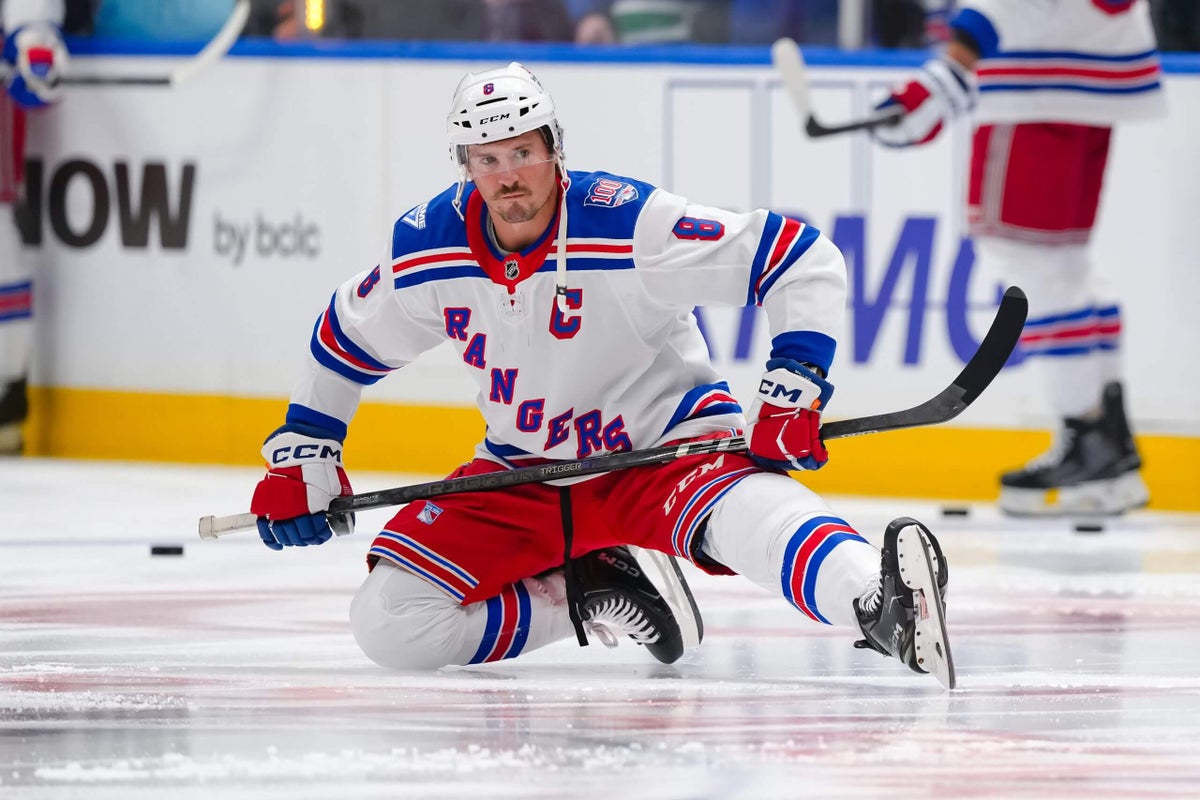
NEW YORK — Exactly one year has passed since the New York Rangers acquired J.T. Miller from the Vancouver Canucks. Since then, the Rangers have gone 37-41-9 and announced they’re entering a “retool.” The Canucks are 33-43-9 and have essentially announced the same thing. Both are in last place in their conferences.
The Pittsburgh Penguins, meanwhile, are 40-26-15 and in playoff position. They essentially formed a three-team trade with the Rangers and Canucks, sending Marcus Pettersson and Drew O’Connor to Vancouver shortly after the Miller trade went final.
A year later, and Kyle Dubas’ club looks like the sole winner of the Jan. 31, 2025, trades. He used his pick (No. 11) to select 18-year-old rookie Ben Kindel, who looks like the Penguins’ second-line center of the future, and traded the Rangers’ pick (No. 12) to Philadelphia for picks No. 22 and 31. Those became Bill Zonnon (No. 22) and Will Horcoff (No. 24), whom Dubas selected after trading up with the No. 31 and 59 picks. The Penguins’ draft-day haul already has benefitted them this season and likely will even more in the future.
In total, here’s where each team stood after Jan. 31, 2025:
• Rangers received: J.T. Miller, Erik Brännström and Jackson Dorrington from Vancouver
• Canucks received: Filip Chytil and Victor Mancini from New York; Marcus Pettersson and Drew O’Connor from Pittsburgh
• Penguins received: Conditional 2025 first-round pick (top-13 protected) from Vancouver via New York; Vincent Desharnais, Danton Heinen and Melvin Fernström from Vancouver
The draft lottery gave the Rangers the No. 12 pick in 2025. Because it was a top-13 pick, they could have chosen to keep it and given Pittsburgh their unprotected 2026 first-round pick. President and general manager Chris Drury decided against doing that, which, in retrospect, was wise. The Rangers have the fourth-worst point percentage in the NHL. As tough as it is to lose a No. 12 pick, surrendering a potential top-five selection to a division rival would’ve been significantly worse.
Vancouver was dealing from a position of weakness when it traded Miller. The standout forward, who had a 103-point season in 2023-24, was in the midst of a rift with teammate Elias Pettersson that had leaked into public, which Jim Rutherford confirmed in an interview with The Globe and Mail. Rutherford said there was “not a good solution that would keep this group together.” Miller also has a full no-movement clause, so he had control over his situation. The Canucks were low on leverage, and Drury pounced.
Chytil, Vancouver’s primary return in terms of win-now help, has struggled to stay healthy. He suffered a season-ending concussion after 15 games with the Canucks in 2024-25, and he’s missed all but 10 games this year because of another concussion resulting from a Tom Wilson hit. He’s back in the Vancouver lineup, but his history with head injuries remains a concern. Mancini, meanwhile, took an unlikely path to the pros and helped AHL Abbotsford to a Calder Cup title last season, but his ceiling is most likely a third-pair defenseman in the NHL.
The most valuable piece the Canucks received in the trade was the first-round pick, which they promptly flipped. Rutherford extended both Marcus Pettersson and O’Connor within a month of the trade. Given the team’s failure to contend this season and eventual decision to trade superstar Quinn Hughes, Rutherford likely would have been better off building for the future with the Rangers’ first-round pick. Of course, there was no guarantee it would be as high as No. 12 at the time of the trade.
Dubas used the No. 12 pick wisely, turning it into Zonnon and Horcoff. The Athletic’s Corey Pronman ranked the two forwards sixth and third, respectively, in his August rankings of Penguins prospects. Since then, Horcoff has had a monster season at Michigan and is among the NCAA leaders in goals (19). The Penguins view Zonnon as a potential middle-six forward, possibly at center.
The Rangers saw Miller’s acquisition cost as worthwhile given his pedigree and his edge. Drury clearly viewed him as a culture setter and named him captain heading into 2025 training camp. The two other pieces in the deal were marginal: Drury traded Brännström for Nicolas Aubé-Kubel, who is no longer with the organization, and Dorrington is a fringe prospect. In August, Pronman listed Dorrington, a 21-year-old defenseman, as a player with a chance to someday appear in NHL games but didn’t include him in his Rangers rankings.
In the end, the Rangers’ decision-making revolved around Miller, not the supplemental pieces. A year removed, the biggest issue might’ve been less the cost and more the timing. The Rangers’ core of forwards was already aging — Vincent Trocheck, Mika Zibanejad and Artemi Panarin were all in their early 30s at the time of the Miller trade — and the team was more than Miller away from being a true contender. That’s become even more apparent this season as the Rangers have tailspun to the bottom of the standings.
“The way that most teams would look at adding a guy like J.T. Miller is to fortify a Cup run,” said one Eastern Conference executive who was granted anonymity so they could speak freely about opposing teams. “The Rangers are trying to win all the time, and he’s a guy you’d want to have. But that’s a pretty depleted roster compared to the Presidents’ Trophy New York Rangers from (2023-24).”
Added one Eastern-based NHL scout: “Right now, I’m sure both (New York and Vancouver) would have liked for the results to have panned out better.”
Miller has not had a strong season for the Rangers by his standards, especially offensively. He has 14 goals and 35 points in 46 games, and only 20 of those points have come at five-on-five. He’s battled injuries over the course of the season. He will turn 33 in March and is under contract through 2029-30 at $8 million average annual value. New York has ample cap space to make that number work, but it certainly will need more production from Miller if this retool has any chance of being quick.
That’s far from assured.
“In the short term, you’d probably say (the trade) has not turned out great,” the executive said. “A year or two from now — the way the league goes if you do the right additions and with (star goalie Igor Shesterkin) and where they’re at — who knows, maybe they’re challenging for the division, and maybe they’re going on a run.
“But it hasn’t worked out this year. That’s for sure.”