
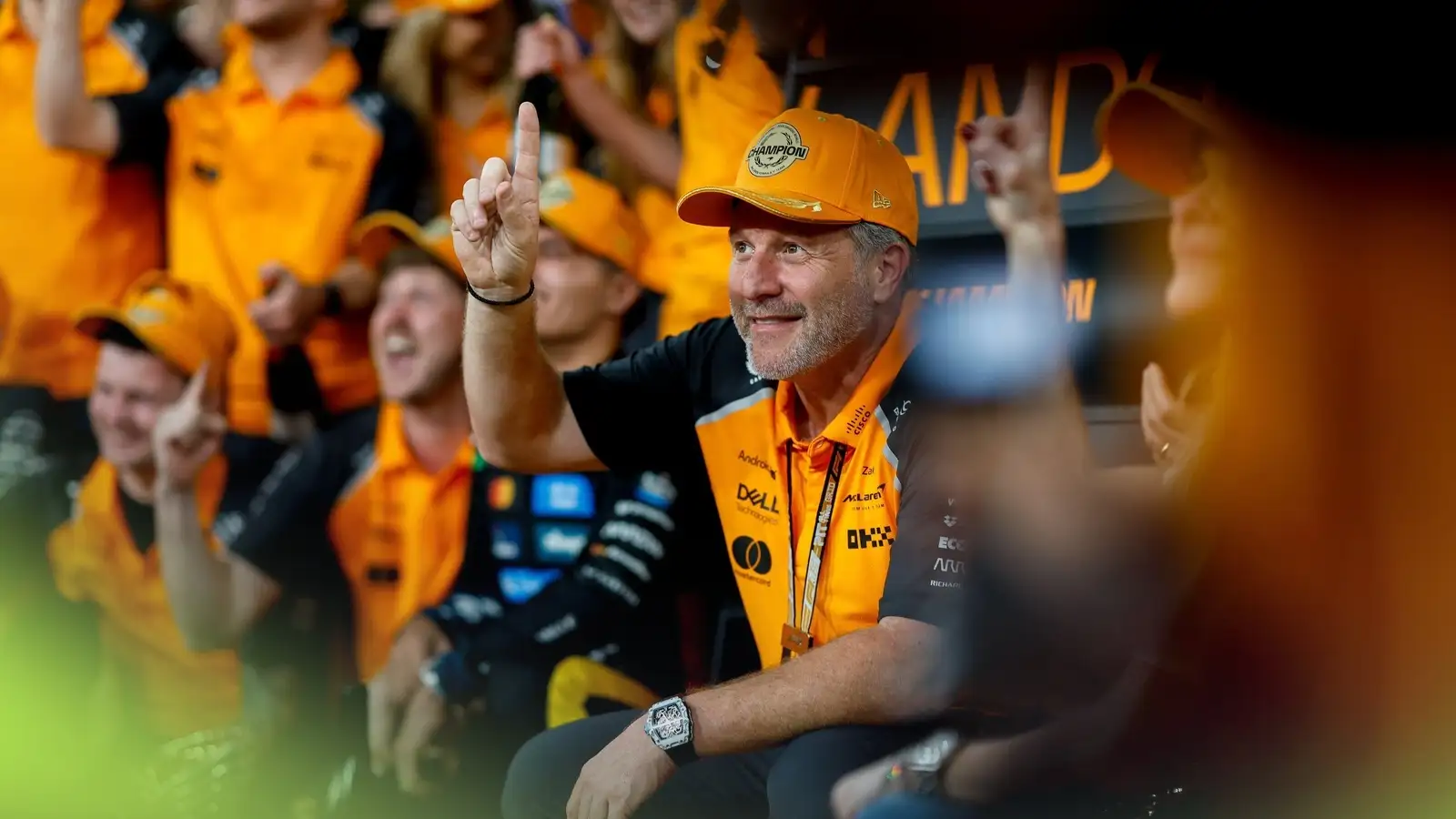
From backmarker struggles and an uncertain financial outlook, McLaren’s return to the top of Formula 1 is nothing short of extraordinary.
The turnaround, which truly became visible to the public when Andrea Stella took over as team principal in early 2023, reflects more than just engineering—it highlights the power of culture and leadership.
Inside McLaren’s astonishing rise from F1 also-rans to world champions
McLaren has long had the ingredients for success: experienced staff, committed owners, and world-class facilities. Yet for years, it was unable to deliver. Following Lewis Hamilton’s 2008 title, the team struggled to compete consistently, even with factory engines from Honda. But then, in 2023, the team was resurgent, and rode that wave to title success the following year – and again in 2025. So what changed? According to Dr. Marcia Goddard, it has to do with the culture within the Woking team.
A neuroscientist-turned-business consultant who has worked with F1 teams, she is an expert on brain-behaviour relationships, and their impact on team dynamics and performance – particularly in high performance environments. Dr. Goddard has also written a book, Driving Performance: 10 Lessons About Building High-Performing Teams From Neuroscience and Formula 1. in which she details a new approach to ‘sustainable high performance’.
According to Dr. Goddard, McLaren’s success has stemmed from Zak Brown’s ability to introduce a no-blame culture, creating a psychological safety net underneath a shared purpose that extended beyond simply winning championships. Combined, that unlocked the latent performance within the team. As Brown himself has said: “ We had the horsepower, but we were spinning our wheels.”
“I think that is the best example of how culture can directly influence performance,” says Dr. Goddard. “They always had talented people, and they had good drivers. They had all the ingredients for success, but they didn’t manage to pull it all together.
“I wasn’t involved in it so I can only speak as an outside observer, but I truly believe that culture was the defining factor in their success.”
Developing a shared purpose was crucial. Throughout McLaren’s transformation, the bulk of its staff have remained the same. The difference is how they think, what they believe; what they are working towards. That shared purpose, Dr. Goddard believes, affords them something to rally around. “Shared purpose is crucial in any environment,” she says. “I used to think that the shared purpose of Formula 1 was winning world championships, but that actually is not the case because most teams don’t.”
Goddard suggests the key was setting a goal that was clear and achievable, but one which rose as the team’s fortunes did. That created unity which, when combined with the no-blame philosophy, offered staff psychological safety, and led to a sense freedom and confidence. There were also changes at senior leadership level. “All of those steps are really important in making that culture transformation work,” Goddard observes.
Brown himself has spoken about at length of the task he was faced with, recounting the state of the team upon his arrival in 2016. With Honda power, McLaren finished sixth in that year’s constructors’ championship, its best result being two fifth-place finishes for Fernando Alonso in Monaco and the United States. A year later, the team slipped to ninth, with only eight points finishes all season.
The opinion at the time was that the weaknesses lay in the Honda engine. But a change to Renault failed to reap any great improvement, leading to the dawning realisation that the team itself had to shoulder that burden. “There was an arrogance, a denial that once we swapped the power unit we were going to be back to McLaren and when that didn’t happen, it was pretty sobering and I realized there were lots of issues with leadership that we needed to improve,” Brown told Fortune in an interview in early 2025.
In response, he began making changes. When Andreas Seidl was approached by Sauber, Brown took the opportunity to promote Stella. Soon after came a structuring of the technical department, and James Key’s exit. Still, it started the 2023 season off the pace. But, by year end, it was a serious contender. “So what made the difference? The leadership, guidance, and motivation,” Brown added. “The leadership team unlocked what was sitting here, which was a championship-calibre group of people who weren’t operating in the right way.”
McLaren found traction well before its 2023 performance increased. After a slow start, a result of the car missing the team’s own development targets, an upgrade package introduced at the Austrian Grand Prix catapulted Lando Norris into podium contention. That wasn’t the start of the renaissance, however, merely the first public evidence of a process that had started long before.
More on McLaren’s resurrection
👉 Ron Dennis apologises for McLaren-Honda F1 2015 struggles: ‘You were right, I was wrong’
👉 McLaren profits quadruple in £530million championship-winning campaign
“Doing all of that is what allowed, I don’t know if it was one engineer or a team of engineers, to finally have that idea, to flick that switch and be like ‘this is going to make the car better’. And then it happened,” Dr Goddard said.
The timing of McLaren’s on-track performance improvement, midway through the 2023 campaign, suggested to Goddard a change in the months prior. The upgrade package is the product of engineering bravery; an ability and freedom to be creative. “You need to have that environment, you need to be intrinsically motivated, which comes from having a shared purpose,” she noted. “And you need to be free, feel free, as an engineer, just to throw ideas out there and to experiment and see what sticks.
“That is, I think, the environment that they have created that allowed them to do this.”
From that Austrian upgrade, McLaren’s fortunes continued to rise. It challenged for wins at the end of 2023, before becoming a serious contender – albeit after another slow start – in 2024 that culminated with the team’s first world championship of any sort since 2008, and first constructors’ crown since 1999. It backed that up with a title double last year, underscoring the team’s return to the very pinnacle of Formula 1. McLaren’s resurgence is far more than a story of engineering excellence, it’s proof that culture and leadership, coupled to a shared purpose, can unlock a championship-winning team.
Driving Performance: 10 Lessons About Building High-Performing Teams from Neuroscience and Formula 1, by Dr. Marcia Goddard, is available to pre-order here.
Want to be the first to know exclusive information from the F1 paddock? Join our broadcast channel on WhatsApp to get the scoop on the latest developments from our team of accredited journalists.
You can also subscribe to the PlanetF1 YouTube channel for exclusive features, hear from our paddock journalists with stories from the heart of Formula 1 and much more!
Read next: McLaren MCL40 reveals next-level aero design in Barcelona