
Photo-Illustration: Intelligencer; Photo: Getty Images
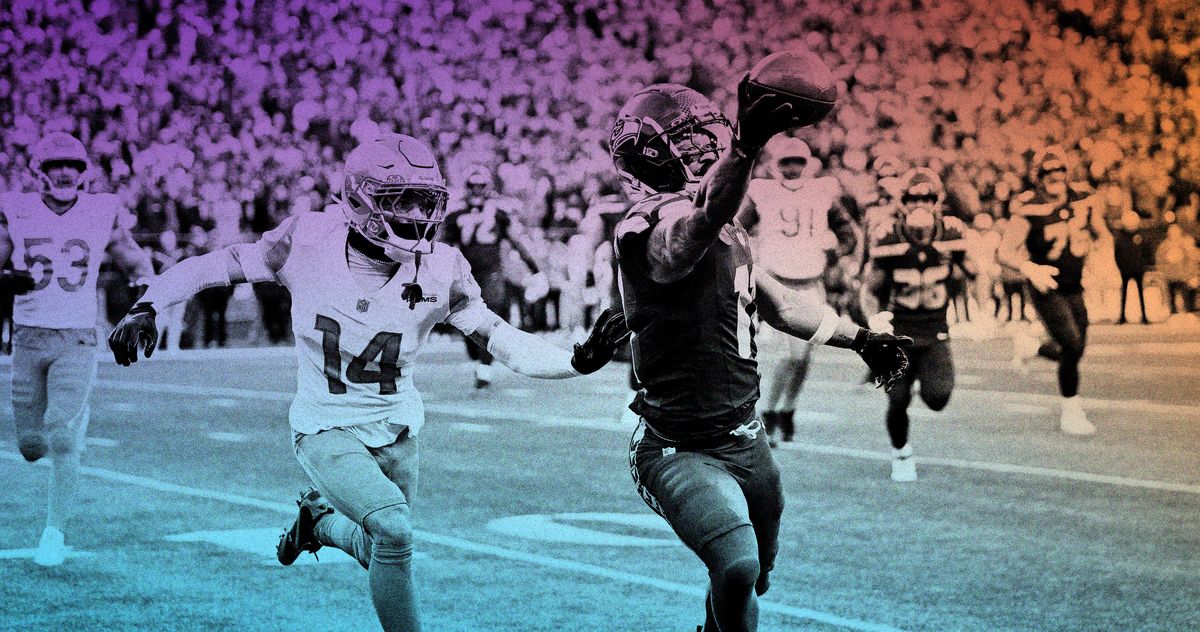
Some of the questions Chuck Klosterman asks in his new book Football are questions you would expect a Chuck Klosterman book about football to ask: Why are Americans so obsessed with the sport? What does it say about our larger culture? Why is Creed’s Thanksgiving 2001 halftime show a seminal moment in our nation’s history? But one of the most surprising, and winning, aspects of the book is how wonky it is, how obsessive about actual gameplay — formations, strategies, historical figures. Klosterman is sometimes portrayed — I’d argue incorrectly — as a distant, almost glib observer of the American cultural condition. But it’s clear that he loves the sport of football in all its excesses and minutiae, and the result is a book that’s unexpectedly emotional and achingly sincere.
Still, there’s plenty of Klosterman’s signature insights and madman logic here, and the book is, like all his other work, consistently hilarious: His wry, seemingly alien sense of humor has always been his secret weapon. I spoke with Klosterman about his argument that football’s dominance has an end date, whether college football is better than the NFL, and how scared he is that men don’t seem to read books anymore.
In the book, you touch on a long-standing theory of mine, which is that one reason football is so popular is that anyone can watch it and feel like an expert, despite having no idea what’s actually going on. But you’re wonkier about football than the average fan. Do you think that makes you a better or happier fan, or the opposite?
That’s probably just a reflection of my personality and interests. When you’re a senior in high school, you have those, like, albums or yearbooks or whatever, and there’s one page where you have to say what you hope you’ll be doing in the future. My fantasy was to be an offensive coordinator in the SEC. What I think is very funny is that even in my greatest fantasy, I did not have the head job.
A lot of people, myself included, argued for years that football is in existential peril, and almost everyone, again myself included, has given up on that argument. That’s why it’s fascinating to see you suggest that football’s hegemony has an end date. To oversimplify a bit, you think that’s largely because of its overreliance on a television- and streaming business plan that won’t last forever, and that as fewer fans actually let their own kids play the sport, it will become increasingly disconnected from their day-to-day experience. Do you think people our age will see that turn, or will we die wondering if it ever comes?
I think there’s going to be this inevitable economic issue involving cable and streaming television, which will be accentuated by cultural and social issues underneath. They’re able to sort of stave off and fight off as long as the NFL is still in this completely dominant financial position. But if that were to shift, the size of the league makes it paradoxically fragile. Will people our age experience that? I’m 53. I suppose I could live another 40 to 50 years. We will probably be right on the cusp of this.
What is particularly tricky is that it’s increasingly difficult to have a good grasp of what the speed of acceleration of culture will be. In the last half of the 20th century, we often talked about the idea of accelerated culture. That was a common thing — it was the subtitle of Generation X. It’s less clear now. In some ways it does feel like the culture is stagnating, but the technological aspects seem to be changing faster than we can even absorb. It kind of creates this weird asymmetry where in many ways the culture of the United States seems sort of stuck, almost broken, and yet all the kind of machinery around it keeps moving. That makes it very difficult to know. It’s very difficult for people to think about football as something that could be in trouble because everything else about it makes it seem as if it is absolutely untouchable. But nothing is.
You say it’s not too big to fail — it’s too big to stop. It almost feels like no other sport could ever get this big again.
The only possible replacement would be soccer becoming a fully global monoculture that includes America. But that doesn’t seem likely.
Do you think football would be in a different place if Damar Hamlin had died?
If it had been understood as an incredibly rare cardiac event, which is what it was, football probably would’ve survived it. But if someone were to die from direct head trauma, things would change. The rarity of Hamlin’s situation pushed the debate in one direction. You probably remember — it was weird how 12 hours after it happened, it seemed like we didn’t know what was happening, but then as soon as it turned out, “Oh, he’s going to live and the reason this happened was crazy,” and then he came back, and everyone was just good about it. It’s just almost like that event has disappeared.
Let’s talk college football, which I write about a lot. You suggest most people love it more than the NFL. Do you?
I don’t want to suggest I’m watching one more than the other, because I’m watching them both all the time. But in terms of what I feel invested in or what I care about, I do care about college sports more, even though everything about society is sort of forcing me to see that as an antiquated notion. It is much more enjoyable to me to have a conversation about college sports than pro sports. But I think the sport is in some trouble. I do not think this is an uncommon thought.
A lot of people really struggle with the NIL stuff, and the transfer portal, though I believe conference expansion — and eventual sloughing off of teams that don’t get TV ratings — is the larger issue. My theory is that college football will eventually become a 32-team minor league, but until then it’s still fun. The gameday experience feels the same to me even if the roster changes completely.
But doesn’t the loss of long-term relationships with players take something away?
As a consumer, not really. I’m not a student. The connection was already an illusion. I’ll watch the team no matter who’s on it.
What I find so charming is the historical element and the regional element and the diversity of offenses from conference to conference — the idea that a player from the West Coast is a different kind of quarterback than you might get from Florida or Texas. Regardless of how recruiting became national, teams were still fundamentally built from the area they come from. That’s what will disappear. I also know that when the talent is distributed equally, there will be a spike in interest; obviously people in Indiana are having an experience with college football they’ve never really had before. But what will happen is that you won’t be able to succeed by doing something strategically or ideologically different. Everyone will start to play the same way as in the NFL. There might be outliers at the very front and the very back, but for the most part they’ll be playing in a very similar style. I don’t like that. I know now there’s almost this pressure that you’re supposed to look at things like Name, Image, and Likeness and be like, “Well, it’s morally just,” but I think you can’t impose those kinds of ethical ideas under everything in the same way. I do think it makes college football, as an experience, worse.
You make the argument in the book that you can only truly understand football if you gamble — that there’s an internal game going on within the actual game that is impossible to get without paying attention to odds.
Only in Las Vegas, with physical money. A lot of problems would disappear if that were still required. Gambling enriches football conversationally, but socially it’s bad. It’s hard to imagine that online gambling and phone gambling are good for society. The only argument you can make for it is that people should be able to do what they want. That’s a good argument for a lot of things, but I don’t think it’s probably good for the world. That said, I’m endlessly fascinated by how accurate Vegas is. I’m just fascinated by the effectiveness and the quality of line creation.When the season starts and two teams haven’t played at all, and one team is a 48-point favorite, somehow the game almost always comes down to a 47-, 48-, or 49-point differential. It just doesn’t seem possible to me. Yet it happens so many years in a row that I just have to accept that they’re right.
I have season tickets to Georgia football, and I attend about ten games a season. But I feel like almost every conversation about football revolves around people — including reporters and the people most connected to the sport — watching it on television. What’s the last football game you attended in person?
It’s been a while. Oregon–Oregon State years ago. A North Dakota high-school game three years ago. If I go now, it’s more for the cultural experience than the game itself. I covered the Super Bowl for ESPN when the Seahawks played the Steelers and it was in Detroit. I spent the whole week covering the world around the game, all that kind of cultural stuff you got to write about because we treat the Super Bowl as this American holiday that has all these festivities tied to it. You’re almost compelled or pushed to write about how overheated and crazy it is; there’s a story about how insane the Super Bowl has become. But I go to the game and it’s odd, because once the kickoff happens and a thousand cameras go off and you see all the little flashbulbs … then it’s just a high-stakes football game. It doesn’t seem in any way radically different from a game in Week Four.
I appreciate your arguments even when I think they’re wrong. This has always been true with your books, but now I think most writers care more about people agreeing with them than people reading their book. Do you think that’s changed since the beginning of your career?
Yes. What has changed about the way people consume literature is the same thing that has happened with the way people consume news, which is that now, the goal is to find information that supports your preexisting bias. That became clear after the 2000 election when all the news networks suddenly realized that people actually prefer a lack of objectivity. It’s not the greatest compliment, but it’s a very good compliment when someone says something like, “This is the best argument that I don’t agree with at all. I just read something that is very persuasive about an idea that to me still seems completely incorrect, but I can’t help but concede that you have made a convincing point for something that I’m just not ready to emotionally or intellectually accept.”
In a way, writing books does still allow that, because the kind of person who is reading online is generally reading something for free. They’re not that invested with it to begin with. You have gotten into a conversation with someone you just randomly came across and will never see again, so you might not be as willing to really invest time into what they told you. But when someone buys a book, they know what they’re reading isn’t something they can really respond to, something that isn’t created for that purpose. It’s a weird one-way relationship. I think that makes it a little more acceptable to just soak in the argument. But there are fewer people who are interested in that now, which is probably why it’s so hard to sell books, especially to guys. The audience for that world has gotten a lot smaller. It’s not because they don’t read anymore. They read all day! They’re reading on their phone and they’re reading what’s on their computer and they’re reading constantly. They’re just not reading books.
This interview has been edited for length and clarity.
Sign Up for the Intelligencer Newsletter
Daily news about the politics, business, and technology shaping our world.
Vox Media, LLC Terms and Privacy Notice