

1000 Yoots, 1 Marilyn
Season 4
Episode 4
Editor’s Rating
5 stars
*****
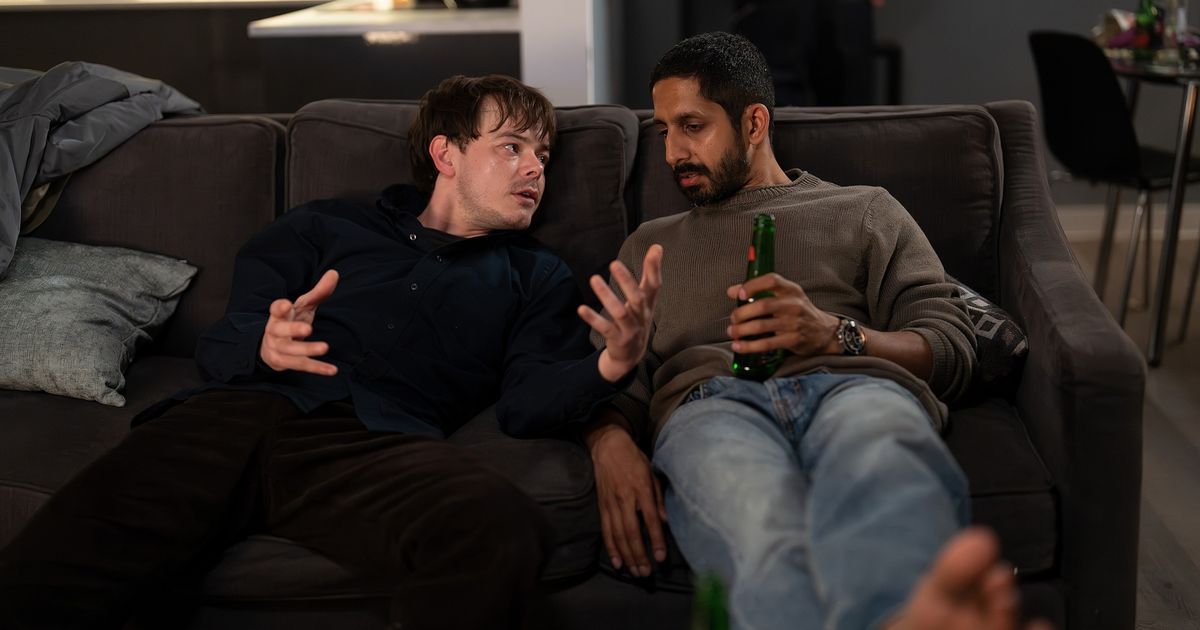
Jim and Rishi are two losers desperately trying to hit rock bottom, and they finally found it.
Photo: Simon Ridgway/HBO
Jim Dycker has a whole-ass depressing life, it turns out. He has a baby so young that he’s still in a pram. He shares custody with a dopey colleague with whom he had a one-night stand. He’s broke, but someone just ransacked his crummy flat. He’s a human adult man with Ritalin-induced acne and paranoia exacerbated by sleep deprivation.
At the top of “1000 Yoots, 1 Marilyn,” though, Jim catches a break. Tender’s response to Jim’s ankle-biting “investigation” is OTT, to his editor’s mind. Edward (David Wilmot) wasn’t impressed with the piece initially, but the sandstorm of legalese it’s kicked up — defamation! injunctions! — convinces him there’s a there there. He agrees to send Jim to Accra provided the reporter cuts ties with the short sellers Tender is accusing Jim of colluding with. No problem, Jim says. But the extended opening sequence is bathed in the same sinister blue light we saw in the season premiere when Jim stalked Hayley into the nightclub. The camera work is as shaky as a Bourne film. There’s definitely going to be a problem, mate.
From Tender’s perspective, it’s an inopportune moment to catch bad press. The app launch is imminent, but the team’s still tirelessly tweaking the user interface, over and over. Now, Henry wants the Crypto tab deleted because it makes Tender seem unsavory, which, you know, true. He would like to see the line “Powered by Pierpoint” axed, though we’ll later learn it’s contractually obligated copy. It’s not just that Henry blames Pierpoint for bungling Lumi’s IPO; he has ideological objections to throwing in with the investment firm. Honestly, can someone please sit this man down and tell him he runs a bank? Henry appears blinded by the fairy tale Tender invented to seduce Labour ministers and the financial press: that their unicorn app will democratize investing, promote financial hygiene, and save the faded empire from irrelevancy.
The infighting extends to the rollout strategy. Robin — the head of comms, who prefers quarter-zips — wants to keep things classy: a press release, features in Wired and TechCrunch, Henry talking shop with the dudes from the Breaking Banks pod. It’s a conservative strategy, but given that the app is in flux and Henry has been at the helm for all of six weeks, perhaps a conservative strategy is what’s called for.
Yasmin — no job title, really embracing a quiet-luxury aesthetic at the office — would prefer something splashier. Imagine Charli XCX in front of a Tender step-and-repeat, extolling the virtues of online investing because having a brat summer isn’t cheap. She wants to see Henry on Chicken Shop Date, which is a joke I wrote before I knew about the Amelia Dimoldenberg cameo later in the episode. (Her character’s surname as it appears in the closing credits? Poulet-Magasin.)
In the end, they split the difference. With a “fuck yeah” from Whitney, Yas books Henry to speak at the Web Horizons conference, even using her friendship with Jenni to secure an attention-grabbing intro from biz seccy Lisa Dearn. Yasmin doesn’t give a toss about Tender or Henry, at least not as a person. Being a Muck isn’t worth as much as it used to be, and the success she wants for her husband is the success she wants for herself. Henry, however, is reluctant to step back into the limelight after the Lumi fiasco. He claims to want to distance himself from the ego-driven part of his personality, though, by his own logic, his ego is what he’s protecting here.
Whitney is bearish on Henry after his meltdown in front of the regulator, but in the end, it’s Henry’s CFO, not his wife, who persuades him onto the stage. Whitney is such an enigma that it’s tricky to ascertain how much he’s working Henry over and how much he would really like to peel back the man’s skin and jump inside. The description drunken Jonah gives to Sweetpea — Whitney’s always obfuscating and dodging, relentlessly refilling other people’s glasses but never finishing his own — complicates the picture. “Tell them about your conscience,” Whitney advises Henry by way of a pep talk. But Whitney knows the story Tender’s selling is a dud — they’re still swiping credit cards for the Bonnie Blues of this world and then paying its Geoffreys to cover their tracks. Is Henry Whitney’s idol or his fall guy?
Henry manages to put in a good, if overweening, performance at Web Horizons, going off-prompter to lament the lack of sincerity in modern life without bothering to relate it back to mobile banking. He tells an audience of investors and reporters that everyone should have access to the Henry Muck experience — that his app will demystify the forces that keep his family rich and almost everyone else much less rich. Britons don’t need a social safety net; they need Tender accounts. High off the applause, Henry runs right past his wife for an attaboy from Whit. Something’s definitely happening here. When the TenderBoyz stand side by side, they stand incredibly close; when they touch each other, they linger, which Yasmin is finally clocking. Moments later, when belligerent Jim arrives at the conference to needle Whitney about what the company is up to in Sunderland, she notices that, too.
It’s about halfway through “1000 Yoots” that Yasmin lands on the phrase poisonous double act to describe the nascent SternTao partnership, which is foundering. Tender’s stock price has been climbing so precipitously that Eric’s worried about a margin call. And after Jim breaks things off with Harper, there’s no way to know if the Sunderland story will ever run. Should they feed it to another reporter? SternTao are 100 percent leveraged on the £250 million they’ve raised, and the only thing they’ve got going for them right now is that Jonah sent Sweetpea all the email correspondence that was subpoenaed in his own defamation lawsuit against Tender.
Yas assures Whitney she has a comms angle to deal with SternTao, but really she has only one comms angle — the same she used to handle Moritz in “Habseligkeiten.” She phones her uncle-in-law and asks him to pretty-please bring the full weight of the Norton Media Group to bear on a tiny trade pub. For proof of collusion, Whitney hands over the photos he had taken of Jim and Harper strolling in a park together. For me, the smile that spreads across her face when Norton tells Yas, “Good nose,” is the most disgusting part of this vile affair.
None of it really matters, though, because the objective has never been to publicly expose Jim or even Harper. It’s to keep Jim’s next story from seeing print. Percy sends the full copy of “The Men Who Hate Britain,” his proposed takedown, including Whitney’s damning art contributions, to Fin Digest for prepublication comment. Meanwhile, it seems Tender has informed Ed about Jim’s harassment of Hayley Clay. Though Ed sees promise in the wayward man-child, he really has no choice but to fire Jim. If he doesn’t, the next day’s story will be about the fintech employee assaulted by his reporter on a drug-fueled night out.
That should take care of Eric and Harpsichord for now — not to mention Harper and Jim — but what about the other poisonous double acts of “1000 Yoots”? After Robin refuses to run the comms department alongside Yasmin, she goes shopping for a lieutenant. Whitney gives her the green light to poach Hayley, who comes to Yas early in the episode for reassurance about what happened between them in the Alps. Yas takes Hayley into her arms and threads a hand in her hair and tells her not to let a loser like Jim Dycker steal her agency. Yas’s creepy grooming is about as subtle as Whitney’s ego stroking.
But when Yasmin offers Hayley the promotion, it’s clear she has misjudged the pliability of “Calabasas,” who wants to know why she’s the woman for the job. “Thought it was because of how good I sucked your husband’s cock,” Hayley suggests, mooning Yas and calling her “Mommy,” which I think means she’s accepting the role. Yasmin looks stunned and horrified. She only wanted a pet.
Now, before we get to the episode’s outrageous, frenzied, tragic coda, I suggest we pause to remember every self-destructive character we’ve met across the past four seasons. Jesse Bloom, who spent years in a low-security prison for tax evasion. Greg Grayson, the dude who ran through the glass wall. Nicole Mallon was a piece of work. And we mustn’t neglect Hari Dhar, Nabhaan Rizwan’s character, who worked himself to death in the series premiere. Hold them all in your mind for a minute, then ask yourself: In all the world of Industry, can you think of a more poisonous double act than Jim and Rishi?
Rishi Ramdani has a whole-ass depressing life too. He spends his days in his SUV, selling coke to finance bros and playing sugar daddy to a child who resembles his dead wife. When Rishi tells her he never hears from his in-laws, who are raising his son, Sugar Baby can’t help herself. “Maybe they’ve got their reasons,” she says, clutching an Hermès shopping bag he tells her not to open until she’s done giving him head. When Rishi later meets with his MIL, it’s to facilitate changing his son’s last name to Smith, which will enable Hugo’s grandparents to more easily travel with their motherless grandson. It’s imperative they check in on their Biarritz holiday home, because real problems aren’t enough to make a rich person’s Champagne problems disappear.
I struggled with the idea that Jim and Rishi could run into each other at the pub by chance, but now that Harper has cut ties, Rishi’s in business for himself. He’s the one who broke into Jim’s flat, though Jim’s too sad, drunk, and delirious to hold it against his new buddy. The men swap tales of woe. The guy who shot Diana is doing time in a hospital rather than prison after his diminished-capacity defense was successful; Rishi is the one serving a life sentence. For whatever it’s worth now, Jim admits he did go down on a near-comatose Hayley, but nothing’s his fault: The porn made him do it.
They’re losers, and they’re trying very hard to hit rock bottom. Also, they’re marks. When a nameless stranger “saves” them from a pub pickpocket, they reward the man with a beer. Later, they invite him back to Rishi’s millennial-gray flat to get high. But the guy isn’t really talking to Rishi and Jim. As they get more coked out and insane, he just keeps turning up the music, baiting the neighbors to call the cops over how loud Rishi, whom they probably avoid in the lobby, is willing to blast Ultravox’s crescendoing “Vienna.” It means nothing to meeeeee.
Rishi and Jim are so sky-high they barely notice when the stranger dips. Ohhhhh, Viennaaaaa. Jim is busy opining that he needs a world war to teach him how to be a man like his grandfather, or something equally stupid. For once, Rishi is blaming himself for his problems, which is refreshing and sad. He’s not in the room when Jim ODs; by the time Rishi comes back in, his face has turned blue. The police are knocking down the door. This means nothing to meeeeee.
He’s sober enough to understand he’s about to be arrested, if not in connection to Jim’s death, then for the quarter-brick of coke he’s got hiding in the toilet cistern. But even as Rishi climbs onto the railing of his balcony, Jim’s words from earlier were still echoing for me: “You are too selfish to conceptualize a world without you in it.” I thought Rishi might accidentally tumble to his death and Industry would be decent enough to at long last free this man from his story.
I could not have been more wrong. Rishi has no friends or family. He has no job or prospects. They’ve erased the name he gave to his only son. He may be alive, but Jim’s still wrong; the world already doesn’t have Rishi in it. So he lets go of the railing and trusts gravity to do its work. It should be over. Dear God, please let it be over. Somehow, though, in his drug-addled state, Rishi seems to have forgotten he doesn’t live in the penthouse. The fall is sufficient to break his legs, but he looks set to survive this disaster, too. The next stop for Rishi will be a prison infirmary, but how much can he care at this point? This means nothing to meeeeee.
Sign Up for the Vulture Newsletter
Entertainment news, for the pop-culture obsessed.
Vox Media, LLC Terms and Privacy Notice