
If you’ve ever watched a football match, you’ve probably been too focused on the game to wonder about the sports science on display. But a surprising amount of chemistry helps the skills of modern players like Mo Salah, Leah Williamson and David Raya.
Let’s start with the ball itself. Originally, manufacturers made footballs from leather, with a vulcanised rubber interior (similar to a car tyre) bladder filled with air. But while leather has some bounce, it’s heavy. Researchers have shown that if players repeatedly head these older balls they may get brain injuries.
Let’s start with the ball itself. Originally, manufacturers made footballs from leather, with a vulcanised rubber interior (similar to a car tyre) bladder filled with air. But while leather has some bounce, it’s heavy. Researchers have shown that if players repeatedly head these older balls they may get brain injuries (bit.ly/3JqJMjs).
Today’s top flights balls are very different. While the ball still has a rubber bladder, the rest is a series of synthetic fibres: polyurethanes, polyolefins and polyester. These are not single substances, but a wide range of lightweight hydrocarbons that can give the balls the exact properties you need. By changing the blend or the synthetic fibres used, you can make the ball firmer, bouncier or affect how much it deforms when you kick it – controlling everything from how much a player can bend the ball in flight, to the velocity the ball will reach as it heads towards goal.
In fact, far more plastic is on a football pitch than you’d think. The players’ boots, the grass (most top professional clubs in Europe play on hybrid pitches which are a mix of real and artificial turf, and lower league teams are increasingly using them as well) and even the teams’ shirts. Liverpool, Chelsea and Tottenham Hotspur all use kit made entirely from recycled plastic bottles.
Material chemistry to keep
A safe pair of hands
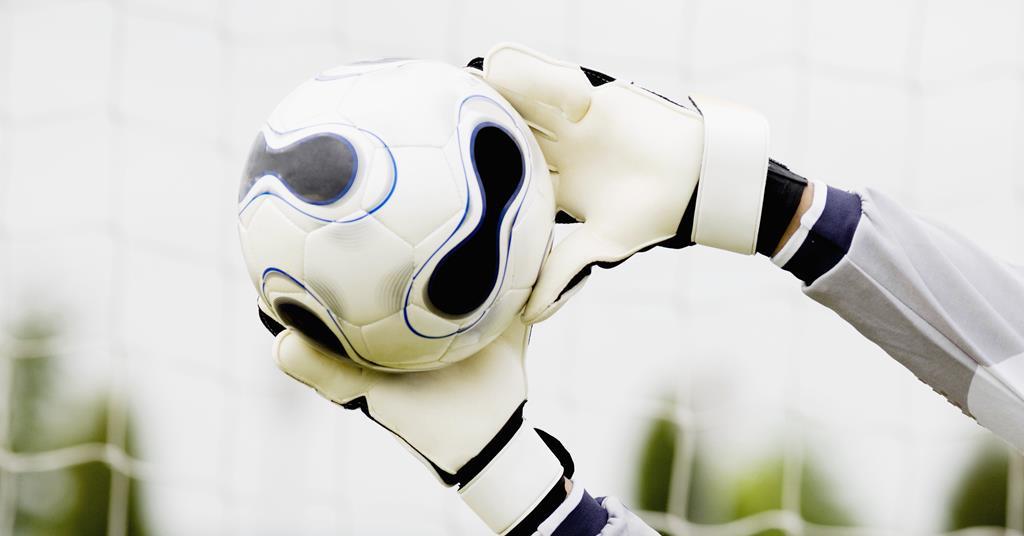
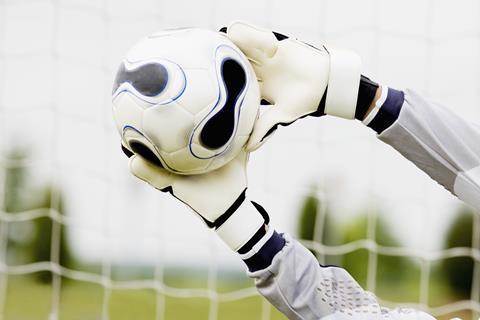
And you don’t just see chemistry in action in the outfield. One of the best examples is the gloves modern goalkeepers wear, which allow the ball to almost miraculously stick to their hands. This is thanks to latex, a naturally occurring long chain of hydrocarbon molecules, which deforms around an object and becomes sticky thanks to the increased surface area and friction. But goalies don’t just have one pair: they use different types of latex for different conditions. Contact latex is a great adhesive when playing in the dry, while Giga Grip latex is better in wet conditions.
Synthetic fabric called neoprene, produced by the polymerisation of chloroprene (2-chlorobuta-1,3-diene), cushions the gloves. The structure of neoprene is not only great at water resistance, but is also spongy and flexible, allowing the gloves to soak up the shock of a ball hitting the keeper’s hand at more than 70 mph and preventing any broken bones.
Referees’ vanishing spray
Chemistry in a can
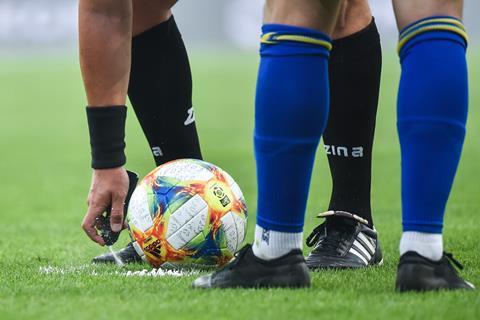
It’s not just the players who get to use chemistry. One of the latest advances we can see in football is the spray referees use to mark out distances, creating a painted white line for defenders to stand behind before it vanishes after the player has taken a free kick. This isn’t paint at all. The spray is about 80% water, 17% butane gas and other ingredients, such as surfactants, make up the remainder. When the referee sprays it from the can, the butane expands rapidly, resulting in bubbles in the water as they squirt it onto the pitch. Normally, this would vanish instantly, but the surfactants inside the spray allow those bubbles temporary stability, forming a gas-in-liquid colloid – in other words, a foam. Eventually, the bubbles collapse and the referee’s marks vanish from the pitch. This means the spray isn’t that different from shaving foam. Scientists only developed the exact formulation to make the ref’s foam last exactly how long it’s needed in 2001 – the year Lauren James was born.
While your learners are on the (lab) bench, share this TikTok with them:
@royalsocietyofchemistry It’s wet, it’s muddy, it’s cold, so let’s play #football 🏃♀️🏃🏾 Ross explains the ways in which #chemistry impacts football matches: ⚽ How the different blends of fibers, like polyolefins, can change how hard or soft the ball is 🧤 Why weather conditions determine which gloves a goalie uses 🫧 How does the referee spray work So next time you are kicking the ball around, or stopping the other team scoring, you can make some chemistry based decisions to improve, and maybe even win the match. #sciencetok #learnontiktok ♬ Football – FASSounds
Kit Chapman
While your learners are on the (lab) bench, share this TikTok with them: bit.ly/4q9wc30