

Pacific women experience well-documented inequalities in labour market participation and wage outcomes, often stemming from limited access to assets, finance and services, as well as enduring social norms that ascribe caregiving duties primarily to women. These gender challenges persist despite strong progress toward gender parity in education. However, when Pacific migrants settle in a new social and cultural context, their established gender norms may be challenged and renegotiated. In this second article on gender gaps, drawing on 2021 Australian Bureau of Statistics Census data, I examine whether gender disparities in labour market performance persist among Pacific communities in Australia following migration.
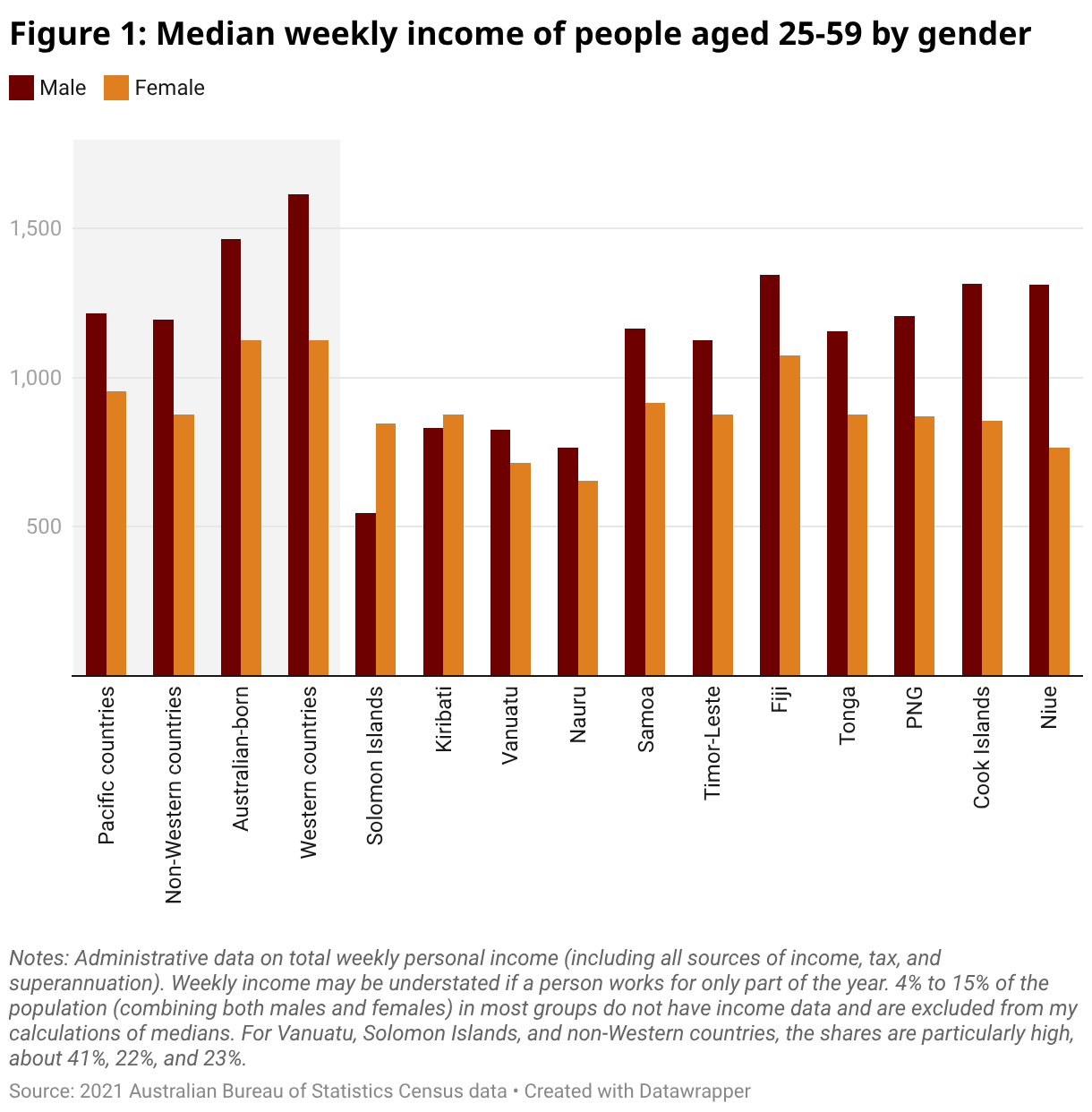
As shown in Figure 1, the median weekly income of male migrants from Pacific countries is 27% higher than that of female migrants. Although this is the smallest gender income gap among all population groups in Australia, it primarily reflects the substantially lower median income of Pacific males relative to Australian-born and male migrants from Western countries, combined with the moderately lower median income of Pacific females.
Income patterns vary across Pacific countries. In most cases, male migrants earn more than their female counterparts. The gender income gap is largest among migrants from Niue and the Cook Islands, where men have relatively high median incomes and women moderately lower incomes. Among migrants from Vanuatu and Nauru, gender differences are minimal, although both men and women earn comparatively less overall. Notably, migrants from Solomon Islands and Kiribati show a reversed income gap, with women earning more than men. However, this result should be interpreted with caution, as approximately 22% of migrants from the Solomon Islands lack administrative income data and are therefore excluded from the median income calculations, which may distort medians.
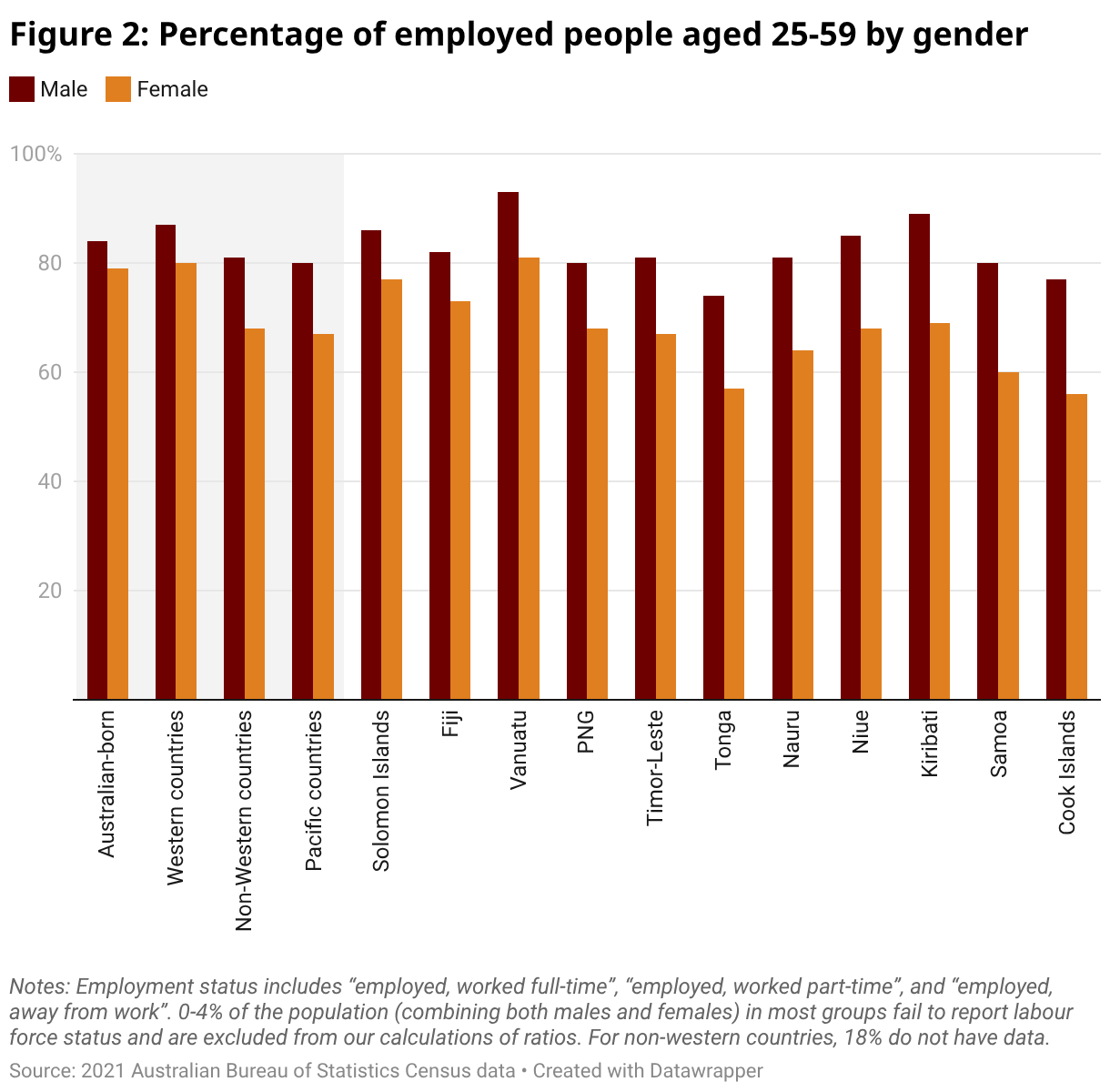
A major contributor to the gender income gap is the gender difference in labour force participation. Figure 2 shows that, across all population groups, the share of employed women is lower than that of employed men. Among Pacific migrants, this difference is 14%, which is larger than that for the Australian-born and Western migrant populations but similar to that observed among non-Western migrants.
Labour force participation gaps exist across migrants from all Pacific countries, though they remain modest, ranging from 8% to 17%. Importantly, women’s participation remains relatively high in Australia, with the lowest rate at 57%. The situation stands in stark contrast to that in many Pacific countries, where few women are in formal employment in their home countries and the majority work in the informal sector.
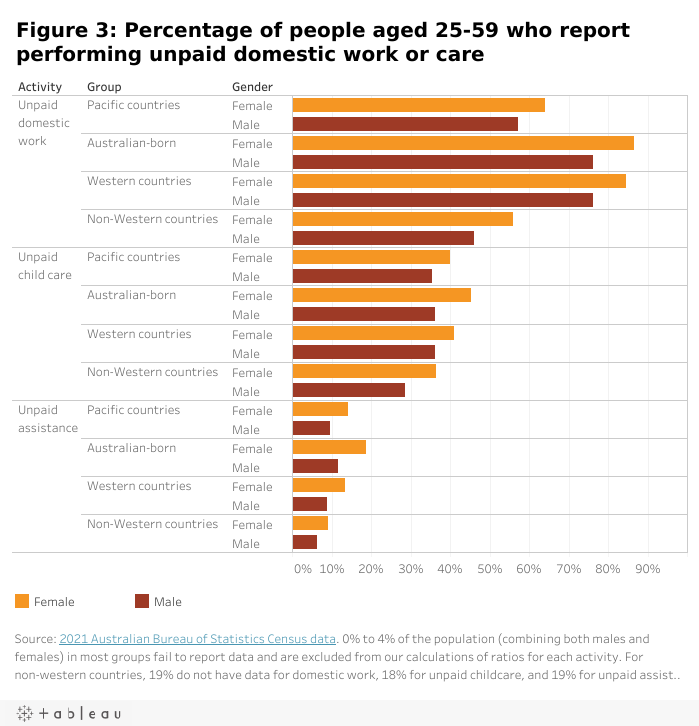
Household responsibilities often play a major role in shaping women’s employment outcomes. These include domestic chores, childcare and caring for elderly family members or those with health conditions. As shown in Figure 3, women are more involved in all these activities than men across all population groups. However, the gender gaps are relatively small and generally consistent, and the overall shares of Pacific men and women participating in household duties are comparable to those of other groups.
Time use tends to better describe the burden of domestic labour. Although both men and women contribute to domestic work, women typically spend substantially more time on it, limiting their ability to undertake paid employment. Census data indicate that in Australia, 29% of Pacific women spend 15 hours or more per week on domestic tasks, compared with only 11% of Pacific men. While this gender difference is large, it aligns with the patterns observed in other populations. Strikingly, the share of Pacific women reporting 15 or more hours per week of domestic work is the lowest among all groups.
Overall, gender gaps in employment outcomes do exist among Pacific communities in Australia, but they are considerably narrower than those in the Pacific region, owing mainly to the much-improved labour force participation of women. Income differences between men and women persist, not due to disparities in access to education — which have largely been addressed — but rather because women take on a greater share of household responsibilities. Even so, the level of domestic commitment among Pacific women is comparable to that of other populations in Australia. Living and working in Australia, therefore, seems to be associated with greater gender equity within the Pacific diaspora. Future research could further examine the casual relationship and the potential role of migration in shaping traditional Pacific gender norms.
Read part 1 and the Understanding Pacific communities in Australia blog series.