
On a recent Saturday morning in Dumbo, Brooklyn, the city was off to a quiet start. Neighbors sipped coffee and walked dogs while the brunch set nibbled croissants inside cafes with tasteful decor. On Washington Street, couples snapped selfies as the Manhattan Bridge elegantly photobombed each perfect shot.
Picture gentrification in your mind’s eye, and it’s likely to look like Dumbo: Luxury apartments, art galleries, restaurants and all manner of boutiques have turned abandoned buildings into desperately sought after real estate, transforming an enclave once defined by blue collar industry into Brooklyn’s fourth most expensive neighborhood. It’s no wonder Equinox Fitness, a $300 a month beacon for moneyed metropolitans, has staked a coveted second floor perch on Front street.
But just a stone’s throw north, at the corner of Adams and Water, is a very different type of gym: Gleason’s, the self-anointed “temple of boxing” and a gritty holdout in a rapidly changing New York.
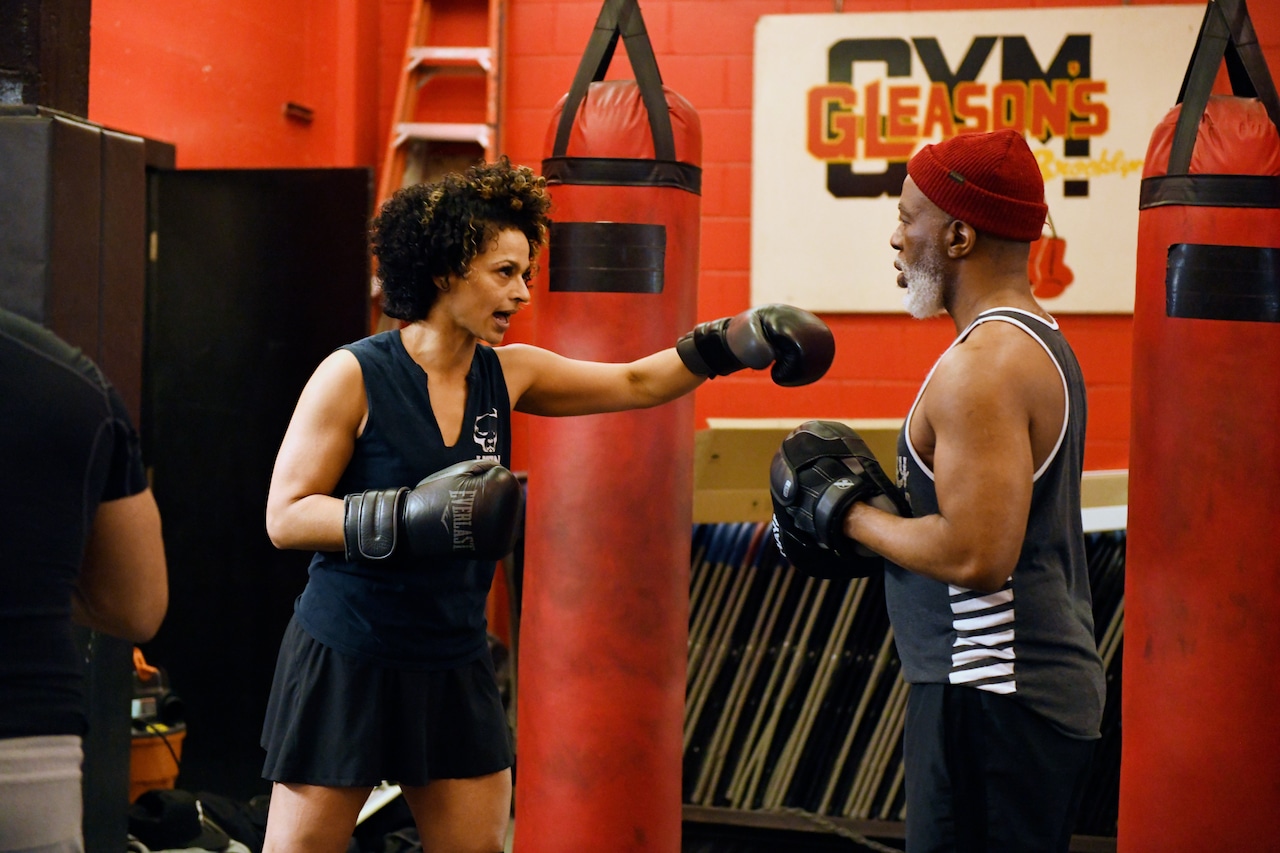
Anyone who walked through the front door of Gleason’s that quiet Saturday morning was met with a defiant symphony of waps, thwaps, pows and thwomps. Fighters shadowboxed, sparred and practiced combinations in a half dozen rings.
Men, women and children attacked heavy bags swinging from chains while others pummeled speed bags, rode air bikes and squeezed out hundreds of crunches as their trainers yelled a mixture of reprimands and encouragements.
In the middle of the chaos, as comfortable as any contender, Rae Binstock—the playwright behind Syracuse Stage’s upcoming world premiere “Relentless” opening February 4— held up her hands and discussed the finer points of pad work with actors Rebecca S’Manga Frank and Jeorge Bennett Watson.
“Let’s not get too academic about it,” Binstock told them as an electronic bell rang throughout the crowded space.
Director Melissa Crespo watched each tiny drama unfold and smiled. She brought her actors to Gleason’s to work on the scenes of training and sparring essential to Binstock’s play, which tells the story of an old-school boxing oasis entrenched in a neighborhood hellbent on change.
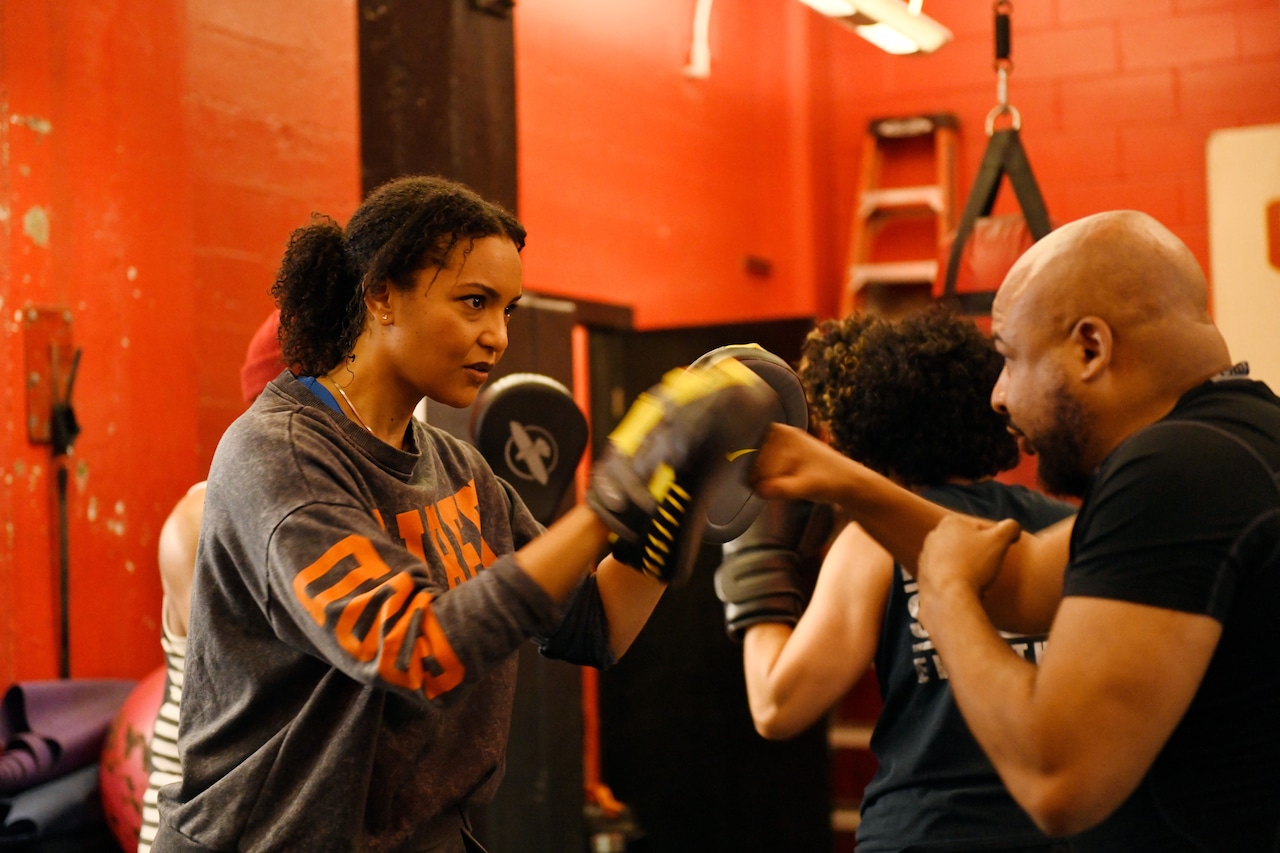 Rebecca S’manga Frank and Shatic Mitchell train at Gleason’s Gym in Brooklyn, N.Y. on January 10, 2026.Brenna Merritt
Across the gym, in a bustling corner, David Harrison Pralgo and Stephen Michael Spencer jumped rope in preparation for their work with fight choreographer Teniece Divya Johnson and boxing coach Shatic Mitchell while Sean Patrick Reilly and Caylie Filipa closely examined a contraption which, from a glance, looked equal parts punching bag and torture device.
Much of what happens at Bailey’s, the fictional gym at the heart of “Relentless,” was inspired by Binstock’s time working the front desk at Gleason’s, America’s oldest boxing gym, where she quickly fell in love with the sport and its colorful community.
Binstock has called “Relentless” a family drama, one where the family happens to be united not by blood but by their devotion to a singular pursuit. Conflict arises when retired boxer Monique, played by Frank, considers selling Bailey’s, the gym she co-owns with Johnny, her former trainer, played by Watson. Their competing interests—Monique knows the gym needs to modernize and expand in order to survive; Johnny is a stubborn purist with an “ain’t broke, don’t fix it” attitude—play out like an urban renewal debate in miniature: How much change can one place endure before it forgets itself completely and becomes something entirely new?
Anyone wondering if the real Gleason’s has staying power need only look out the window onto Water Street: a sign proudly announces the thoroughfare as “Gleason’s Gym Way,” an honor bestowed by the city of New York in 2024. It’s still a marquee name in the world of boxing, an institution that has trained countless champions like Mike Tyson, George Foreman, Muhammad Ali, even the actress Hilary Swank.
Originally opened in 1937 in the Bronx, Gleason’s moved to Manhattan before landing in Brooklyn in 1985. Its continued success can partly be traced to its unstuffy and democratic approach to training: Gleason’s was among the first gyms to allow “white collar” boxers (those with no aspiration to fight in a match) and women to work alongside their amateurs and pros.
“It’s a place like no other,” Crespo said. “I think of it kind of like a library, where everyone is welcome.”
Gleason’s openness and acceptance is what sets it apart, according to Binstock, who describes the gym as one of the last “truly New York places, a waystation where people of every age, gender, color and background cross paths without a moment of hesitation.”
That was on display as the cast moved their rehearsal into the ring, marking punches and stopping to discuss each moment, while all around them boxers trained for their own upcoming matches—if there was any real difference between actors and fighters, no one seemed to notice. For Crespo, that was the true value of the team’s time at Gleason’s.
“I want them to understand what it means to be here all day,” she said. “The culture, the people, the sounds. That’s what we’re trying to capture on stage.”
After running through their choreography, the cast, tired but energized by the work, layered on their winter gear and headed back outside. It was raining, but the streets were alive with the weekend dinner crowd. Binstock hung behind, helping the staff—her former coworkers—set up folding chairs in front of a ring. A sandwich board screamed “Boxing in Brooklyn” in all capital letters, and displayed the card, 15 fights deep. It was Saturday night at Gleason’s. Business as usual.
Show details
What: “Relentless” by Rae Binstock
Where: Syracuse Stage, 820 E. Genesee St., Syracuse
When: February 4-22, 2026. Tickets at SyracuseStage.org/Relentless.