
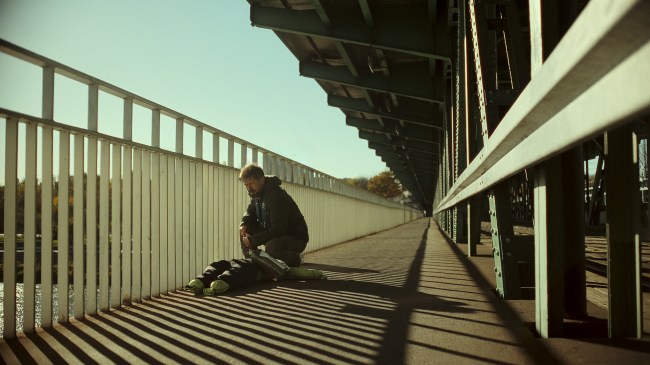
During the introduction of the second Sundance screening of his new film “Closure,” director Michał Marczak, in reaction to an audience question at the film’s premiere, wanted to make sure the audience understood the film they were about to watch was a documentary. “None of the scenes were staged.”
It’s a clarification that turned out to be necessary, as the woman exiting the theater in front of me said to her friend, “Thank God he said something, I would’ve sworn that opening was the start of a fiction film.”
This is, in part, by design. Marczak likes to quote his cinematic hero, and fellow Pole, the late Krzysztof Kieślowski, “fiction films should look like documentaries, and documentaries should look like fiction films.”
“Closure,” the story of a father’s search for his missing son, is a more straightforward documentary subject and shoot than Marczak’s previous film, “All These Sleepless Nights,” which premiered at Sundance in 2016. That documentary, which weaved through Warsaw nightlife like an early Paul Thomas Anderson film, pointed to a filmmaking talent poised for a future in scripted narrative, as Marczak’s cinema was more electric than 99.9 percent of indie films. And the Polish director and his wife, producer Karolina Marczak, were, in fact, on the road to making a narrative feature, having written a script set on the Vistula River, which they were rafting down on a research trip, when they met Daniel.
“One night, we were trying to dock to one of the islands. Our flashlights went out, and it got a little bit dangerous,” said Marczak. “The banks were really high, and a man, Daniel, appeared from out of nowhere with this flashlight and guided us to safety.”
Their savior, a late-40s man travelling alone, welcomed them to join him at his campfire. It was there that he shared the story of why he was on the river: Daniel had been searching for the body of his missing teenage son, Krzysztof, who investigators had reason to believe likely committed suicide by jumping off a bridge into the river.
In the morning, Marczak helped their new friend with his equipment. The image of Daniel standing in a small boat on the enormous river, scouring below its surface with a camera at the end of a pole, stuck with the filmmaker. When the Marczaks returned home, the plan was to finish the next draft of their script, but “I just couldn’t concentrate because I had him in the back of my mind, and we ended up putting off the fiction film to make this doc,” said Marczak.
That image of Daniel in the boat would be Marczak’s starting point for a month-long process of testing and prep, to find the language of “Closure.” Nature would’ve played a very different role in Marczak’s planned scripted film — filled with sun, swimming, and the joy of nature.
“Daniel was fighting the river with all his power,” explained Marczak. “So how do I make the river the antagonist in the movie?”
The director, who would also serve as a one-man film crew, decided to shoot with wide lenses from inside his subject’s boat (rather than another vessel) to create a sense of being with Daniel, placing us inside his struggle. He also wanted to avoid being handheld, which would add a “frenetic nervousness,” when Marczak was convinced the film should mirror Daniel’s “meditative, repetitive search.”
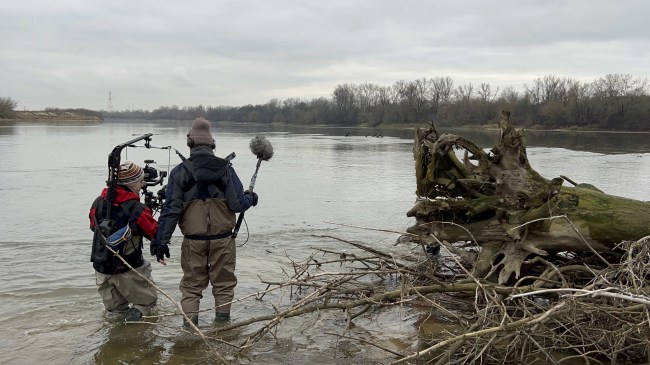 Behind the scenes of shooting ‘Closure’courtesy of filmmaker
The base of the “Closure” camera and sound rig was a Sony A7 III (the updated version of the small, relatively inexpensive camera employed on “All These Sleepless Nights”) and an Easyrig. The setup also included a custom prime lens made at Panavision in Poland and a modified DJI LiDAR for focus pulls, all designed so Marczak could shoot by himself for eight hours straight — and while getting good sound, and with all his equipment either on his person or in his backpack.
“It’s all off-the-shelf [gear], but the magic is in the details and how you combine it,” said Marczak. “We just pushed to the maximum of what that camera can do. We spent an insane amount of time [including during pre-production] in color grades to clean up the image, de-noise it, add more definition, more color, and grain to it.”
Before shooting every day, Marczak would listen to William Basinski’s “The Disintegration Loops” and music from Oscar winning composer Hildur Guðnadóttir’s early collaboration with Die Angel (tracks the “Closure” team was later able to license for the film), which the director said “gives me rhythm and helps me in the operating [the camera] to set my mood and tone.” Marczak has trouble pinpointing it, but that music was intrinsically linked to how he envisioned Daniel’s compositions framed against nature. The combination of music and image spoke to how he understood both his internal and external struggles in the context of his film.
Marczak knew he needed to counter the very close perspective of Daniel with wider shots that provided context for the vast river and the surrounding nature. He wanted, though, to avoid b-roll, and he actively disliked the way drones were used in non-fiction filmmaking.
“I really don’t like drones, so I had to come up with a way to explain it to myself so it could work,” said Marczak. “The idea was that the drone would always be a continuation of the action; it would be part of my sequence.”
In other words, the drone footage of Daniel searching could match cut with what was being filmed on the boat and in the river, rather than moving outside the unfolding of dramatic events to establish the world and tone, which was exactly what Marczak hated.
To accomplish this, Marczak’s wife and producer Karolina tracked him on GPS, driving alongside the river with a drone pilot in her car. When the opportunity arose, the director would call in the drone, quickly take control, and shoot footage of the scene from above. Then, once done, quickly fly the drone back to the operator and quickly switch back to his Easyrig setup. Rather than waste time getting out of the water and the frame, Marczak decided he’d “paint himself out of shots” with visual effects in post production.
That’s not to say Marczak’s presence is not felt in the movie, as his deeply personal interactions with Daniel come at key moments in the second half of the film. For the filmmaker, the choice to include those interactions was what felt “the most genuine to the process of how the film was made.” It would often just be the two of them on the river, with Marczak helping Daniel with the search when he was not filming.
“We would sleep on these islands, we got genuinely close, we have become friends, we’ve helped each other, and there was a strong connection right from the beginning,” said Marczak. “Daniel gave me [a new father] a lot of life advice, and we had a lot of sincere conversations, so at a certain moment I thought, while filming, ‘You know, maybe I’ll use this.’ And I started to mic myself.”
Marczak knows his voice off-screen works against his attempt to make his film feel like a fiction film toward the end, and he acknowledged he could easily have cut it out without missing a narrative beat.
“At the end of the day, it is a documentary, I want to make it as cinematic as possible, but then there’s certain things in documentary that I love, as well, that you don’t have in fiction. It’s beautiful, I think, to utilize the tools of everything that cinema has to offer, both fiction and documentary.”
“Closure” premiered at the 2026 Sundance Film Festival. It is currently seeking U.S. distribution.