
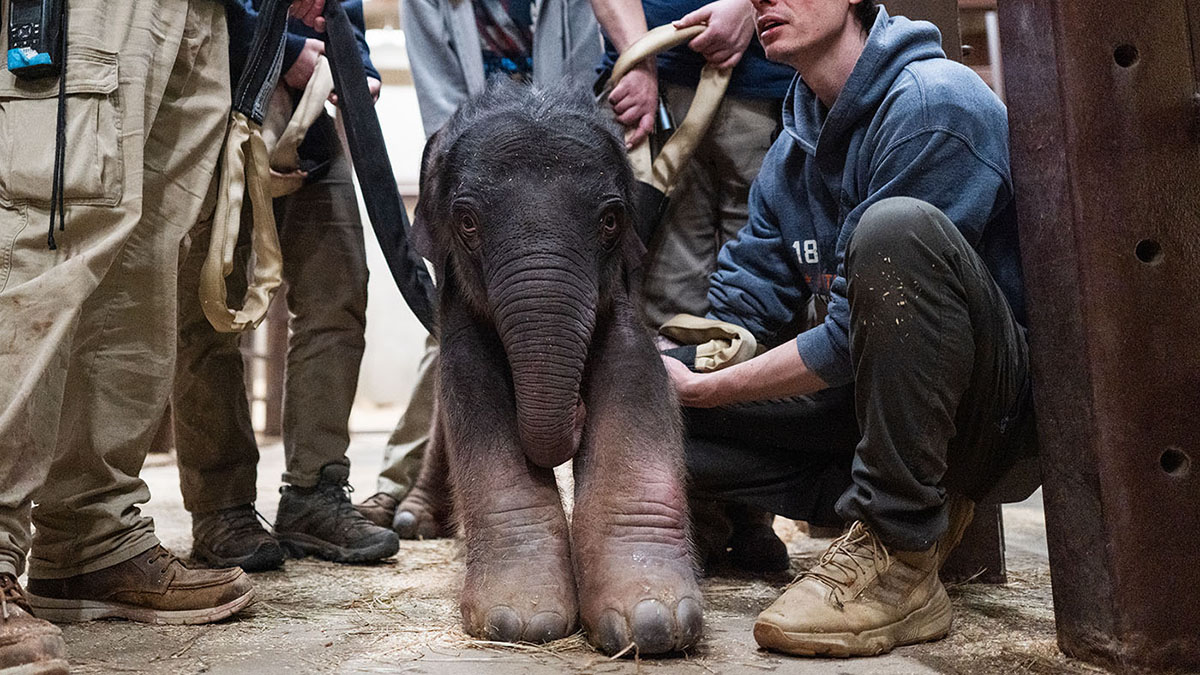
An eagerly awaited Asian elephant calf has made her grand arrival at the Smithsonian’s National Zoo.
The baby was born Feb. 2 at 1:15 a.m. after a 21-month gestation to parents Nhi Linh and Spike, the zoo announced.
The calf appears healthy, alert and bright-eyed, tipping the scales at 308 pounds and measuring 38.5 inches tall, zoo vets said. They also listened to her heart and lungs, examined her eyes and ears, tested the range of motion in her limbs and took a blood sample.
Roshan Patel/SmithsonianRoshan Patel/Smithsonian
Smithsonian animal care and veterinary staff with the Asian elephant calf that was born to female Asian elephant Nhi Linh on Feb. 2, 2026 at the Smithsonian’s National Zoo. The Zoo’s Asian elephant Spike is the father of this calf. (Photo: Roshan Patel/Smithsonian)
Although Asian elephants have long resided at the National Zoo, this elephant calf is the first to be born there in nearly a quarter-century.
“After waiting nearly 25 years for an Asian elephant calf, this birth fills us with profound joy,” said zoo director Brandie Smith.

In this photo: Staff are looking at the ultrasound of elephant mom-to-be Nhi Linh.
Elephant calf born after 21-month pregnancy
Asian elephants are an endangered species.
Nhi Linh (pronounced “nee lin”) and Spike bred in April 2024 following a breeding recommendation from the Association of Zoos and Aquariums’ Species Survival Plan, zoo officials said. Asian elephant pregnancies typically last 18 to 22 months.
The zoo announced Nhi Linh’s pregnancy back in November.
This calf is the first offspring for the 12-year-old mother, the zoo said. Although 44-year-old Spike has fathered three calves at other zoos, none survived.
“Because Nhi Linh and Spike’s genes are not well represented in zoos, their calf will help strengthen the genetic diversity of the Asian elephant population in North America and around the world,” zoo officials said in a news release.
When will the baby elephant go on display at the National Zoo?
Not quite yet.
She’ll need up to a month off-exhibit bonding with her mother, their herd members and zoo keepers behind the scenes.
“Asian elephants are an intelligent, sensitive and social species, so building these bonds is critical to the calf’s development,” the zoo said.
Dates for her public debut will be announced in the future. Once she does go on display, she’ll also be viewable on the zoo’s Elephant Cam.
“When you see the calf and those heartwarming interactions with the herd, I hope you’ll be inspired to help save this endangered species. What we learn from our elephants in D.C. directly strengthens our work to protect wild Asian elephants across Southeast Asia,” Smith said. “I’m incredibly proud of our team, whose expertise made this moment possible for Nhi Linh and for all of us.”

Smithsonian animal care and veterinary staff with the Asian elephant calf that was born to female Asian elephant Nhi Linh on Feb. 2, 2026 at the Smithsonian’s National Zoo. The Zoo’s Asian elephant Spike is the father of this calf. (Photo: Roshan Patel/Smithsonian)
Zoo visitors will still be able to see the other herd members and meet a keeper daily at 3 p.m.
However, the Elephant Community Center will be closed intermittently to provide quiet for the new mother and her calf. Staff members hope to give them access to the other indoor and outdoor habitats as soon as possible, but outdoor access will be dependent on the weather, the zoo said.
Baby elephant’s name to be selected by public vote
Members of the public will be able to vote on the new baby’s name while raising donations for elephant care and conservation.
Elephant fans will be able to vote for their favorite name by making a donation of $5 or more on the zoo’s website, with $1 representing one vote. The zoo said all funds raised will go to Asian elephant care and conservation.
The polls are open through Friday, Feb. 13 at noon. The zoo will announce the winner on its website.
People can choose from four options nominated by the zoo’s elephant care team:
Linh Mai [LIN-my]: “spirit blossom.” Linh means spirit or soul, and Mai refers to the apricot blossom, a flower associated with Tết (Lunar New Year), which begins Feb. 17.
Thảo Nhi [TOW-nee]: “gentle and beloved.” Thảo means gentle or kind and is associated with nature, and Nhi means small, little one or beloved.
Tú Anh [TOO-ahng]: Tú means talented or gifted; Anh means bright and intelligent.
Tuyết [TWET]: Traditionally means “snow,” referencing the calf’s winter birth.
The choices were inspired by Nhi Linh’s name, which is of Vietnamese origin, the zoo said.