
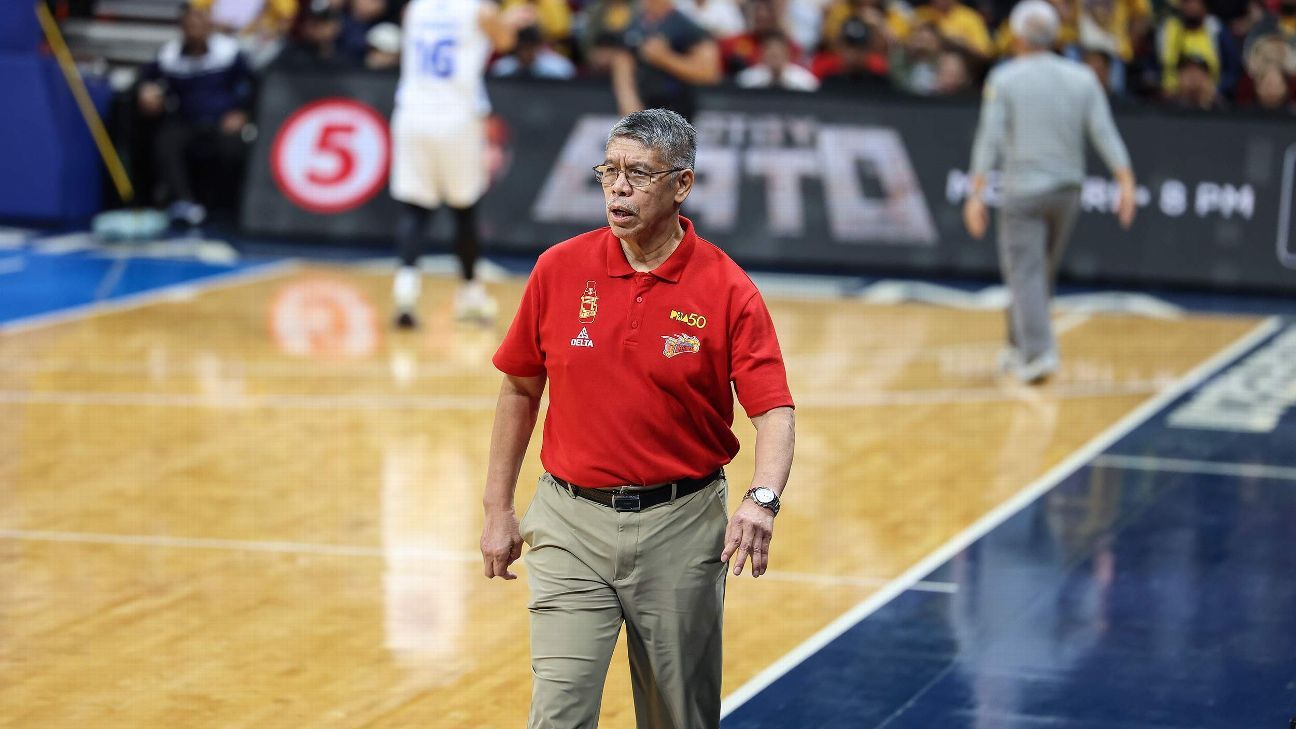
Only two head coaches in PBA history can claim to have won ten or more championships with a single franchise.
The obvious name is Tim Cone, whose 13 titles defined an era at Alaska.
The other is Leo Austria — the steady hand behind San Miguel’s modern dynasty, stacking an 11-championship résumé with the Beermen.
Editor’s Picks
2 Related
However, Austria’s excellence has never been built on simply having the most talented roster. It has been forged through his ability to extract the best from every piece at his disposal by empowering stars, elevating role players, and now turning depth into a competitive advantage.
For the San Miguel franchise, then operating as the Petron Blaze Boosters, the early to mid-2010s were defined by instability.
A revolving door of coaches came and went, from Olsen Racela to Biboy Ravanes to Gee Abanilla, even extending to foreign consultants Rajko Toroman and Todd Purves, as the team searched for answers.
That turbulence reached its breaking point in 2013, when import Renaldo Balkman was involved in a highly publicized altercation with teammate Arwind Santos — an incident that culminated in a five-year ban and symbolized a squad that had lost its footing.
In response, San Miguel made yet another change, this time hoping not just to reset, but to redefine itself. In 2014, the Beermen handed the reins to Austria — a decision that would alter the franchise’s trajectory.
Fresh from his stint as head coach of San Miguel in the now-defunct ASEAN Basketball League, Austria was elevated to the top post as the team reclaimed the San Miguel Beermen name. His first task was not simply to win, but to restore order, identity and belief to a franchise in desperate need of direction.
The talent was always there, but the real challenge lay in managing egos and defining roles. But what Austria was able to identify and fully tap in when he took over the helm was to make the direction of their offense clear: everything would orbit around June Mar Fajardo.
Coming into his third year in the league, Fajardo was already looking ripe to be given the reins, which Austria established that he will be the alpha of San Miguel for the foreseeable future.
Throughout his years of success, Leo Austria has never been afraid to evolve his game plan — one that ultimately largely revolves around getting the best out of cornerstone June Mar Fajardo. PBA Media Bureau
And rather than forcing touches or juggling hierarchies, Austria built a lineup that accentuated Fajardo’s strengths and simplified everyone else’s responsibilities.
That blueprint eventually took shape in what became San Miguel’s “Death Five” of Alex Cabagnot, Chris Ross, Marcio Lassiter, Arwind Santos, and Fajardo — a group that blended skill, toughness, and cohesion at an elite level.
In the backcourt, he utilized Cabagnot’s playmaking and late-clock composure, Ross’ defensive pressure and pace-setting duties. Lassiter also spaced the floor as one of the league’s most reliable shooters to provide enough spacing, while Santos became the perfect connector — a switchable defender who could stretch the floor and slash when needed.
At the center of it all was Fajardo, whose size, touch, and passing punished single coverage and collapsed defenses — complementing and supplementing all those aforementioned skill sets.
This led to an early breakthrough for Austria and San Miguel, as the first conference under his guidance resulted in an instant Philippine Cup championship in 2014.
But as the team developed chemistry with Austria, every possession had a purpose, and every player understood where his value came from.
Offensively, San Miguel leaned on high-post actions and inside-out basketball, allowing Fajardo to dictate the game without monopolizing it. Defensively, the lineup was versatile enough to switch, recover, and control the glass, turning stops into efficient half-court execution.
Factoring in the right pick of imports to fit Fajardo’s inside domination through Arizona Reid, Charles Rhodes and Chris McCollough, they were able to play an efficient inside and outside game.
Overall, the run would persist to five straight Philippine Cup titles from 2014 to 2019 and a total of eight championships with the Beermen’s “Death Five” core — including a historic “Beeracle” against the Alaska Aces in the 2016 Philippine Cup of climbing back from a 0-3 deficit in the finals.
Leo Austria’s single-franchise haul of 11 championships with San Miguel Beermen places him only behind Tim Cone’s 13 with the now-defunct Alaska Aces. PBA Media Bureau
When that group eventually aged and the league began to catch up, Austria did not abandon the formula — he updated it.
The next evolution came with the arrival of CJ Perez, with his rim pressure becoming a modern counter to teams loading up on Fajardo, restoring balance to San Miguel’s offense. With the remnants of the past batch of San Miguel players — they would add one more title in the 2022-23 Philippine Cup.
But Austria’s second tour of duty further emphasized role definition through the integration of former Adamson Soaring Falcons that he handled before.
Jericho Cruz supplied nonstop energy and physicality, turning tempo swings into an advantage. Don Trollano added three-level scoring, punishing defenses that overcommitted inside or lost track of shooters on kick-outs. Rodney Brondial did the dirty work — extending possessions with offensive rebounds and absorbing physical matchups that freed Fajardo to operate with space and rhythm.
Behind the same principles that defined his first run, Austria steered the Beermen to back-to-back Philippine Cup championships in Seasons 49 and 50.
In the end, Leo Austria’s legacy with San Miguel is not defined by eras or personnel, but by clarity and control.
From one core to the next, the constant has always been structure — an offense anchored on Fajardo and surrounded by pieces designed to complement, not compete with, his dominance.
What separates Austria is not just how often San Miguel has won, but how consistently it has evolved without losing its identity. That kind of sustained excellence doesn’t happen by accident.
It’s the product of vision, adaptability, and firm coaching conviction.
At this point, the body of work speaks for itself. It’s finally time to put proper respect on Leo Austria’s ability as one of the PBA’s elite coaches