
The Guardian is bringing in compulsory registration for its heaviest Australian users as it seeks to grow engagement and revenue.
The Guardian’s chief supporter revenue officer Liz Wynn told Mumbrella the decision to make some users register and log in to use the free news site has been carefully considered, with the impact to advertising balanced against the benefit of direct reader connection.
”We’ve been trialing it across a few territories. So we started in Ireland. We then did some experimentation in New Zealand. We did a trial here in Australia, and actually this week we’ve introduced it across our whole audience in Australia,” she said.
The new rule applies to the top 0.5% of users, who are prompted to log in or register “three or four times” before a strict requirement to register kicks in. Unregistered readers cannot continue reading.
ADVERTISEMENT
“ We’ve seen an order of magnitude increase in registrations and sign in,” Wynn said.
”In a world where the media landscape is evolving so much, and platforms are changing and search is no longer a certainty – I mean it never was – we really want to have a direct connection with our most loyal readers.”
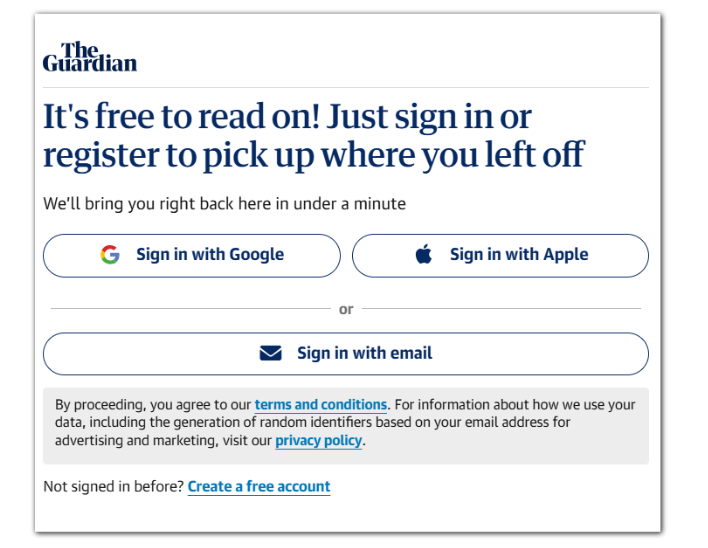
The Guardian’s heavy-user intercept
“We know that, [if] we’ve got somebody registered that’s a strong sort of lever for us to be able to continue to engage them, drive regularity of reading, and drive emotional engagement that [makes them] want to support us in the long run.”
She said the move “makes obvious business sense” and had been “a very natural step.”
Wynn is responsible for around two thirds of all revenue at Guardian Media Group – reader contributors and subscriptions – which includes the group’s global publications in Australia, US, Canada, and Europe as well as the UK home market.
The group’s records for the last financial year (2024/25) clearly show digital reader revenue (up 22% year-on-year) fuelling overall growth (up 7% for the year), with print revenue and advertising more or less flat.
The Guardian’s operations run at a loss (last year around A$45m) which is made good by earnings from the gargantuan Scott Trust, a A$2.4 billion pot of money set up in 1936 by the then-owner of the Manchester Guardian, John Scott. The stated aim of the trust is “to secure the financial and editorial independence of The Guardian in perpetuity”.
While Wynn is upbeat about the impact of compulsory login, she answers a question about increased roll-out cautiously.
”We are not setting a path or sort of a goal around ramping that up. Particularly, what we’re using is an algorithm that carefully balances page views and advertising revenue against the friction of having the registration prompt.
“That’s in good balance for us at the moment. We’re getting very little disturbance to the page views and great upside.”
Wynn, who moved to the Guardian from the UK’s Sky TV in 2023, said the discovery that some readers wanted to contribute without receiving anything in return was a revelation.
“Discovering this huge motivation amongst our readers to want to support us and to sustain our journalism through the contribution model was a real unlock moment for us.”
Hal Crawford’s full conversation with The Guardian’s Liz Wynn will be published in coming days on the Mumbrellacast.