
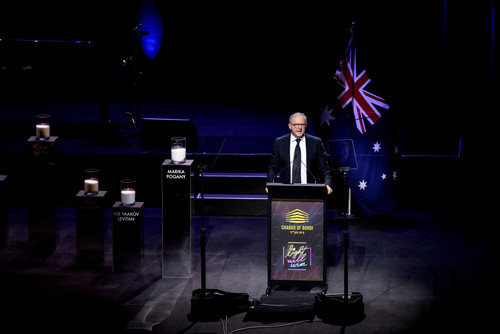
Australia’s media union says the government is attempting to stifle public debate and reduce press freedom with the passage of new legislation on January 20 aimed at combatting antisemitism, hate speech and extremism in the country. The International Federation of Journalists, with its affiliate the Media, Entertainment and Arts Alliance (MEAA) condemn the passage of any bill that prohibits vital press freedoms.
The new legislation comes in the wake of the Bondi terror attack, which resulted in the deaths of 15 people and critically injured another 49 on December 14, 2025. On January 12, Prime Minister Anthony Albanese recalled Australia’s parliament to discuss new national security legislation with an Exposure Draft of the proposed Combatting Antisemitism, Hate and Extremism Bill 2026 released on January 13. The bill originally included strict gun control reforms and new laws on hate crimes, migration and racial vilification, but some of the latter elements were subsequently dropped due to concerns of unjust ramifications. By January 20, the Combatting Antisemitism, Hate and Extremism Bill 2026 was formally passed, with the support of the country’s conservative Liberal Party. The bill was voted against by the Nationals, Greens and One Nation parties.
The new bill criminalises public acts that promote or incite racial hatred to cause a reasonable person to feel intimidated, harassed or fear violence. It also tightens legal defence frameworks where religious texts are quoted for the purpose of religious teaching or discussion, including speech and writing. The legislation applies to speech, symbols, gestures and online communication seen as promoting racial hatred, particularly antisemitism. Under the new bill, hate speech will now be criminalised without mandatory proof of threat of violence or damage. Individuals prosecuted face a mandatory 12-month imprisonment sentence with a maximum of five years for aggravated offences including the involvement of religious officials or attempts to radicalise youth.
In rejecting the bill, the Greens Party noted it would suppress legitimate social criticism and commentary on nations committing human rights abuses. The New South Wales Council for Civil Liberties (NSWCCL) said its vague definitions could lead to unfair criminalisation, while the Australian Federation of Islamic Councils criticised the bill’s rushed passage and selective consultation. The Australian Human Rights Commission said the bill threatens the democratic right to assembly, while its mandatory sentencing undermined judicial independence.
The new legislation follows a series of crackdowns and restrictions to assembly in the country with greater police powers enacted after the December 14 mass shooting. The attack took place during a Jewish event to celebrate the beginning of Hanukkah.
MEAA said in its statement: “Stifling public conversation, reducing press freedom, and dampening creative expression is not a path to either healing or justice. Speech prohibition laws should not be expanded; they should be confined. Journalists, artists, and creative workers need to be supported in telling stories and giving commentary without fear or favour.”
The IFJ said:“The government’s passage of a bill with vague terminology and heightened prosecution powers is gravely concerning and will, with certainty, impact the important work of journalism.”