
By Jack O’Shea-Ayres
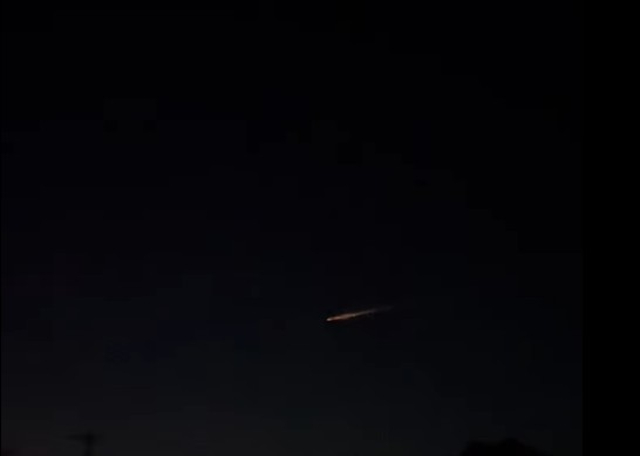
Moorabool’s residents beared witness to a bright, large object making its way through the skies in the early hours of 3 February.
About 5.27am Tuesday, a slow-moving sprite of sparks illuminated the sky for locals in Western Victoria, which was captured by Ballan resident Stevan Lukic who saw it on his morning commute to work and posted a video of the event to Facebook.
“I was driving on my way to Ballan station to take the early train into work when I saw it. At first, I thought it was an aeroplane bursting into flames,” he said.
“Then I thought it was a meteor breaking apart in the atmosphere. I think in total it was visible in the sky for a good 45 seconds, it moved pretty slowly.”
The object was visible across many parts of Victoria, viewable from Ballan right across to Torquay, with many quick to think it was a comet or meteor, but Monash University associate professor Michael Brown identified the object as space junk.
“This object was definitely space junk,” Professor Brown said.
“Basically space junk usually travels horizontally across the sky and takes 10 of seconds to break and burn up. By contrast, meteors typically come into the atmosphere at steeper angles and burn up in seconds, while fainter comets are so distant their motion is imperceptible.”
Professor Brown confirmed the space junk belongs to SpaceX chief executive Elon Musk.
“This space junk has been identified as Starlink-5103, which is one of thousands of internet satellites that have been launched in recent years by Elon Musk’s Space X,” he said.
The Starlink satellites provide internet access to the population and typically remain in orbit for several years.
However Professor Brown said the occurrence was no rare phenomenon.
“The number of satellites re-entering has increased in recent years, with over 1000 re-entries globally last year, with several visible over Victoria,” he said.
He confirmed the re-entering satellites pose little danger to properties on the ground.
“Satellites largely burn up in the atmosphere upon reentry, with relatively little debris making it to the ground and damage to property being exceptionally rare,” professor Brown said.