
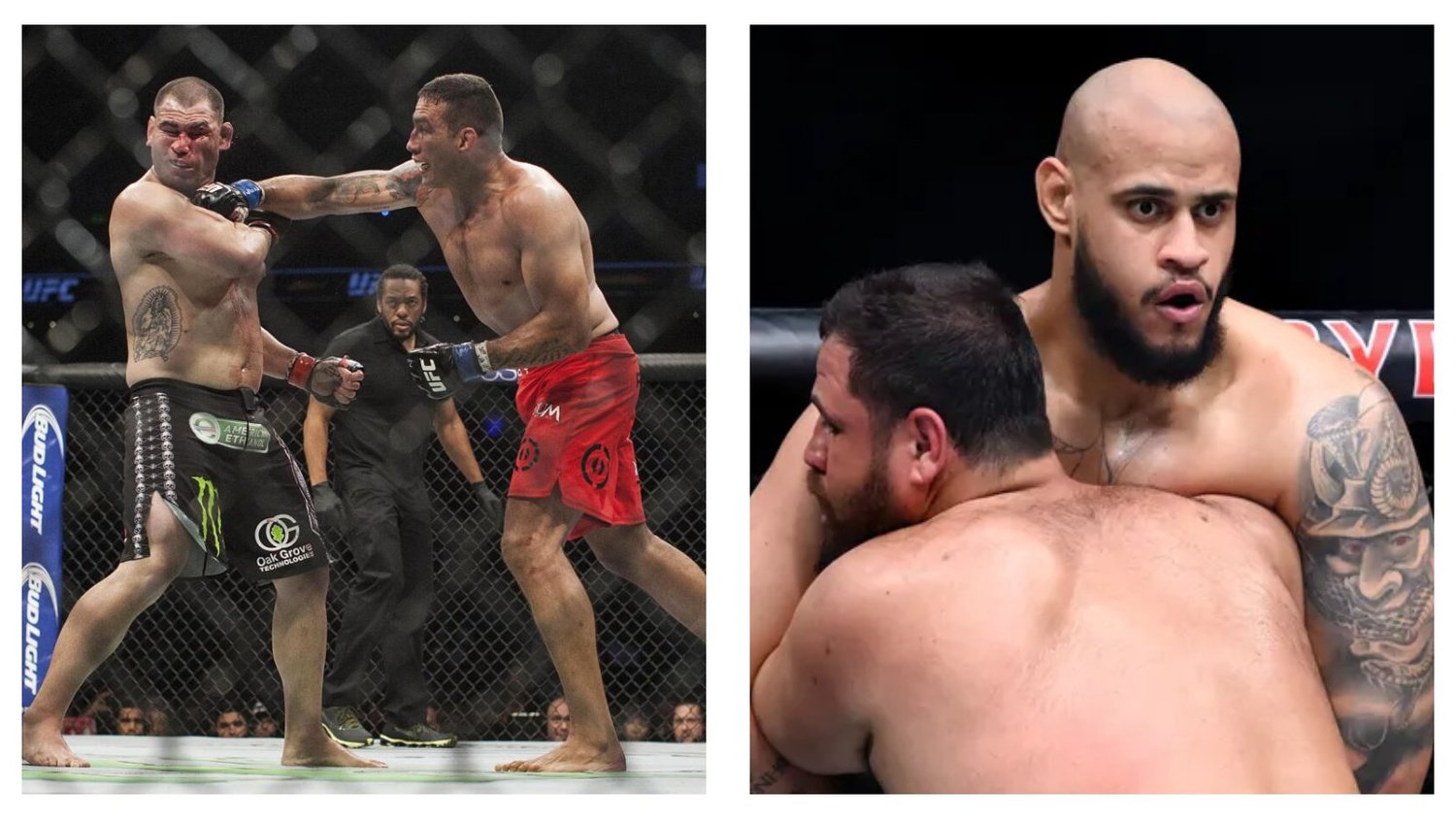
A two-speed division
But below them, the drop-off is stark. Relying on size, toughness and the ever-present possibility of a KO, they lack the athletic base or technical depth to sustain five-round fights.
This gap has created a two-speed division, with the elites operating on modern MMA sensibilities, and the rest still fighting in the dark ages of 90’s no holds barred competitions.
To understand why this is the case, it helps to visualise the global population as an enormous pie chart, with naturally large, athletic men taking up a very small sliver of this.
It’s all about talent pools
When you further specify the number of men who match this criteria and also want to be punched in the head for a living, the number becomes smaller and smaller.
It comes down to talent pools, and the number of large men who are willing to put their bodies through MMA training isn’t a particularly large one.
And who could blame them, when they could potentially earn millions more competing in a different sport?
MMA: the poor man’s sport
It’s well established now that MMA is the poor man’s game compared to boxing, American football and the NBA, where the money attracts the true genetic freaks of the athletic population.
Not only this, but MMA at the highest level requires a familiarity with pain and violence in a way that very few people are wired for.
What we’re left with are undisciplined and flabby middleweights that are comfortable fighting a few weight classes higher if it means they don’t have to eat clean while outside camp.
Whilst this may seem harsh, we’re not too far removed from an era when the heavyweight division was stacked with killers, not just confined to outliers at the top.
The division that once was
Less recent fans will remember legends like Cain Velasquez, Junior Dos Santos, Fabricio Werdum, Andrei Arlovski, Stipe Miocic and Alistair Overeem. While they weren’t always the most well-rounded fighters, they brought years of high-level experience in other combat sports.
Even Brock Lesnar, for all his limitations, made the division a spectacle and brought a crossover appeal that none of his contemporaries could match.
Before this, the Japanese promotion Pride, which dominated the scene in the 00’s, set its own benchmark that still lingers to this day, with names like Mirko Cro Cop, the Noguira brothers and Fedor Emelianenko. These are the pioneers who raised the bar for everyone.
YOU MAY ALSO LIKE: MMA analysis: Has the UFC done enough to cultivate a new generation of stars?