
 A puck sits on the Olympic rings logo during a women’s hockey practice session prior to the Sochi 2014 Winter Olympics. (Bruce Bennett/Getty Images)
Tonight marks an interesting milestone in the NHL season — in the sense that, there’s not going be an NHL season, at least not for a period of 20 days while many of the best players in the world are off playing in the Milano Cortina Winter Olympics. After tonight, February 5, the league won’t pick up again until February 25.
How long is that layoff in the context of hockey history? Well, it’s not the longest mid-season break ever: That distinction belonged to the 143-day-long pause in NHL play between March 11, 2020 — one of the most fateful days in sports history, when the Covid-19 pandemic effectively shut down all leagues at once — and August 1, 2020, when the NHL returned to play in the “bubble” environment of the playoffs. A mere 20-day break, pre-planned well ahead of time, is positively short by comparison with that.
But 20 days is, however, the longest mid-season pause outside of the Covid pandemic, surpassing the 18-day break built into the 1997-98 schedule for the Nagano Olympics in Japan — the first-ever Olympics to feature NHL players:
With the exceptions of last year’s 13-day pause for the 4 Nations Face-Off (itself an Olympics-like tournament) and the 1992 players’ strike on the eve of the playoffs (which stopped play for 12 days), every other mid-season break of longer than 8 days was due to players participating in the Olympics.
And what does a long break tend to do to the season when the players return from their national teams and pick things up again?
In terms of overall leaguewide scoring levels, things remain very predictable from before the break to the rest of the regular season. In the five pre-2026 Olympic seasons above, the average goals per-team, per-game was 2.79 before the break and 2.78 after, with a 0.97 correlation between before-and-after GPG within seasons.
As a comparison point, I took all non-Olympic, 82-game seasons since ‘97-98 and split them at Game No. 59 of the season for each team — the average Olympic break happens when teams have played 58.6 games — to see how leaguewide scoring behaves before/after that point in a normal season. And in that sample, goals per-team, per-game were 2.84 before the split and 2.84 after, with a 0.91 correlation within seasons.
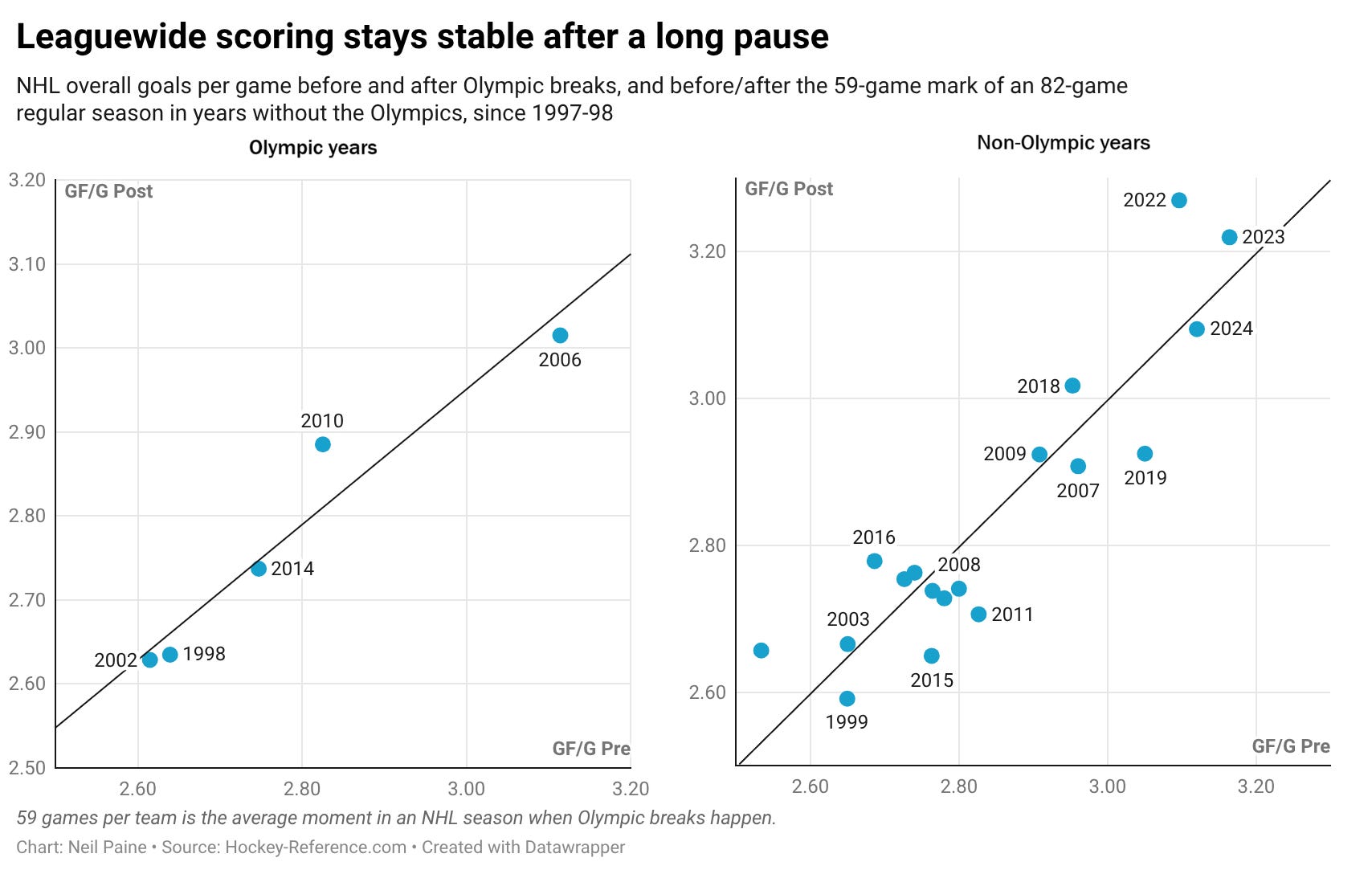
So it doesn’t appear that an Olympic-sized gap in the middle of the schedule really changes how the hockey is played on the other side, in either direction. Scoring remains basically the same as it ever was — and in fact, it appears to even be slightly more stable and predictable from earlier in the season on the other side of an Olympic break than it is at an equivalent point in a normal season without a pause.
There is another factor I wanted to consider, though: Does team performance become less predictable on the other side of an Olympic break?
In that regard, the long layoff may actually have a meaningful effect. To test this, I again looked at pre-2026 seasons with Olympic breaks, plotting the relationship between a team’s Elo rating at the break and its goals-per-game differential over the rest of the regular season, once the break was over. In our sample, the correlation there was 0.49, which is an OK but hardly airtight relationship.
And how about our control group — non-Olympic seasons since ‘97-98, split at the 59-game mark per team? In that sample, the correlation between Elo through 59 games and rest-of-season goal differential was 0.60, which is somewhat higher — indicating a stronger relationship:
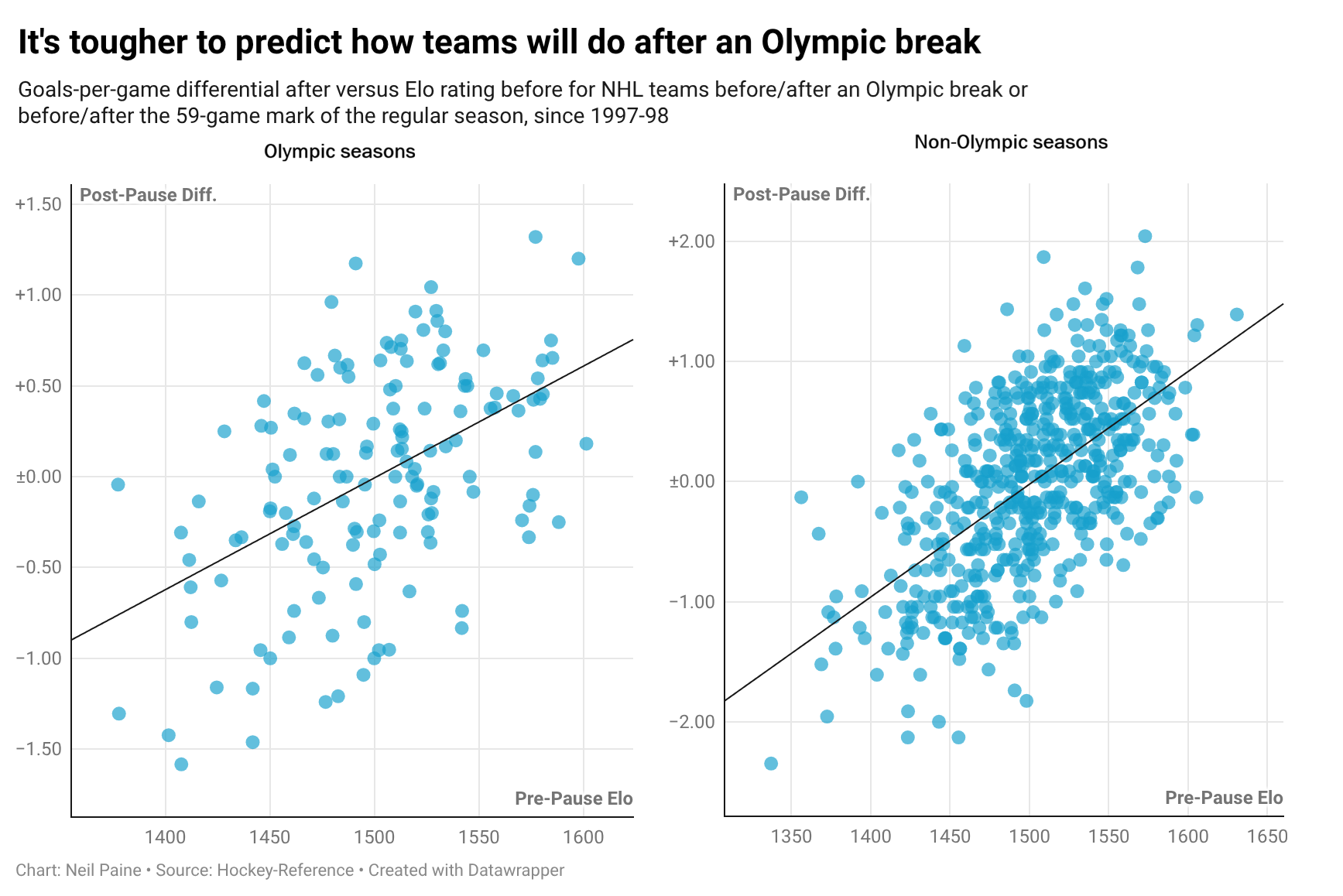
Now, hockey being hockey, there are limits to how well you can predict any 23-game stretch of the season, long layoff or not. But it does seem that the current snapshot of the league rankings may get slightly more scrambled than usual when the games resume. Just to take an example, a team like the Colorado Avalanche, with a 1587 Elo, would expect to post a +0.79 goals-per-game differential over the rest of a normal, non-Olympic season. But in a season with an extended Olympic break, that predicted figure drops to +0.53 — a not-insignificant difference.
That’s just based on the historical trend, of course; it doesn’t know that the Avalanche specifically have been in a slump recently and probably could use the break to regroup, notwithstanding all of the stars that they sent to Milano Cortina. But it illustrates how the best teams may be closer to the pack when play resumes than we’d normally expect, and that’s another factor to consider when looking ahead to the playoffs — the ones that award the shiny silver Stanley Cup, that is, not the tournament to award the shiny gold Olympic medals.