
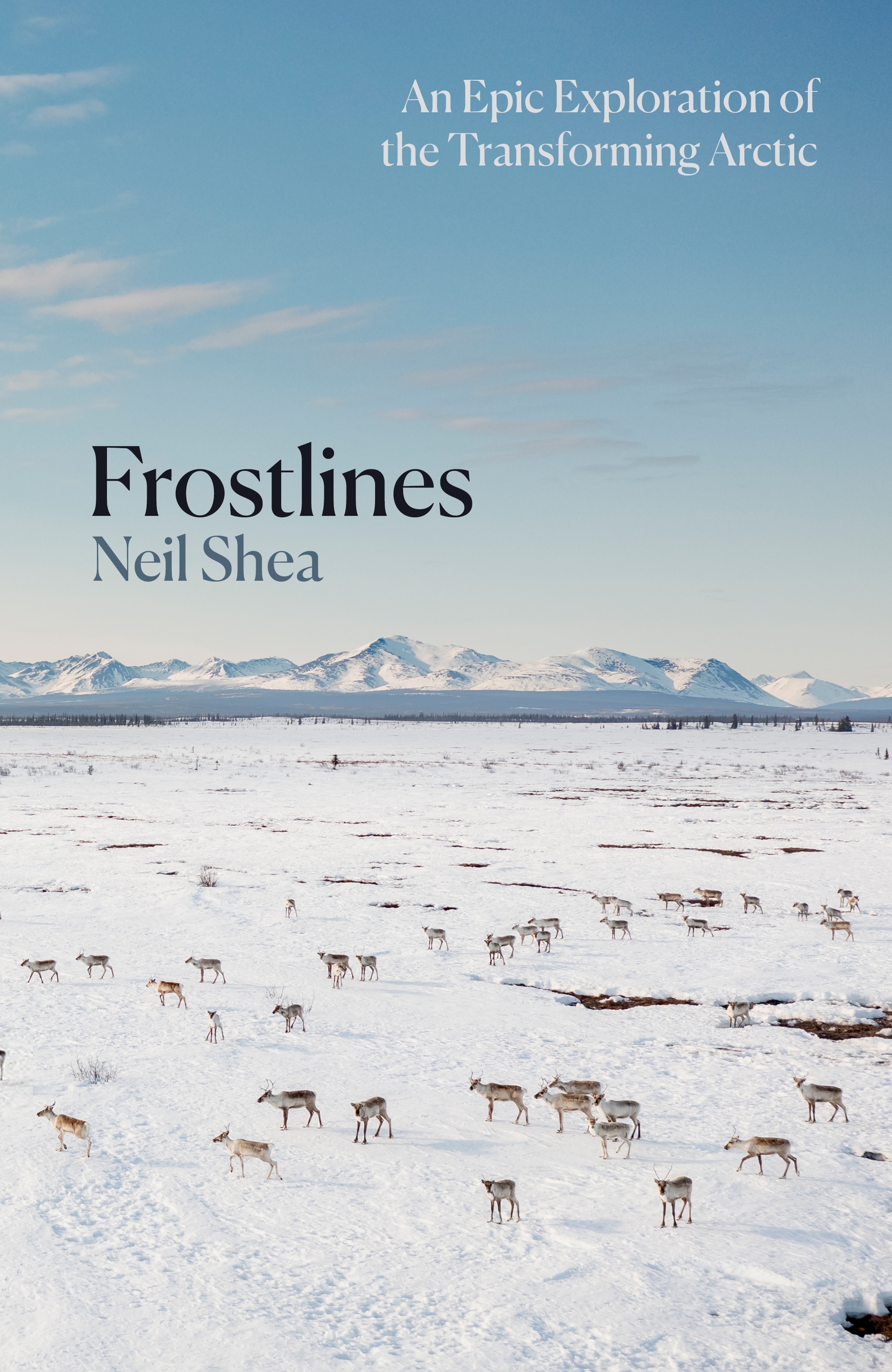
The Arctic Circle cuts through eight countries: the US (via Alaska), Canada, Denmark (via Greenland), Iceland, Finland, Sweden, Norway and Russia. The difficulties for writers seeking to venture across borders — and the costs of remote access — mean that ambitious pan-Arctic travelogues are rarer than a unicorn’s horn. But since Barry Lopez’s masterly Arctic Dreams, published in 1986, the region has experienced climate breakdown and an escalating geopolitical scramble. We’re sorely in need of an update.
Neil Shea’s Frostlines, therefore, is a book to treasure. Like Lopez, he draws on multiple field trips. For more than 15 years Shea has worked for National Geographic, enabling many of the far-flung journeys that form the backbone of his debut book. There is, however, a nagging gap. Russia has more than half of the Arctic Ocean’s coastline but, to Shea’s regret, he doesn’t get there. It’s understandable but still a crying shame that Shea didn’t manage to slip in before Putin’s invasion of Ukraine made reporting impossible in the Russian Arctic.
The book opens with Shea’s memory of his novice immersion in the far north, on a 2005 journey to Canada’s Admiralty Inlet when “climate change wasn’t the emergency — the daily alarm — that we know now”. Shea describes narwhals piercing “the sea’s glassy surface”, of pricking “our air world” as if it were “nothing more than a pincushion”. Caressing each other’s tusks, “something powerful was passing between them, and for this we had no language”.
But the Arctic he saw then “no longer exists”, he says plainly. “The Arctic is warming three or four times more rapidly than any other region on the planet.” His motivating impulse pivots around the question: “What can it mean, for all of us, if the north ceases to be cold?”
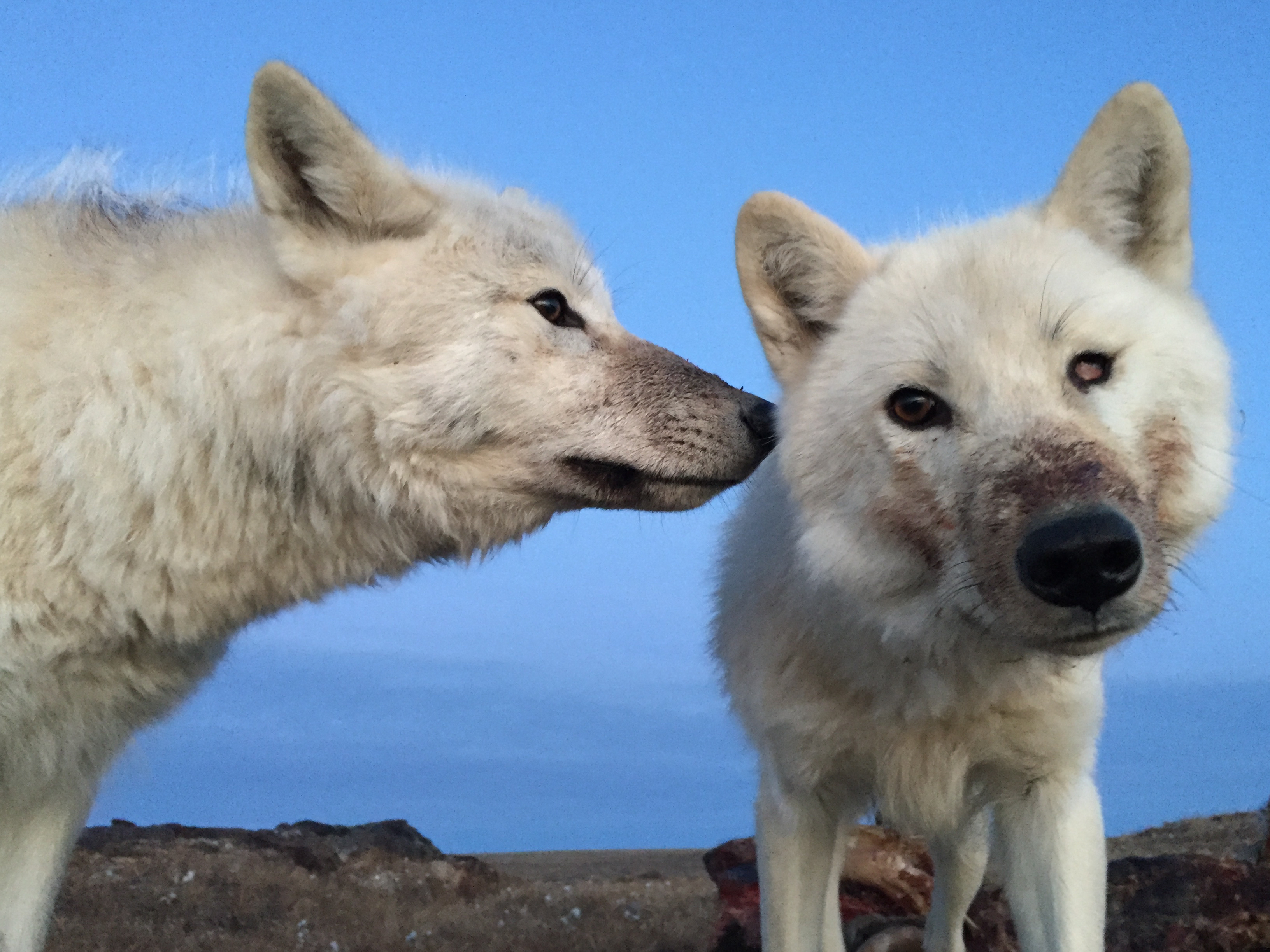
On Canada’s Ellesmere Island, Shea gives us an intimate portrait of a wolf pack. The pups are like “a couple of pillows pushed together”, with large paws and “carpet-tack teeth”. He develops a relationship with an injured, one-eyed wolf with a “blank egg-white orb”. But the highlight is when a wolf slices open “the nylon skin” of his tent “with alarming precision” to steal his inflatable pillow.
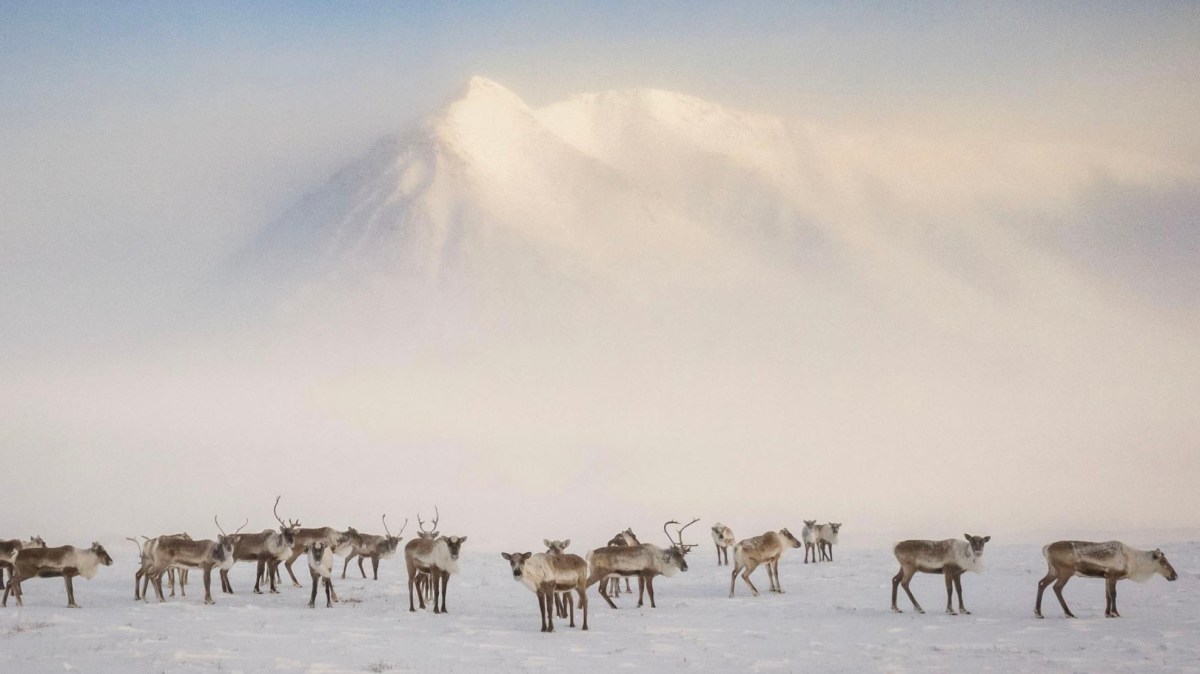
By the time we reach the tundra caribou in the Northwest Territories, he has us on the hook. Here, his investigation of the caribou’s “great vanishing”, along with their habitat, becomes an opportunity to present the complexity beneath the term “climate change”. Instead of cutting fossil fuels to reduce warming, “governments have taken half measures” — the caribou’s predator species are shot; indigenous hunting of caribou is regulated; local people are forced to rely on expensive imported foods instead. In one particularly moving encounter, an Inupiat elder describes it as “like feeling a cold coming on”, until the fear kicks in that it’s something deeper, “shot through your whole system”.
Wolves in Canada
NEIL SHEA
The second half of the book focuses more on humans. Shea meets the Nunamiut living on the “caribou highway” in Alaska. This is the western Arctic herd, where caribou numbers have not yet been devastated. But when Shea joins a hunt, and the shot caribou is opened up, its insides are “speckled with little gray pustules. Tumors”. The herd is “sick”. Shea describes “overwhelming” grief: “Even though I’m a southerner, I feel it, a silence spreading below our modern clamour.”
When he turns his travels to Europe, he asks why, in the mid-15th century, the Greenland Vikings, or Norse, disappeared. The plague? A little Ice Age? Did the bottom fall out in the trade of walrus tusks when Europe turned to elephant ivory? We have options, he says, to stop the melting Arctic, starting with radically reducing our greenhouse emissions. “Here, perhaps, is the great difference between the Norse mind and our own. They tried to survive. Sometimes we don’t seem like we want to.”
• How the UK is testing a radical plan to refreeze the Arctic
Finally, Shea travels to Kirkenes, a former mining town near the Norwegian-Russian border — “the most controversial place in the Arctic”, Shea claims (true at the time of writing, before President Trump claimed ownership of Greenland). Shea is confronted by the stark contrast between “the mythic scale” of an older Arctic where ice, animals, people and stories once moved freely, and an “unnatural”, “cruel” barrier. For five weeks he drives and walks the Norwegian frontier, travelling “through sublime, spring-sodden country”, the line marked by 4ft-high posts “decorated like goldfinches, with black caps and bright yellow bodies” and “well-appointed, even cozy” military observation posts.
Across all these journeys, Shea interweaves natural and human history, travelogue and climate reporting, without losing sight of how it feels to be in this landscape: the “days where everything is so white it blinds”, where “time resembles fluid, pooling around us”. His descriptions of the vast backdrop make the individual details all the more arresting, like when he raises the distant, “ancient dead” from a medieval graveyard in Greenland, describing two entwined skeletons — a six-year-old child wrapped in the arms of an older male.
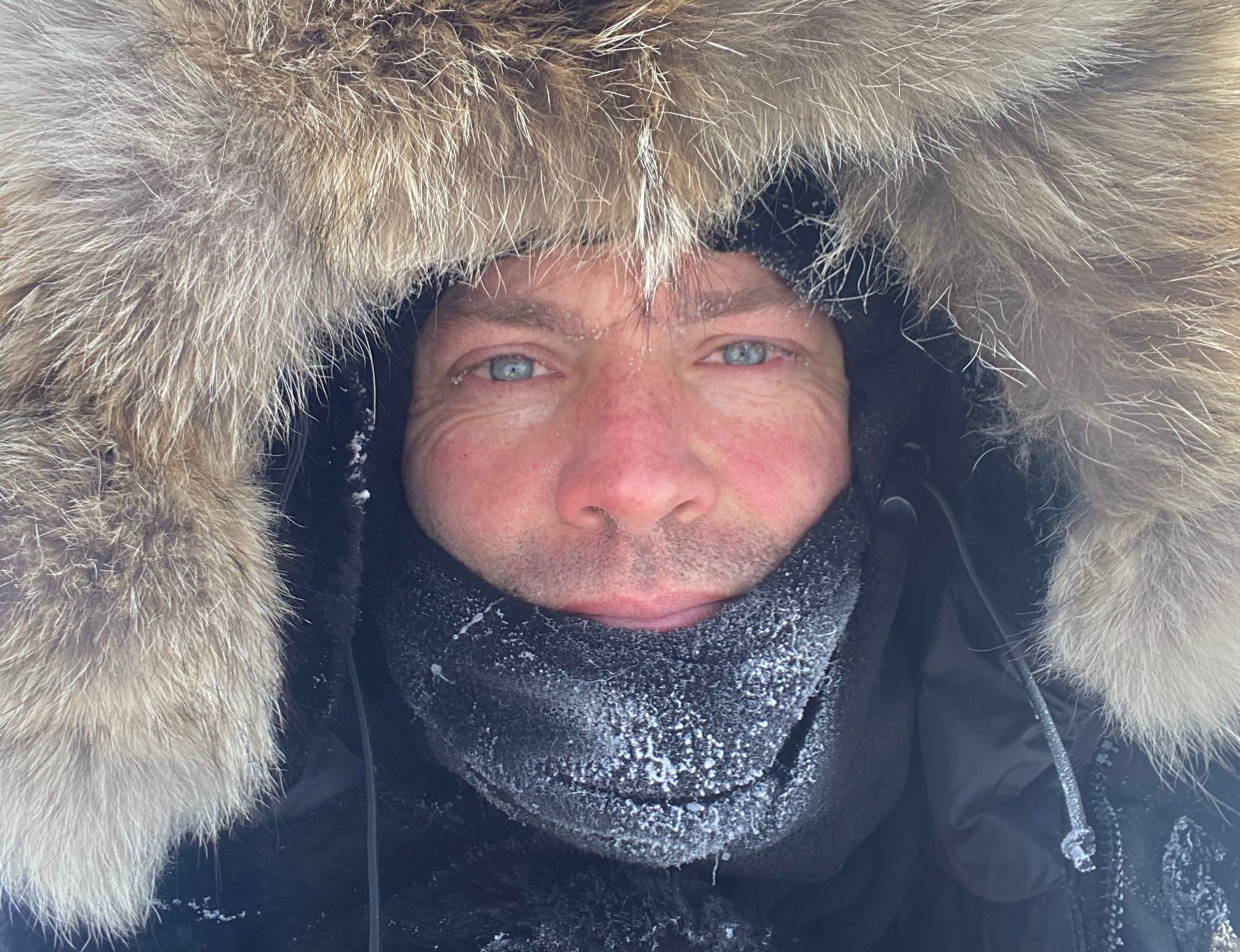
The author and National Geographic writer Neil Shea
NEIL SHEA
This dramatic camerawork — zooming from wide angle to detail — is what gives the book its momentum, which is important, not only to balance out the grimness of the melting Arctic, but to conceal the book’s weakness: the episodic individual chapters mean that the big picture sometimes disappears from view. But that’s a small quibble. Shea is a likeable, self-effacing narrator. At one point, he’s so busy waving with happiness from his kayak, he’s goofily unaware of ruining his colleague’s photograph of narwhals. On a quad bike, he hits a boulder and is launched “like a circus clown out of a cannon”. He’s willing to reveal his vulnerabilities, including his fear of falling through the ice. “One thing I learn quickly out here is that when you are camped on the surface of a frozen lake, no one wants to talk about climate change.”
• Read more book reviews and interviews — and see what’s top of the Sunday Times Bestsellers List
In the book’s final scene, on the Norwegian-Russian border, Shea describes a double rainbow, one end falling on the road in front of him, the other vanishing above some trees. “I had never seen such color. It seemed so close, an invitation of light.” This image of an arc of light somehow re-stitching the broken Arctic like a heavenly bridge is, momentarily, compelling, a symbol of possibility.
That rainbow emerged over the very same place where, in June 1968, a few dozen Norwegian conscripts faced a Soviet “army of thousands”, moved to the border by Moscow as an act of provocation. That face-off came to nothing, but has the Russian threat dispersed? The north is ceasing to be cold, but geopolitically it is hotting up. As Shea says, it is a place for “imagining apocalypses”. The terrifying thing is this: since Frostlines went to press, Russia isn’t the only “Bear” in the circle.
Sophy Roberts is the author of The Lost Pianos of Siberia and A Training School for Elephants
Frostlines: An Epic Exploration of the Transforming Arctic by Neil Shea (Picador £20 pp240). To order a copy go to timesbookshop.co.uk. Free UK standard P&P on orders over £25. Special discount available for Times+ members