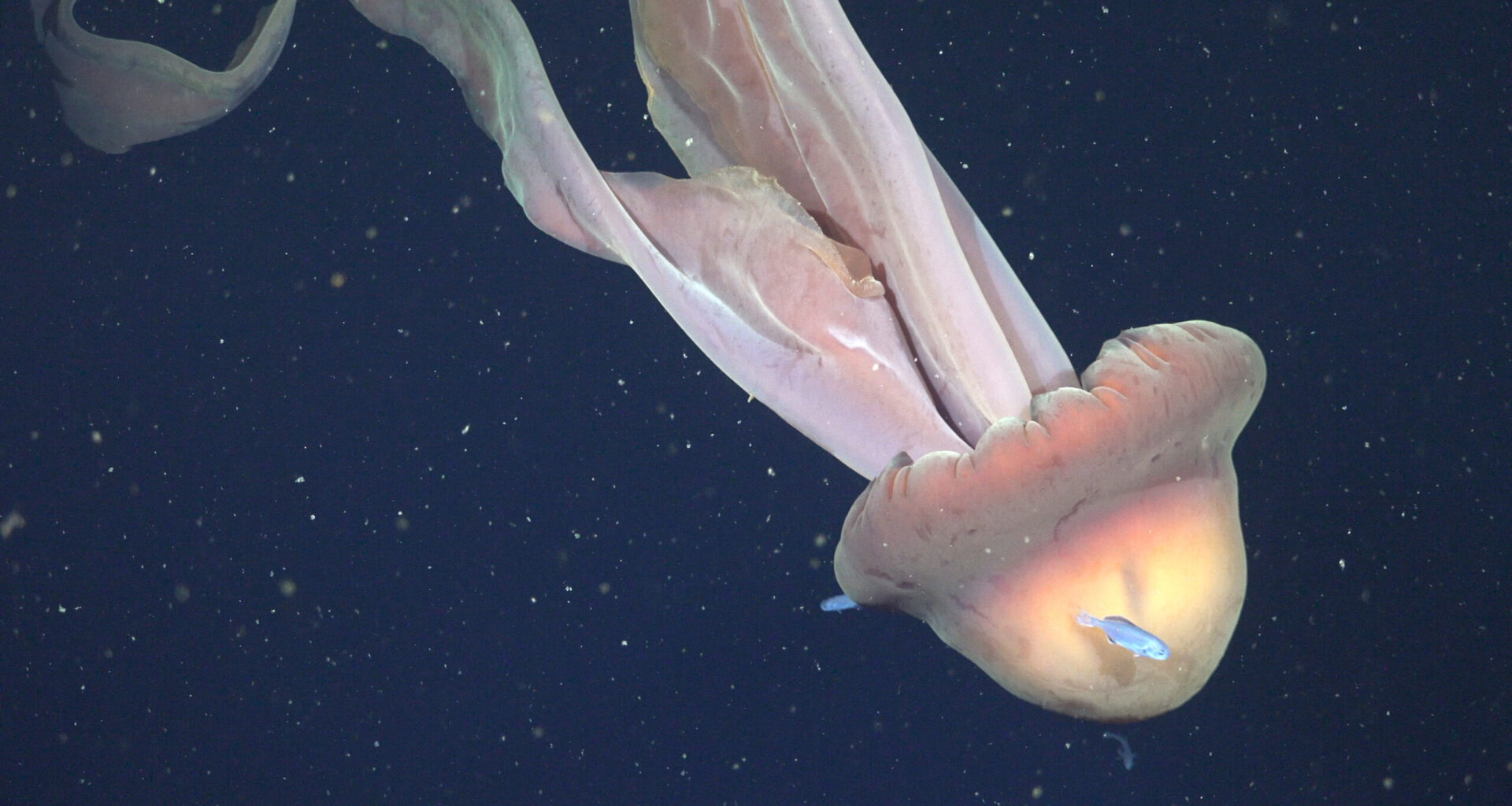
A group of researchers have documented rare deep-sea jelly fish, exploring the biodiversity along Argentina’s continental shelf.
Stygiomedusa gigantea, more commonly known as the giant phantom jellyfish, can grow as long as a school bus. It was filmed 250 metres below the surface in the South Atlantic Ocean.
The science team from the Schmidt Ocean Institute said the jellyfish does not have stinging tentacles, but catches prey with its four, long, ribbon-like arms.
The team had set out to locate cold seeps – deep-sea environments where methane and other chemicals released from the seafloor serve as energy for microbes – which provide sustenance for animals like clams, mussels, and tube worms. They found one active seep measuring one square kilometer.
Alongside this, researchers found a rich, biodiverse ecosystem in the deep sea: they observed rich reef complexes, and recorded 28 suspected new species – including worms, corals, sea urchins, sea snails, and sea anemones.
They documented the largest known Bathelia candida coral reef in the global ocean – which at 0.4 square kilometres is nearly the size of Vatican City. Recognised as a Vulnerable Marine Ecosystem indicator species, Bathelia candida has been documented throughout the Southwestern Atlantic Ocean, with the largest patches off the coast of Argentina, but scientists hadn’t understood its extent until this expedition.