
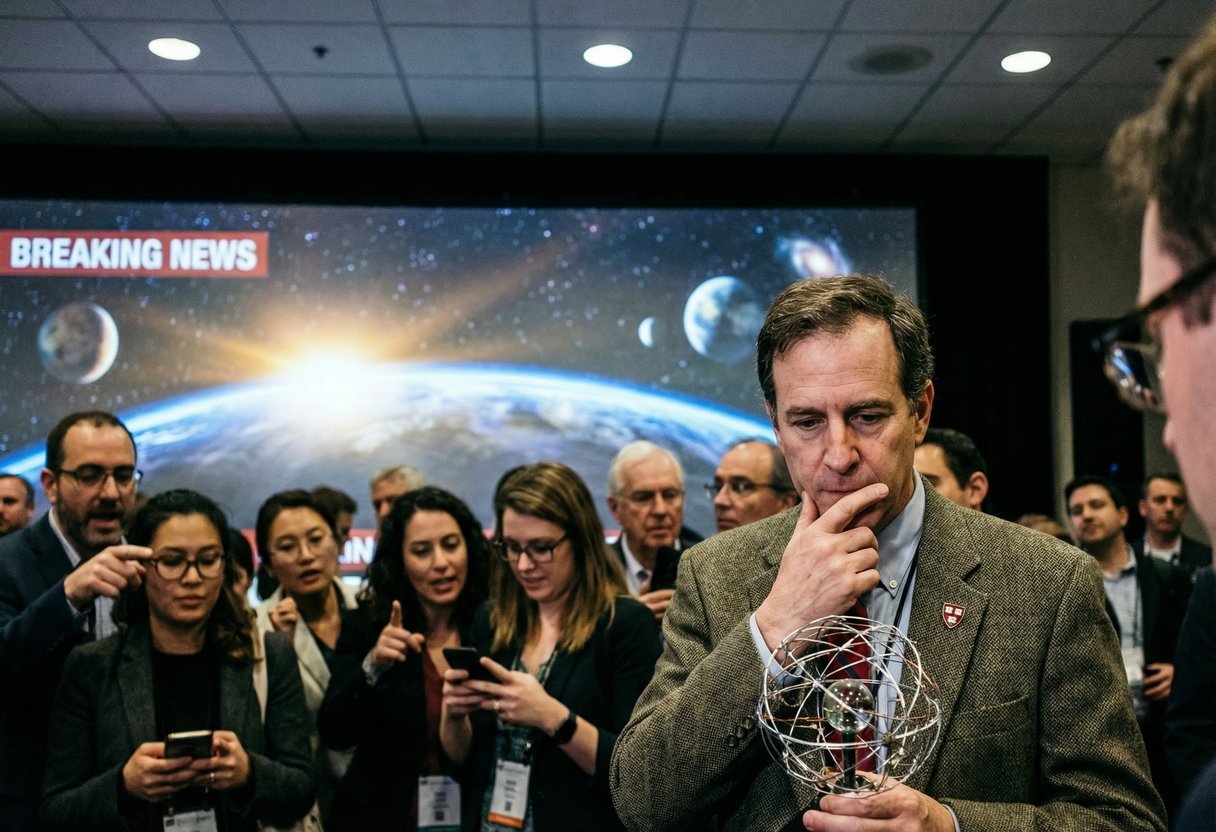
Michael Guillén, an ex-Harvard physicist, is staking a provocative claim about the cosmos: a precise spot at its farthest limit as the seat of the divine. That would place God roughly 439 billion billion kilometers away, at the cosmic horizon where relativity suggests time all but stops. The pitch has drawn curiosity and eye rolls in equal measure, with outlets like Slate and Fox News blasting its speculative leaps. Between unreachable galaxies and talk of pre-Big Bang remnants, readers volley jokes, doubts, and philosophy while empirical evidence remains out of reach.
An unconventional theory from a Harvard mind
On February 1, 2026, journalist Mélina Loupia spotlighted an unusual claim from Michael Guillén, a former Harvard physicist (as reported by Loupia). He proposes a literal “address” for God: 439 billion billion kilometers from Earth, near the universe’s farthest limit—the cosmic horizon. The pitch blends cosmology and metaphysics and, indeed, invites readers to test where evidence ends and interpretation begins.
The cosmic horizon: A boundary in astrophysics
The cosmic horizon marks the outer edge of the observable universe, where galaxies recede so fast their light can’t reach us. This boundary is a scientific construct, grounded in expansion and relativity. Guillén stretches it further, suggesting a realm where time effectively loses meaning and only immaterial phenomena, like light, can traverse space there (per general relativity). This is the case, he argues, for contemplating the divine.
Science meets scripture
Guillén aligns this horizon with biblical depictions of heaven as unreachable by the living, sketching a bridge between physics and theology. The overlap is speculative but conversation‑worthy, because it reframes “beyond” as a coordinate rather than a metaphor. Can cosmological distances and sacred language share a map without distorting either?
Praise, skepticism, and public conversations
The response has been brisk. Outlets including Slate and Fox News have pushed back or mocked the claim, calling it speculative or even “fake news.” Online, reactions land across a wider spectrum; for example, a commenter citing Descartes argues that God “is” beyond existence itself, not locatable (a philosophical stance, not a measurement).
Skeptics highlight the absence of testable predictions or data.
Humorists joke about pinning the divine on a map app.
Philosophers recast the debate as language versus reality.
A bold narrative, but without proof
Guillén extends the idea further, floating that regions beyond the horizon could contain traces from before the observable Big Bang, or overlap with a divine realm. The narrative is bold and tidy, yet there’s no empirical evidence to support it. In addition to the scientific cautions, the claim blends categories that resist verification. Still, it keeps the public conversation moving, and that matters for curiosity’s sake.