
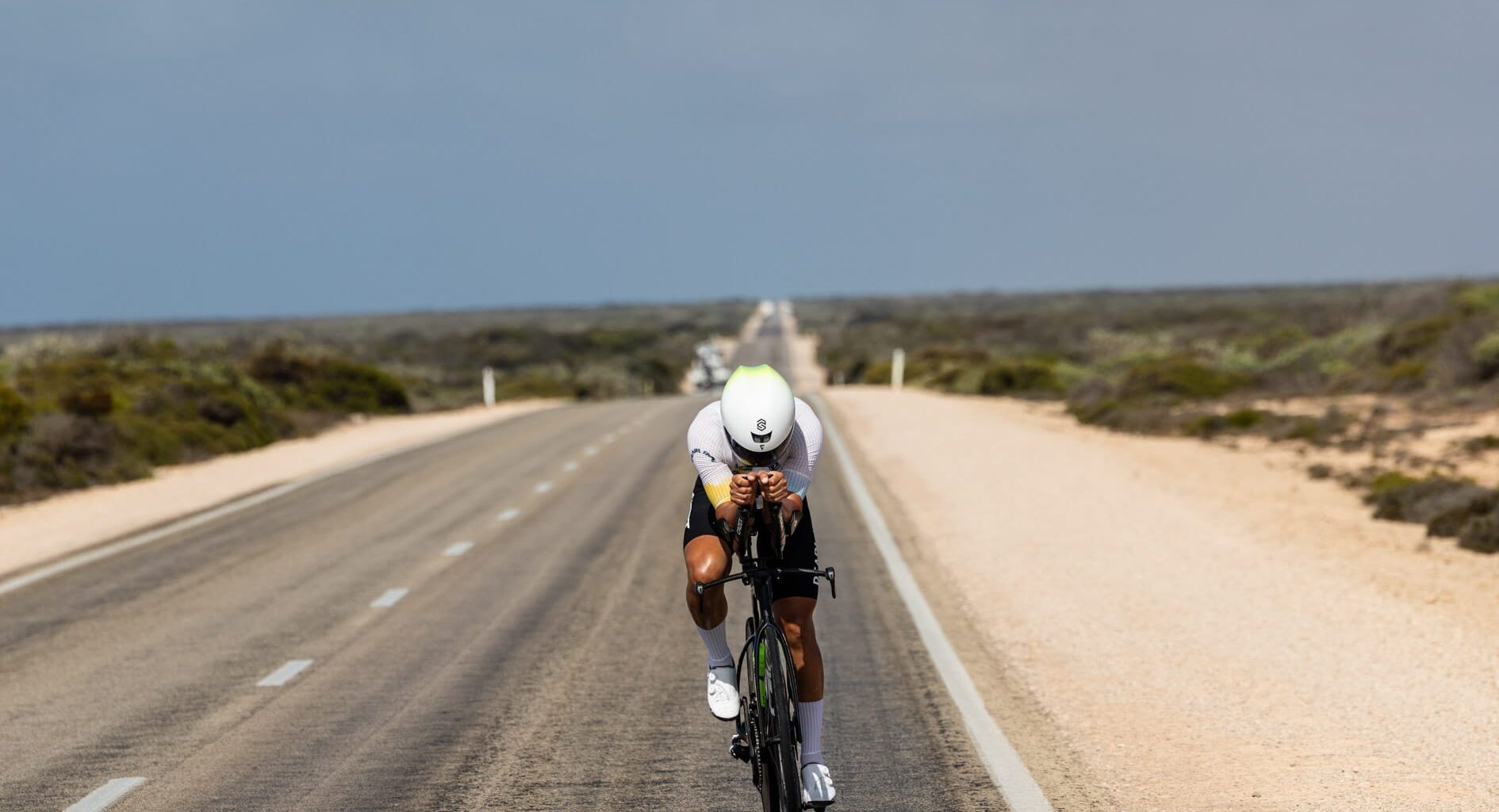
In January, Australian professional off-road cyclist Brendan Johnston sought to achieve the Fastest Known Time (FKT) record for crossing Australia. The pre-existing record for the approximately 4,000 km ride sat at an impressive six days, 11 hours, held by Austrian ultra-specialist Christoph Strasser.
Before the attempt, Escape Collective caught up with Johnston to talk about the attempt, the preparation, and the tech choices. Johnston fell short of the record, but managed to raise over AU$38,000 (and counting) for Tour de Cure, a charity for cancer research.
This article was written by fellow professional off-road cyclist Melisa Rollins of what it was like to support the attempt, and where things went wrong for Johnston.
Some ideas are too big to argue with. You just sit there and let them sink in.
That’s how I felt when Brendan first told me of a dream to ride from Perth to Sydney faster than anyone ever had.
“What do you think about me attempting the fastest time for crossing Australia?” he asked me about a year ago.
I didn’t really know how to conceptualize it at the time, but I was obviously on board. Somewhere in that conversation, the idea took shape. He’d call it PTSD, Perth To SyDney. The name carried a few meanings, but most importantly, it gave the ride purpose.
At 17 years old, Brendan was diagnosed with a rare form of testicular cancer. He had to battle it as a kid who wasn’t even out of high school yet and during treatment, all he wanted was to be normal. He treated every lab test like a stepping stone. Get it done, move on. Get back to being normal. That mentality worked and it got him through, but it didn’t leave much room to process what was actually happening to him.
Over time, those unprocessed layers – like a lasagna of stacked trauma – became something he carried into adulthood. While that tremendous amount of grit served him in many ways, it also started to haunt him. He was searching for a way to confront it … for a purpose. For something that felt big enough.
That’s where crossing Australia came in.
The cause and crew
Tied to the ride was a fundraiser for Tour de Cure, an Australian charity best known for its long-distance cycling tours that raise money for cancer research, prevention, and support programs. During treatment, Brendan learned how much that work matters, how many people it takes to keep someone alive, and how fragile and powerful the human body can be at the same time.
That understanding stayed with him. One of the things Brendan carried forward was a deep respect for the human body and how its limits are largely unknown … and for him, there was something deeply healing about exploring those limits by choice. At age 34, he could choose to suffer. The 17-year-old version of him never had that option.
There was already noise around the attempt. Brendan chose to start on January 10, a time of year known for potential prevailing easterly winds, meaning headwinds for most of the route. For some, that decision invited criticism. But January wasn’t a romantic choice … It was the only viable one. Brendan is a professional cyclist, racing the bulk of his season from April through October, and this window (post-season and pre-build) was the only time his body, career, and life allowed for something this consuming.
Ironically, the existing record had been set starting on the exact same date in January 2017. Ideal or not, January 10 was locked in long before the wind forecasts: accommodation booked, vehicles secured, crew committed. This was also Brendan’s first proper FKT attempt. His first time taking on a distance like this. His first time navigating logistics of this scale. He wasn’t an expert and didn’t pretend to be. He showed up ready to learn and adapt, and willing to take on whatever was handed to him.
Which brings us to Perth, Western Australia. After about a year of planning, we arrived at Cottesloe Beach with a long road ahead (to be covered in short time.) Brendan had asked seven helpers to join him on the journey, each with a unique role and a meaningful connection to his life.
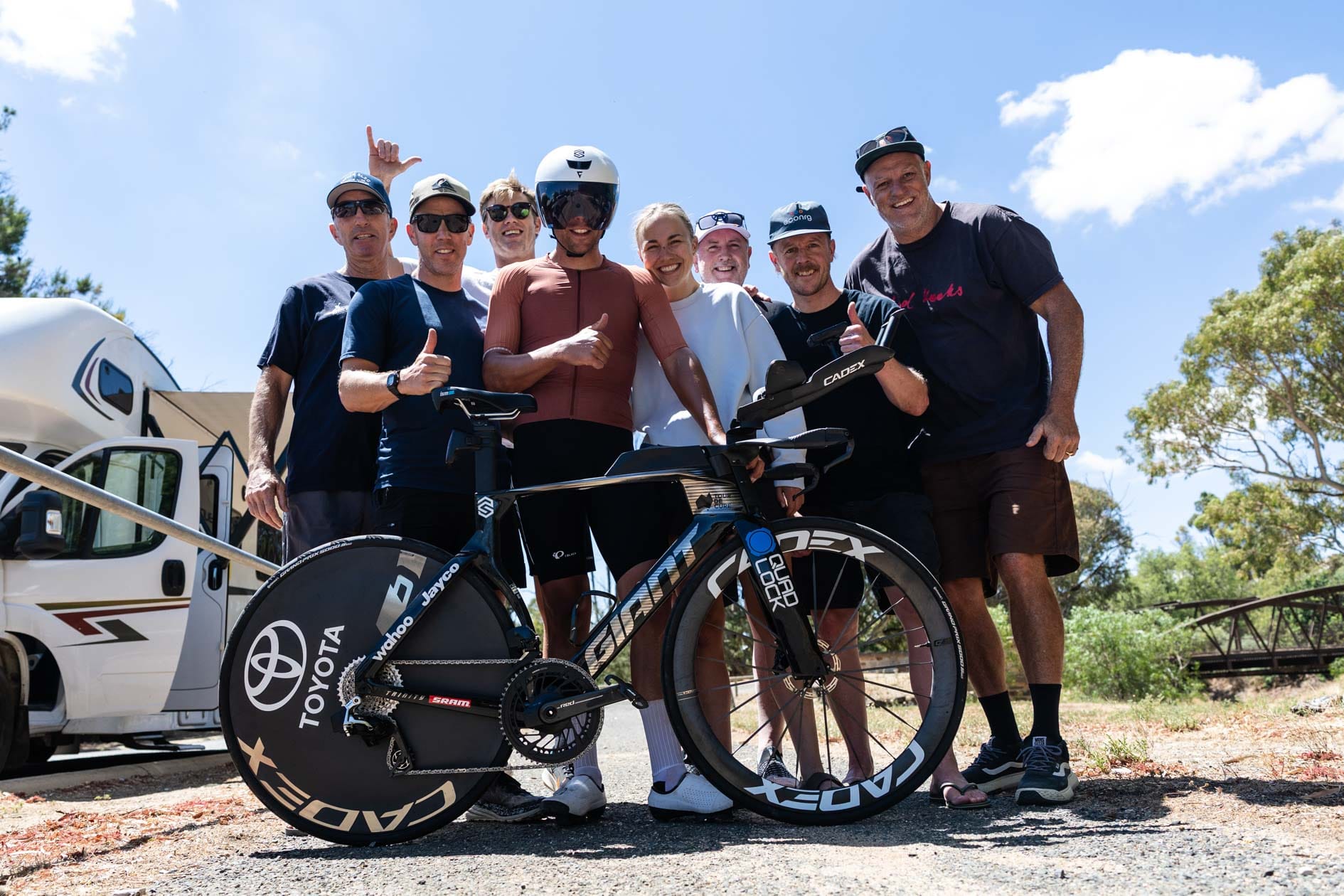 The full team.
First was Kye, one of his best childhood friends. It felt particularly fitting for Kye to be there, because he had also been there 17 years ago during Brendan’s battle with cancer. Kye is now a physiotherapist, so beyond being a close friend who had seen Brendan at his most vulnerable, he also brought a professional understanding of just how much the human body could tolerate over the 4,000 km attempt.
To document the trip, Brendan brought along Glen, a videographer and photographer. Glen was the only crew member who was technically being paid, but no amount of money could have covered the role he ended up playing. He was a driver, photographer, documenter, feeder, communicator. He was often the first to sense Brendan’s emotional state, maybe because the media demanded it. Brendan was excited to share his story. Deep down, he carries a lot of pride in what he’s built since his diagnosis. Even during the hardest hours, Glen helped him find moments to smile, to inspire, and to keep his head on straight.
Next was Paul, a lifelong family friend. Paul had been on some of the very first bike rides Brendan ever did and was also a close friend of his parents. Back in Moruya, Paul sweeps surf boats for competition, which involves dictating how crews move along the water and how effort is applied to be as efficient as possible. He pushes people to go harder while still making them feel supported. Brendan has always felt that in their relationship and wanted to bring it into the attempt.
As a trusted mechanic, Brendan asked Marc to join, another longtime friend who had been through much of his racing journey. Marc also brought some of the best comedic relief of the entire trip. At times we were deep in the trenches, sleep-deprived, wind-chapped, irritable. And then Marc would cut eye holes into a pair of pantyhose, put it over his head, and feed Brendan through the car window. In the darkest moments, he was the light. And it was comforting to know that light would always be there.
The Tour de Cure fundraising effort brought Andrew into the crew. Possibly the strongest logistical mind of all of us, Andrew was constantly booking accommodation, tracking fundraising progress, chasing publicity, and communicating with truck drivers barreling down the highway. He wore 10 hats at once and was an essential piece of the puzzle.
Shaun was another key presence, not just for the ride but for Brendan’s life. During Brendan’s first year racing in America, his first true year fully committing to sport, Shaun was there through some of the lowest lows. Shaun understands Brendan’s body and mind in a way few people do. He was there to help make the hard calls. Even though none of us wanted to consider not finishing, Shaun knew that Brendan’s health, career, and role as a father mattered far more than any arbitrary finish time.
And then there was me. Sometimes just a passenger princess with fluctuating moods, I spent most of my days planning meals for the crew and riding with Brendan when possible. Riding alongside him might sound romantic, but between the howling wind, his aggressive TT helmet, and the pace, we couldn’t even talk. His all-day pace was my race pace. I sat on his wheel, feeding him, watching in real time as he battled. I got to live out my dream of being a WorldTour domestique.
Kicking off
The day before the ride was chaotic. With everyone arriving in town, we still had to organise three vehicles, plaster on “cyclist ahead” and sponsor stickers, and do a massive $1,000 shop for supplies. Brendan went to bed at 7pm, just hours before his 1am start. As we lay in bed, we checked the wind. Easterly. Surely it would improve away from the coast, we thought. With that final optimism, we fell asleep.
At 11:30pm, the alarm went off. The wind was howling.
I sent Brendan off with a bowl of oatmeal, Kye, Glen, Marc and Andrew, and two vehicles. Then I went back to sleep, resetting my alarm for 4:30am so I could prepare meals for the next two days as we would be mostly off-grid. Shaun and Paul would join me later in the third vehicle as the follow car.
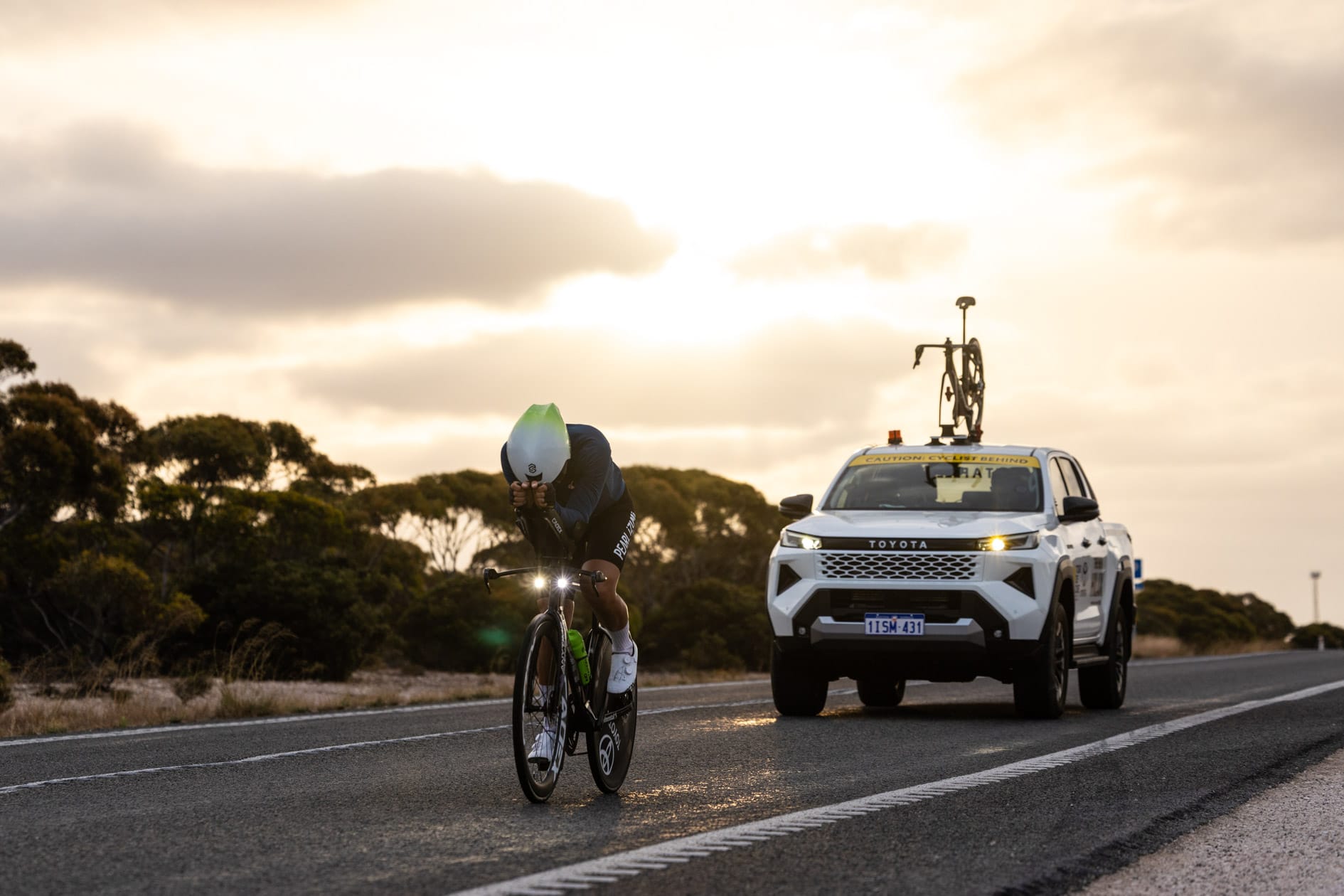
By the time we met Brendan around 1 pm, he was already behind schedule and visibly suffering. The headwind was relentless, and he was pushing too hard, trying to claw back lost time. At the first stop, he complained of intense shoulder pain. The TT position, combined with the wind, was causing him to overuse stabilizing muscles and destroy his upper back. There was a sense of dread in the air. We could tell this was going to be a long week.
I had insisted on being able to train during the week, especially after being asked by the current Marathon world champion Kate Courtney to race Cape Epic with her in just a few months’ time. Day one after lunch was my first ride with Brendan.
It was nothing like I expected.
This post is for subscribers only
Subscribe now
Already have an account? Sign in
Did we do a good job with this story?
👍Yep
👎Nope