

Never miss an important update on your stock portfolio and cut through the noise. Over 7 million investors trust Simply Wall St to stay informed where it matters for FREE.
Pfizer (NYSE:PFE) reported positive Phase 2b VESPER-3 data for its monthly injectable GLP-1 obesity therapy acquired from Metsera.
The company outlined plans to launch an expansive late stage development program, including more than 20 pivotal studies and multiple Phase 3 trials.
The GLP-1 program targets the growing obesity treatment market at a time when Pfizer is addressing revenue pressure from lower COVID-19 product demand and upcoming patent expirations.
For you as an investor, this move puts obesity care more firmly at the center of Pfizer’s long term story. The company is already a large, diversified pharmaceutical group, and adding a monthly GLP-1 injection gives it exposure to an area that has drawn significant attention across healthcare. The Metsera acquisition and new data update are part of a broader effort to refresh the product portfolio as older drugs face competition.
What matters next is how quickly Pfizer can convert this positive mid stage data into late stage results, regulatory filings, and, eventually, real world adoption. The scale of the planned development program signals that obesity is likely to remain a key focus for Pfizer (NYSE:PFE), which could influence where the company allocates capital, forms partnerships, and directs commercial resources over the coming years.
Stay updated on the most important news stories for Pfizer by adding it to your watchlist or portfolio. Alternatively, explore our Community to discover new perspectives on Pfizer.
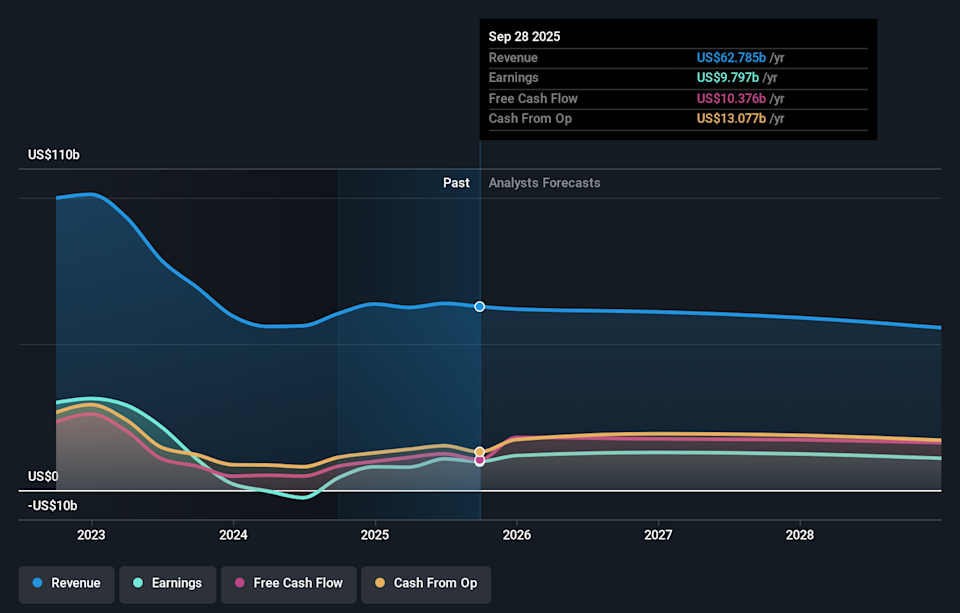 NYSE:PFE Earnings & Revenue Growth as at Feb 2026
How Pfizer stacks up against its biggest competitors
For Pfizer, positive Phase 2b data for the monthly GLP-1 obesity injection is an important proof point that its late entry into weight-management drugs could still matter in a market currently led by Eli Lilly and Novo Nordisk. The plan to run more than 20 pivotal studies, including multiple Phase 3 trials, signals that obesity is intended to be a large, multi-year revenue stream that can help offset pressure from lower COVID-19 product sales and upcoming patent losses.
This update lines up with the existing investor narrative that sees obesity, oncology, and specialty medicines as central to Pfizer’s long-term repositioning. The Metsera acquisition and broader GLP-1 pipeline support the view that business-development deals are being used to rebuild the portfolio as older products face competition. This is what many analysts have been watching for as a potential driver of a future rerating.
The GLP-1 program gives Pfizer a clearer entry into a fast-growing obesity market where competitors like Eli Lilly and Novo Nordisk already have large franchises.
Positive mid-stage data and a broad late-stage trial plan could, if successful, widen Pfizer’s options across different patient groups and dosing preferences.
Investors still face execution risk, including whether Phase 3 results, safety, and eventual market uptake justify the roughly US$10b Metsera deal and large R&D spend.
Analysts have flagged key risks such as earnings pressure from loss of exclusivity and questions around dividend coverage, which could limit how much investors are willing to pay for new obesity assets.
From here, you may want to track the start and design of the Phase 3 VESPER trials, comparisons to existing GLP-1 drugs on efficacy and tolerability, and any updates on how management frames obesity within its 2026 revenue guidance and post-2027 patent-cliff plans. If you want a broader view of how this GLP-1 news fits into Pfizer’s long-term story, take a look at the community narratives for Pfizer and see how other investors are connecting the dots.
This article by Simply Wall St is general in nature. We provide commentary based on historical data and analyst forecasts only using an unbiased methodology and our articles are not intended to be financial advice. It does not constitute a recommendation to buy or sell any stock, and does not take account of your objectives, or your financial situation. We aim to bring you long-term focused analysis driven by fundamental data. Note that our analysis may not factor in the latest price-sensitive company announcements or qualitative material. Simply Wall St has no position in any stocks mentioned.
Companies discussed in this article include PFE.
Have feedback on this article? Concerned about the content? Get in touch with us directly. Alternatively, email editorial-team@simplywallst.com