
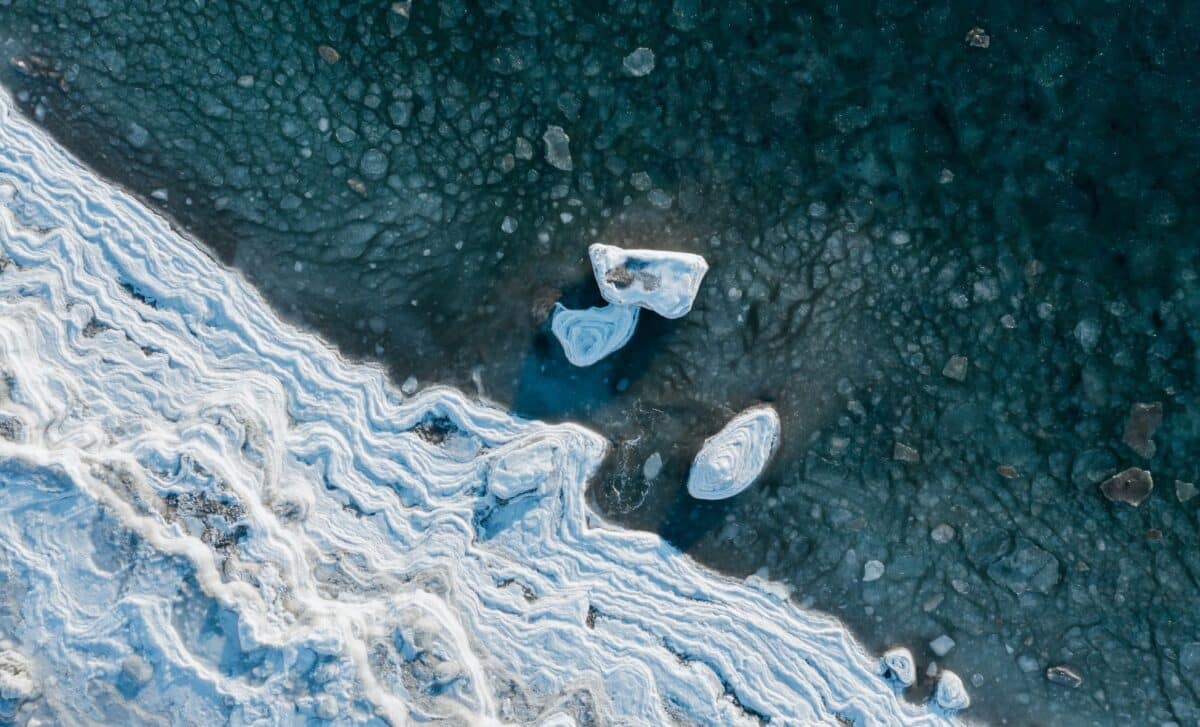
This breakthrough could improve early warnings, helping to track ice loss and its far-reaching consequences on global climate, ocean currents, and weather patterns. As the Arctic experiences rapid warming, accurate ice predictions are now more important than ever.
Arctic sea ice plays an essential role in regulating Earth’s climate. By reflecting sunlight, it helps cool the planet and influences ocean currents and atmospheric patterns far beyond the polar region. However, as the climate crisis accelerates ice loss, scientists are increasingly relying on real-time tracking to understand how the ice behaves and to forecast its future. A new model, developed by a team of researchers from the U.S. and U.K., offers an unprecedented level of accuracy in predicting sea ice extent, especially during September, when ice cover typically reaches its lowest point each year.
A Revolutionary Approach to Predicting Arctic Ice
The forecasting system, outlined in a study published in Chaos, uses a sophisticated method to model Arctic sea ice extent based on interactions between various factors, including long-term climate memory, seasonal patterns, and rapidly changing weather conditions.
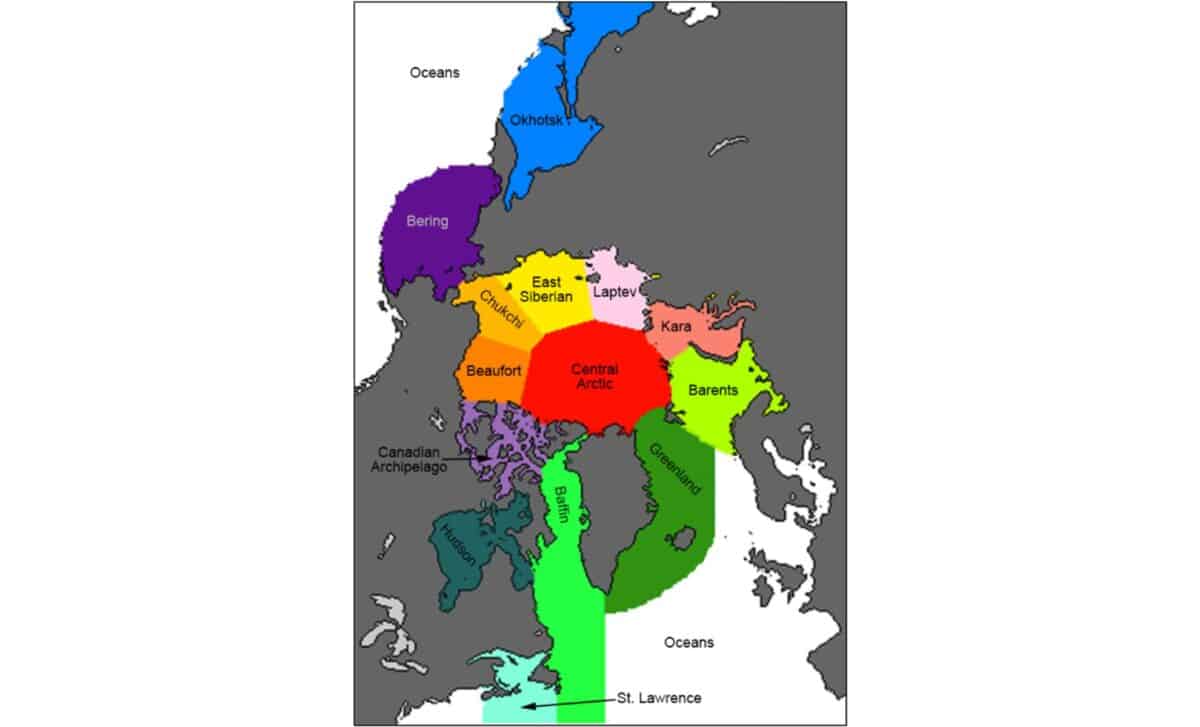 Map of Arctic regions (from NSIDC SIE documentation) ©Chaos
By analyzing daily sea ice extent data from the National Snow and Ice Data Center (NSIDC) dating back to 1978, the team was able to develop a predictive model that delivers reliable forecasts up to four months in advance. According to the study, this method outperformed existing prediction techniques, providing a clearer picture of how sea ice will evolve over the course of the summer.
Impact on Indigenous Communities and Industry
The ability to predict sea ice conditions in real-time is particularly important for Indigenous communities in the Arctic, who depend on ice for hunting species like polar bears, seals, and walruses. Dimitri Kondrashov, one of the lead researchers, explained that reliable forecasts help reduce risks and costs for communities that rely on sea ice for their livelihoods.
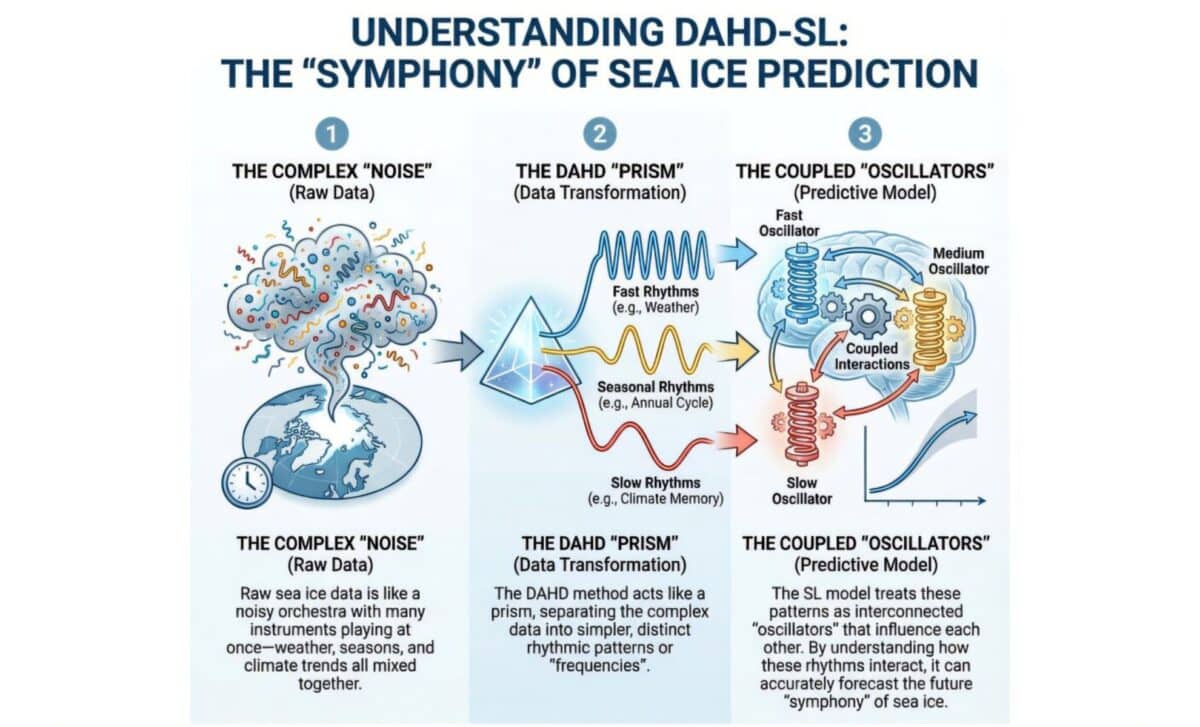 The researchers’ method for modeling sea ice extent simplifies complex Arctic data into rhythmic patterns, which are then represented as coupled oscillators to generate precise forecasts, mimicking the interaction of various natural cycles. © Kondrashov et al.
In addition, industries such as oil and gas drilling, fishing, and tourism that operate in the Arctic also stand to benefit from improved ice forecasts, allowing them to better plan and mitigate the risks posed by changing ice conditions.
Testing and Future Improvements
The researchers tested their model by applying it to September data from past years and in real-time during September 2024. The results were promising, with the model accurately capturing both short-term and seasonal changes in sea ice extent. When compared to other forecasting methods, it consistently provided more accurate predictions. Kondrashov noted that the model performed well across large regions of the Arctic, despite significant annual variation in sea ice conditions.
Moving forward, the team plans to refine the model further by adding more atmospheric and oceanic variables, such as air temperature and sea level pressure. Incorporating these additional factors could help improve predictions of rapid fluctuations in sea ice, providing even more reliable forecasts for the future.
This breakthrough forecasting system represents a major step forward in understanding and predicting Arctic sea ice behavior. By providing accurate, real-time predictions months in advance, the model can help researchers, policymakers, and local communities prepare for the ongoing changes in the Arctic and mitigate the environmental and socio-economic impacts of ice loss.