
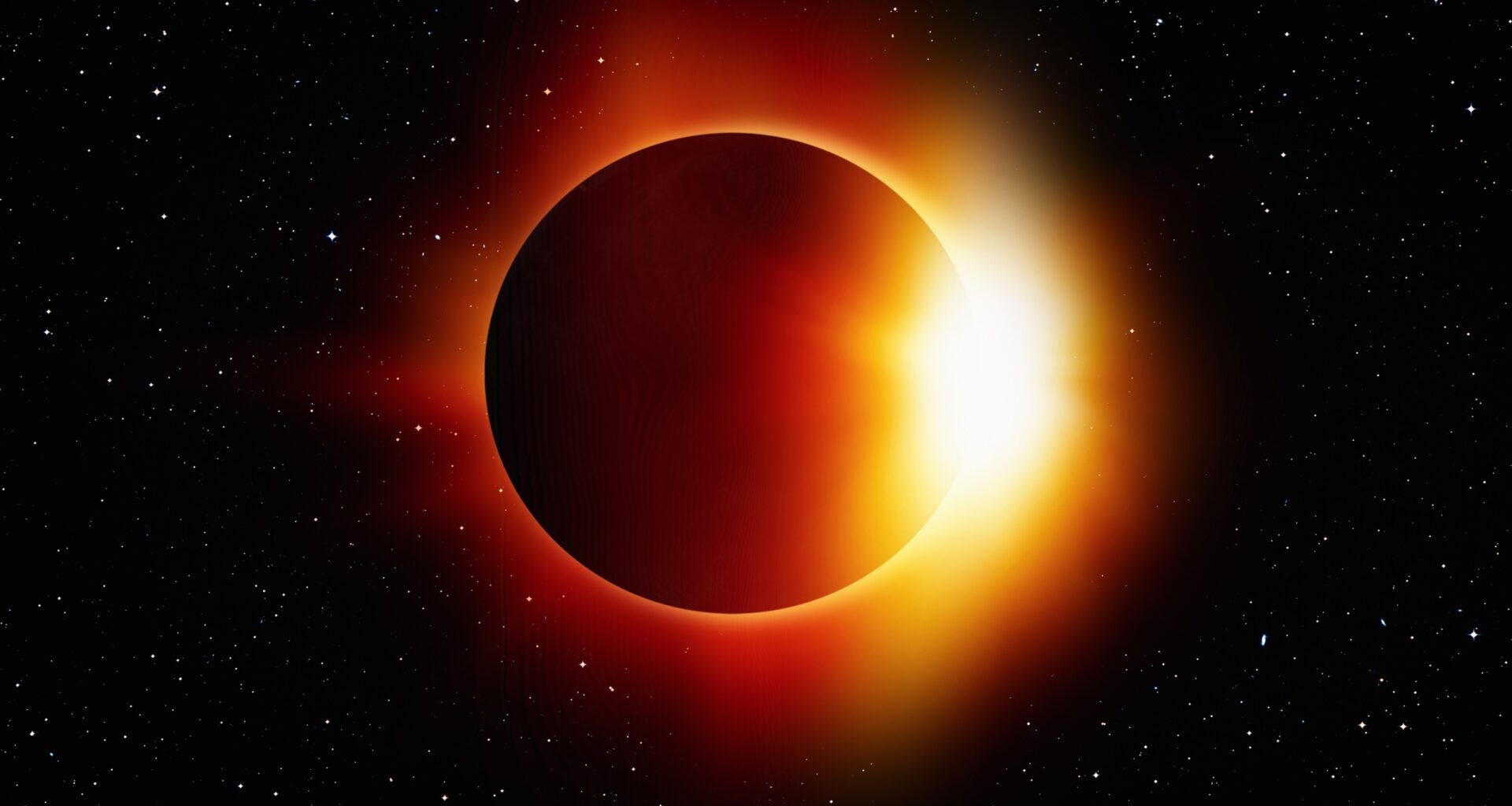
A total solar eclipse doesn’t just dim the sky. For a few surreal minutes, it flips the usual rules of daytime on their head – light drops fast, temperatures dip, and the world briefly feels like it’s holding its breath.
For scientists who want to understand how animals react to sudden changes in light, that short window is gold.

A research team recently used the April 2024 total solar eclipse as a natural experiment in the grasslands of the Midwestern United States.
Their focus wasn’t on what animals did visually, but on what they sounded like. In prairies, sound is a big part of daily life: birds call, insects buzz, frogs chirp, and human noise floats in and out.
All of it together forms a “soundscape” – the mix of natural and artificial sounds that shapes the feel of a place.
The team’s goal was to see how that soundscape shifts when the light suddenly collapses in the middle of the day, and what that can tell us about how animals use light cues to time their behavior.
Listening instead of looking
Light level helps guide a lot of biological routines, from seasonal migration to breeding. The researchers wanted to know: if you suddenly remove sunlight, do prairie communities behave as if it’s dusk? Or do they do something else entirely?
To test this, they used passive acoustic monitoring – specialized recording devices that capture animal vocalizations without disturbing the animals themselves. These recorders ran in the days before the eclipse, during the eclipse, and after it.
The team then compared soundscape diversity, complexity, and intensity at three Ohio sites: Larry R. Yoder Prairie Learning Laboratory, the Tecumseh Nature Preserve, and Highbanks Metro Park.
Eclipses and animal behavior
The picture that emerged was nuanced. The eclipse did line up with changes in how much sound was happening and which sounds were present, but it didn’t produce a dramatic shift in acoustic complexity.
“Solar eclipses are wonderful events that let us experiment in natural settings what sudden losses of light could be doing to animals,” said Madison Von Deylen, lead author of the study and a PhD student in evolution, ecology and organismal biology at The Ohio State University.
She also emphasized why this matters beyond eclipse day. “Both overexposure and underexposure to light can have negative consequences on animal physiology, and only a handful of studies have experimentally assessed how eclipses influence animal behavior.”
Listening to subtle changes
One of the most interesting things here isn’t just the eclipse. It’s the method. Instead of relying on people watching animals (which can be biased, limited, and hard to scale), the researchers leaned on soundscape analysis as a way to measure ecosystem response.
Von Deylen pointed out that this kind of sound-based work is still relatively new in eclipse research.
“We used a fairly novel technique to accomplish this,” she said. “Acoustic monitoring and soundscape analysis has a lot of promise for being able to track changes in ecosystem composition over time.”
That last part is the key. Soundscapes don’t just capture obvious events. They can pick up subtle shifts like whether certain birds are calling less, whether insects quiet down, or whether the whole community temporarily reorganizes its behavior.
Why timing changed everything
Eclipses don’t happen on a schedule that’s convenient for biology. But in this case, timing made the event especially informative.
The April eclipse landed during breeding season for many prairie birds, when vocal behavior is already intense and patterned.
That meant the recorders were catching a soundscape that was “busy” to begin with – and also full of distinctive calls tied to mating and territory.
The team originally expected something simple: a quick plunge into darkness might make the prairie sound like evening. That’s a reasonable guess because dusk is one of the strongest natural light transitions animals experience every day.
But the prairie didn’t just “turn into dusk.” The results suggested that overall sound activity was actually highest on the day of the eclipse.
Changes beyond the eclipse itself
Rather than everything simply quieting down as if night had arrived, some animals may have responded in ways that increased total acoustic activity.
This may have happened because the eclipse comes with other changes besides light like temperature shifts, altered wind patterns, or even the weirdness of a sudden mid-day “night” paired with the broader context of moon phase and daily rhythms.
This is a good reminder that animals don’t respond to one variable in isolation. Light is huge, but it’s tangled up with other cues.
The eclipse is dramatic, but it’s also messy in a very real-world way – which is exactly why field studies like this are valuable.
What did and didn’t change
The team found that the eclipse was associated with changes in sound activity and diversity. That means the “who” and “how much” of the prairie soundscape shifted, at least temporarily.
What didn’t change as much was acoustic complexity – a more structural measure of how layered or intricate the overall soundscape is.
You can imagine a place where the loudness changes and some species swap in or out, but the overall “texture” of the soundscape remains fairly stable. That seems to be closer to what they observed here.
And that difference matters. If complexity stayed steady, it suggests the ecosystem didn’t simply collapse into silence or flip into a totally different mode.
Instead, the community may have adjusted – some voices dropping out, others becoming more active – while the broader structure of the sound environment held together.
The researchers were careful not to oversell the results. “The conclusions that we were able to draw from this study were extremely context-specific,” Von Deylen said. “But it lays the groundwork for more complex, larger-scale studies.”
Thus, a single eclipse in a specific region, during a specific season, won’t tell you how every ecosystem reacts.
But it does show that soundscape monitoring can detect meaningful changes during an abrupt environmental shift without needing to catch every animal on camera or tag individuals.
Future work will likely refine these quantitative approaches so soundscape analysis can be used more widely in ecology and conservation. Von Deylen also made it clear she sees this field as something that’s only going to grow.
“I’m really excited to see where soundscape work goes in the next couple of decades,” she said. “It will be of great help in answering new conservation questions.”
A total eclipse is rare. But the bigger idea – using sound to track how ecosystems respond to change – could become a regular part of how we monitor the natural world, especially as environments are pushed by climate shifts, habitat loss, and human noise.
In that sense, the eclipse wasn’t just a spectacle in the sky. It was a brief stress test for a living landscape, and a reminder that sometimes, the best way to see what animals are doing is simply to listen.
The study is published in the journal Ethology Ecology & Evolution.
—–
Like what you read? Subscribe to our newsletter for engaging articles, exclusive content, and the latest updates.
Check us out on EarthSnap, a free app brought to you by Eric Ralls and Earth.com.
—–