

February 7, 2026 — 5:00am
Save
You have reached your maximum number of saved items.
Remove items from your saved list to add more.
Save this article for later
Add articles to your saved list and come back to them anytime.
Got it
AAA
This week, tech investors had a visceral experience of that horror movie trope where the heroine realises the terrifying phone calls are coming from within her house.
They were forced to look at their software investments and ask: “What if artificial intelligence is coming to eat us, not help us?”
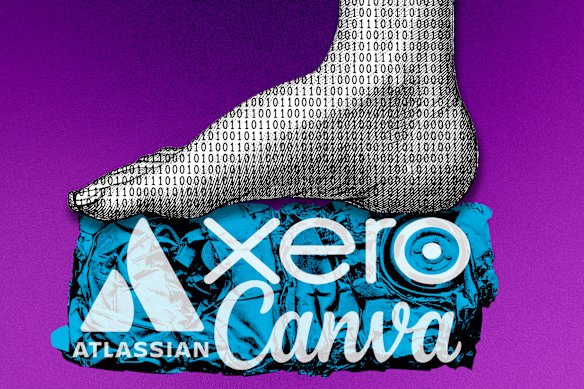 New AI tools could threaten the future of Australian giants like Atlassian, Canva and Xero. Monique Westermann
The lightbulb moment came from a seemingly innocuous release from an AI darling Anthropic called Claude Cowork, a productivity agent for the legal world that helps automate tasks.
You can imagine the thought process that followed: What if this agentic AI tool doesn’t just replace legal assistants? What if it replaces software tools law firms are currently using?
And what would stop a domino effect on the core apps used across businesses globally?
As Barclays asked in a research note last week: Is this the end of software?
First to implode were listed publishing and legal software companies, including Thomson Reuters, but this was soon followed by data companies like the London Stock Exchange as fears spread to AI’s impact on data companies.
By the time this hysteria hit Australian shores on Wednesday morning, hundreds of billions of dollars had been wiped off the valuation of both software and financial tech groups as well as listed private equity groups such as Blackstone and KKR, which have gorged on software companies over the past decade.
Losses exceeded $US1 trillion ($1.44 trillion) by the end of the week, compounded by worries over the vast amounts other tech companies were spending on AI.
The argument for high margin software companies being valued on multiples of revenue – based on the assumption there will be no end to their hold on enterprise customers – has been smashed.
Claude was not the first sign of trouble; it merely supercharged fears that have been building since last year.
Even in Australia, the plunging share prices of REA (locally) and Atlassian (on the Nasdaq) have been sending warning signals since last year that AI might be more foe than friend.
 Investors are wondering if real estate agents will need REA if buyers can use agentic AI tools.Peter Rae
The threat for property group REA is easy to understand. Why would real estate agents need to pay as much as $5000 for a listing with the group when an AI agent, actioned by potential buyers, can grab the information directly from the agents?
Agent Claude and its ilk appear to have spelled the danger out so clearly that everyone is now taking notice. The problem is, no one is sure which companies will be winners and which will be roadkill.
Xero held an investor briefing this week to allay AI fears that have halved its share price in less than a year.
“We have a clear AI strategy that supports our long-term growth opportunity,” Xero boss Sukhinder Singh Cassidy said.
Even the most recent tech darlings who rode the software-as-a-service (SaaS) wave, such as Atlassian and Canva, are in a lot of strife.
“We call it the ‘SaaSpocalypse’, an apocalypse for software-as-a-service stocks,” Jeffrey Favuzza, a trader at securities group Jefferies, told Bloomberg.
“The draconian view is that software will be the next print media or department stores, in terms of their prospects,” he said.
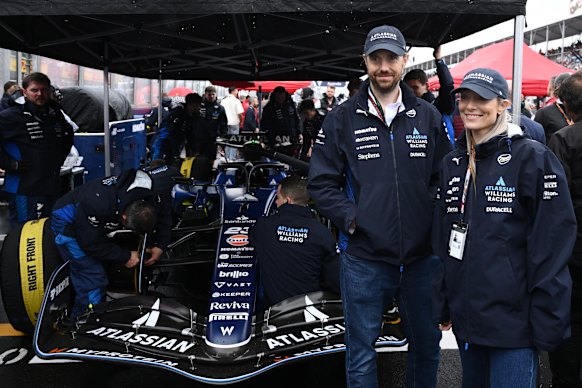 Tech billionaire Mike Cannon-Brookes is struggling to convince the market that Atlassian won’t be left in the slow lane by nimble AI-native rivals.AAP
You only need to look at the sinking Adobe share price, which is down more than 40 per cent over the past year as the market worries about AI driving “seat compression” as higher productivity reduces paid licences.
It will be a big issue for Canva, which was valued at more than $US40 billion last year.
Australia’s vocal tech billionaires from Atlassian, Mike Cannon-Brookes and Scott Farquhar, also know this narrative well.
Atlassian’s share price has dropped from a year high of $US326 to just $US97 this week. Cannon-Brookes and co-founder Farquhar told investors on Friday that they would stop selling shares “to further underscore their conviction in our massive long-term growth opportunities” but their remaining Atlassian stock has shed as much as $US24 billion in value over the past year.
At Atlassian’s December quarter results on Friday, Cannon-Brookes weathered awkward questions about the Anthropic storm, but he used Atlassian and Anthropic’s co-sponsorship of the same Formula 1 team to explain how the two could co-exist.
“We’re both helping that team to get to the front of the grid with a combination of all of our software and tools, and I think that’s a great example,” he told analysts and investors.
“AI is the best thing to happen to Atlassian, and the results we are seeing today are no accident,” he said as the group’s share price dropped by about 10 per cent in extended trading.
Our tech rich-listers are not the only ones who need to worry.
This existential uncertainty is awful news for the privately owned, multibillion-dollar tech success stories like Canva, Culture Amp, Safety Culture and Rokt, which has delayed its public listing due to the AI volatility.
Related Article
It is also a major stress test for Australia’s insanely successful venture capital groups, which have multibillion-dollar valuations on tech start-ups like Canva. And keep in mind that there is a good chance your super fund is invested in these venture capital groups.
But the interesting part is how venture capital has already pivoted from SaaS start-ups to the world of AI.
While Atlassian says it can upgrade its business tools with AI, US-based Aussie Alex McLeod clinched a billion-dollar valuation for his AI start-up Serval, just two years after its inception.
Like Atlassian, it targets developers and tech support teams, but it is built from the ground up on AI.
In Australia, AI start-ups dominated the $5 billion that venture capitalists spent on start-ups last year.
Blackbird Ventures said about 60 per cent of its recent early-stage investments had been in start-ups that had AI central to their core services.
It might make it that much harder for old dogs like Cannon-Brookes to convince the market that Atlassian can learn new tricks.
The Business Briefing newsletter delivers major stories, exclusive coverage and expert opinion. Sign up to get it every weekday morning.
Save
You have reached your maximum number of saved items.
Remove items from your saved list to add more.
 Colin Kruger is a senior business reporter for the Sydney Morning Herald and The Age.Connect via email.From our partners