
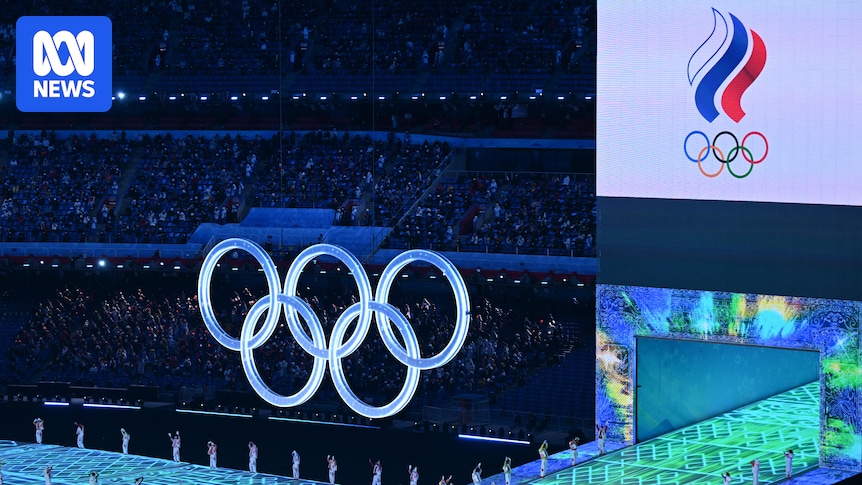
Another Olympic Games. Another festival of sport without Russia or Belarus.
As was the case in Paris two years ago, there will be no sign of the Russian or Belarusian flag, name or colours at the 2026 Winter Olympics.
But there will be a handful of athletes with Russian or Belarusian passports competing in northern Italy.
Why was Russia banned from the Olympics?
Russia was banned from the Olympics in October 2023, 20 months after the invasion of Ukraine that took place in the days after the Beijing Winter Olympics.
Belarus, due to the country’s support of Russia’s war, was also banned.
The principal reason for the ban was not the war specifically, although the IOC did recommend that individual sporting organisations suspend Russia in March 2022.
It was actually when the Russian Olympic Committee took over sporting organisations in several regions within Ukraine, such as Donetsk, Kherson and Luhansk, that the IOC confirmed the ban.
That constituted “a breach of the Olympic Charter because it violates the territorial integrity of the NOC [National Olympic Committee] of Ukraine”, according to the IOC.
Wasn’t Russia called something else in Beijing?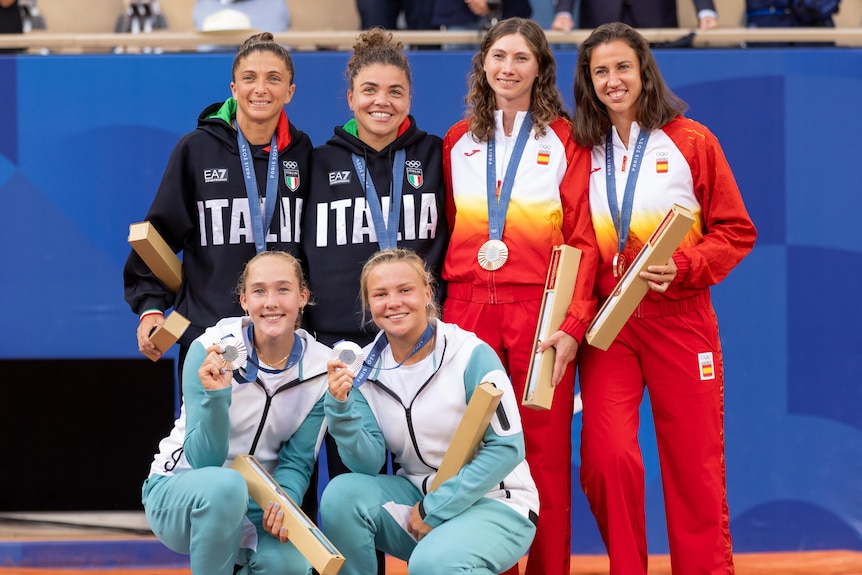
Tennis players Mirra Andreeva and Diana Shnaider (front) had to wear bland uniforms, devoid of national colours in Paris. (Getty Images: DeFodi Images/Tnani Badreddine)
In Tokyo in 2021 and at the 2022 Winter Olympics in Beijing, Russian athletes competed under the moniker ROC.
ROC stands for Russian Olympic Committee, and Russian athletes were allowed to represent the committee, even though they could not represent their own country.
That acronym was used due to a long-running state doping scandal that further intensified at those Games after the positive test of 15-year-old figure skater Kamila Valieva.
Russia sent 200 athletes to the 2022 Beijing Winter Games under the ROC moniker, winning 32 medals, including five golds.
What is the AIN at the Winter Olympics?
AIN stands for Athlètes Individuels Neutres, which in English is Individual Neutral Athletes.
The AIN is the name used to represent approved Russian and Belarusian athletes at the 2026 Winter Olympics.
It is the same designation that approved athletes from those two countries were given at the 2024 Paris Olympics.
There, 32 athletes competed, winning a gold, three silvers and a bronze medal.
Those athletes are banned from using the neutral Olympic flag and Olympic anthem, which has been used in the past for neutral athletes.
It will, instead, use a flag depicting a circular AIN emblem and a one-off instrumental anthem that has been assigned by the IOC.
Which Russian or Belarusian athletes are eligible?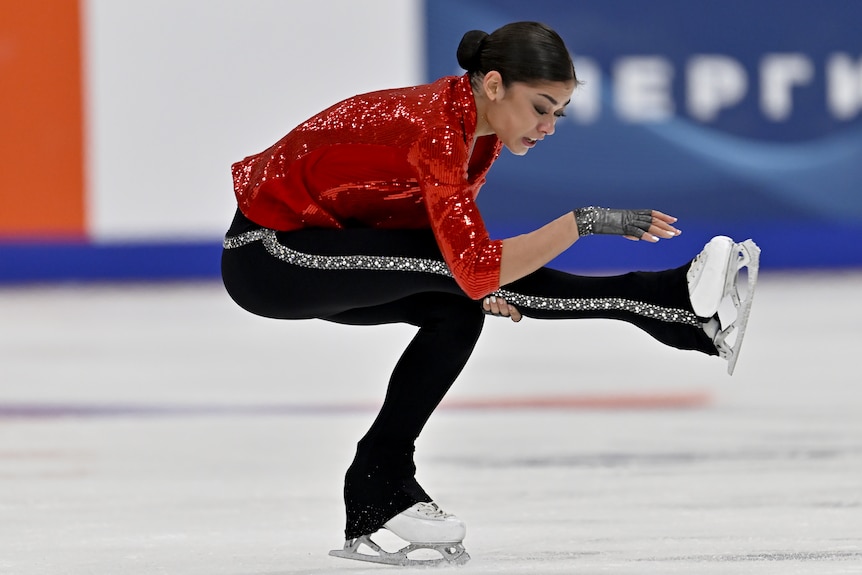
Figure skater Adeliia Petrosian, of Russia, will perform as an individual neutral athlete at the Milano Cortina Games. (Getty Images: Anadolu/Sefa Karacan)
A total of 20 athletes will compete under the AIN banner at these Games; 13 from Russia and seven from Belarus.
They cannot compete in team events, the IOC justifiably stating that individuals cannot be part of a team, which rules out ice hockey, curling and the team figure skating events.
The “principles of participation” state that only athletes who have “not acted against the peace mission” of the IOC “by actively supporting the war” will be invited.
The BBC conducted an investigation that suggested four of the Russian athletes cleared to compete have, in fact, breached the terms laid out by the IOC, either by being members of the Russian armed forces or by liking pro-War material online.
The athletes have to be approved by their sport’s governing body, so FIS for skiing, ISU for ice skating events, the FIL for luge and the ISMF for skimo.
They are then vetted by an IOC-appointed panel.
Here is the list:
Russia:
Yulia Pleshkova — Alpine skiingSimon Efimov — Alpine skiingSavelii Korostelev — cross-country skiingDaria Nepriaeva — cross-country skiingPetr Gumennik — figure skatingAdeliia Petrosian — figure skatingDaria Olesik — lugePavel Repilov — lugeIvan Posashkov — short-trackAlena Krylova — short-trackNikita Filippov — ski mountaineeringKseniia Korzhova — speed skatingAnastasiia Semenova — speed skating
Belarus:
Marina Zueva — speed skatingHanna Karaliova — cross-country skiingViktoriya Safonova — figure skatingMaria Shkanova — Alpine skiingAnastasiya Andryianava — freestyle skiingAnna Derugo — freestyle skiingHanna Huskova — freestyle skiingRussian athletes took FIS to court to compete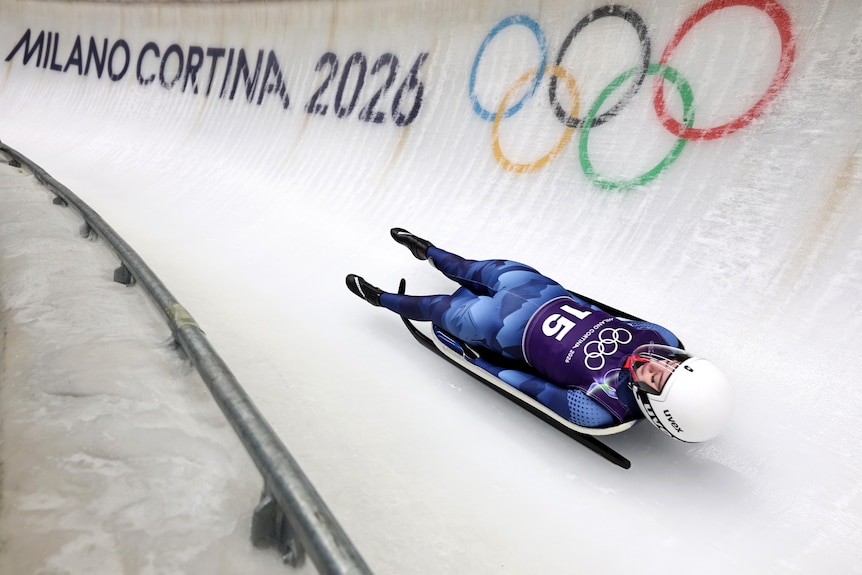
Daria Olesik fought a legal challenge to be able to compete. (Getty Images: Carmen Mandato)
Only a handful of Russians and Belarusians have been invited to compete in skiing events, but even that number is controversial.
Skiing governing body, the FIS — which oversees Alpine, Nordic and freestyle skiing as well as snowboarding events at the Games, 57 of the 116 medal events — had banned all Russian and Belarusian athletes from competing in sanctioned events since February 2022 and renewed the ban in October last year.
However, Russia appealed to the Court of Arbitration for Sport (CAS) which overturned the ban on December 2.
The FIL (International Luge Federation) had also issued a blanket ban on athletes from those countries but had that overturned by CAS
Sports bodies had justified the exclusion of Russians for security reasons, to protect athletes and prevent protests that also could disrupt events.
Are Russia ever going to come back into the Olympic fold?
You’d argue it will be inevitable at some point, not least since FIFA president Gianni Infantino said the ban on Russia competing in football should “definitely” be lifted, “at least at youth level”.
Infantino told Sky News that the ban had “not achieved anything” and “created more frustration, and hatred.”
That was described by Matvii Bidnyi, Ukraine’s sports minister, as “irresponsible” and “infantile”.
“They detach football from the reality in which children are being killed,” he said.
“Let me remind you that since the start of Russia’s full-scale aggression, more than 650 Ukrainian athletes and coaches have been killed by Russians.”
Nevertheless, this came after a recommendation from the Olympic Summit that international sports federations allow Russian teams and athletes to compete under their national flag at youth level.
And IOC president Kirsty Coventry said sport should be a “neutral ground” where athletes can “compete freely, without being held back by politics”.
However, she also noted that “the October 2023 decision [to suspend Russia and Belarus] still stands. We have kept in place the neutral athletes’ status, as per Paris, and that decision has not been spoken about in the last couple of weeks”.