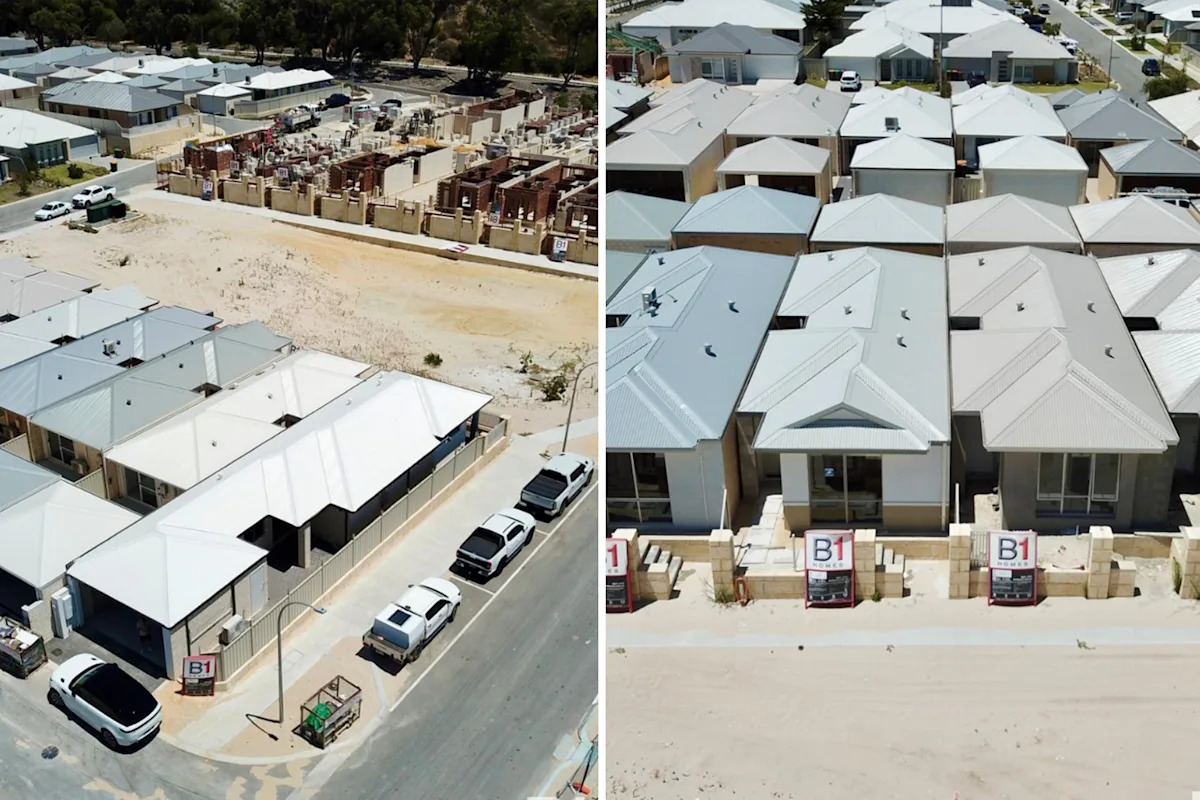
Potential home buyers are lashing out at “soulless” housing estates on the outskirts of Aussie cities. Rows of new builds in a Perth estate, that appear to almost be touching each other, “look like hell”, some residents say.
Images of the estate in Yanchep, roughly 55km from Perth’s CBD, were criticised last week after B1 Homes revealed online that a local couple had snapped up one of the lots as an investment property. The post has since copped complaints about the lack of visible trees and room between each dwelling.
“You’d be able to smell the curry being cooked next door for sure,” one man said, while another joked that he’d be scared to fart in case his neighbour heard it.
Others pondered if it would have been better to construct an apartment block with a “shared green space”.
The tightly packed homes are the result of a “disturbing” property trend gaining traction across the country as Australia’s dire housing crisis escalates, with availability hitting record lows while demand continues to grow.
They are largely designed for first-home buyers, whose dream is getting more out of reach as “affordable” home prices jump faster than premium dwellings.
While they’re keen to get their foot on the ladder, it doesn’t come without some obvious sacrifices, Liam Davies, a lecturer in sustainability and urban planning at RMIT University told Yahoo News Australia.
Do you have a story? Contact newsroomau@yahoonews.com
Why housing trend across Australia incites ‘visceral’ reaction
Zero-lot boundary homes, like the ones pictured above, are built directly on the property line.
How close a house can be built to the boundary line is determined by local council and state zoning regulations, but in many regions, the garages at least can be built right up to the boundary.
Images of such suburbs often trigger “a bit of a visceral reaction” because when we live in the inner-city, we expect to compromise our space for more amenities such as transportation, parks and public transport, Davies said.
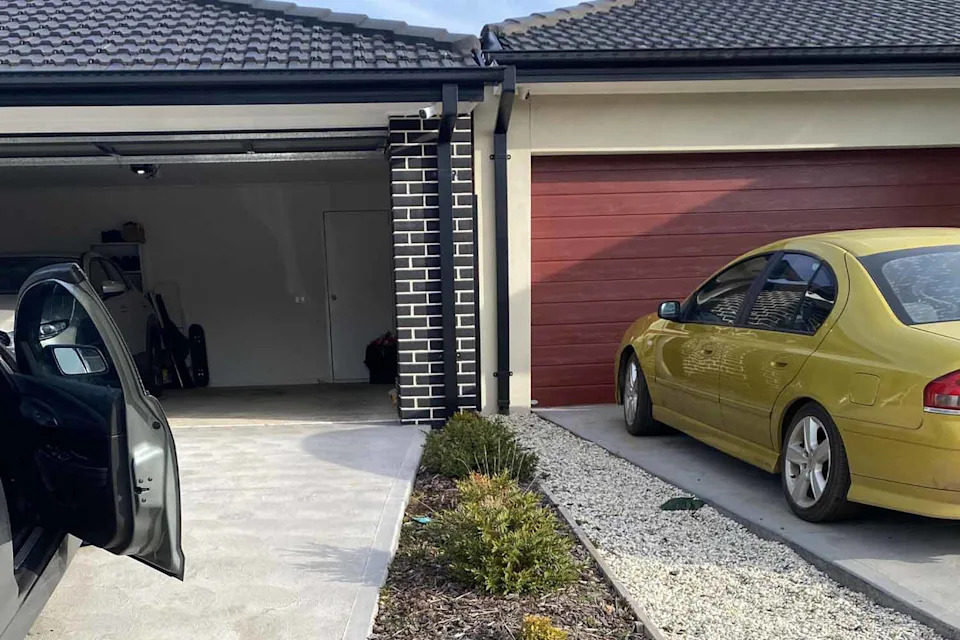
Properties in Victoria being built close together have created tension among neighbours, Yahoo previously reported. Source: Reddit/al4n4h
If you live in the suburbs, you typically have less amenities, but the trade off is a much bigger house, traditionally, a backyard and “more self-contained living experience”, he explained.
“We can almost think about it in the dichotomy between these two trade-offs, but what we don’t want is low housing amenity and low neighbourhood amenity,” the researcher told Yahoo News.
“To address housing affordability, what we’ve seen is a bit of a trend towards more townhouse and row house design on smaller blocks in suburban areas, [but] are we delivering suburbs that people want to live in? Or are we delivering, in a very literal sense, a product that allows people to achieve some level of home ownership?
“Really, they’re kind of losing in both ways. They’re not getting a house with a nice backyard, they’re not getting a house with generous bedroom sizes, and they’re also not getting either neighbourhood amenity that creates a quality and vibrant life.”
Aussies are making big sacrifices to get on the property ladder
People have been making lifestyle trade-offs to fit within their budget for several years now, Davies said.
The problem is especially obvious in Perth, which has seen “extraordinary growth in housing prices over the past few years”, meaning “people are quickly getting priced out”, Davies told Yahoo.
Aussies are often buying houses that are “too small for their needs and too far from where they want to live because it’s what they can afford”.
“The suburban dream is the Hills Hoist, the sprinkler on the lawn. Now increasingly, we’re not seeing that, but when it’s squeezed to the point that you can’t even imagine where you put pot plants, or where you’d sit outside for a morning coffee or for breakfast, it starts to become a bit of an awkward feeling,” Davies said.
At the end of the day, Australia has a housing affordability crisis, and local authorities are reacting to this by allowing increasingly small blocks to lower costs, he added.
Local council responds to images of ‘hellish’ housing estate
The Yanchep housing estate is located within the Wanneroo City Council, which is expected to see a 64 per cent population growth over the next decade, reaching 400,000 by 2035.
Speaking to Yahoo, the council explained that “this style of development is governed by a state-led planning framework that sets the requirements for lot size and configuration, as well as housing design standards, across Western Australia”.
“The City’s role is to assess applications for compliance within those requirements, while supporting well‑functioning, liveable neighbourhoods where people can move around easily, connect with others and feel a part of their community,” the spokesperson added.
Yahoo understands the photos of the new estate show the development prior to completion, with landscaping, street trees, footpaths, road finishes and pedestrian connections yet to be delivered.
B1 Homes did not respond to multiple requests for comment.
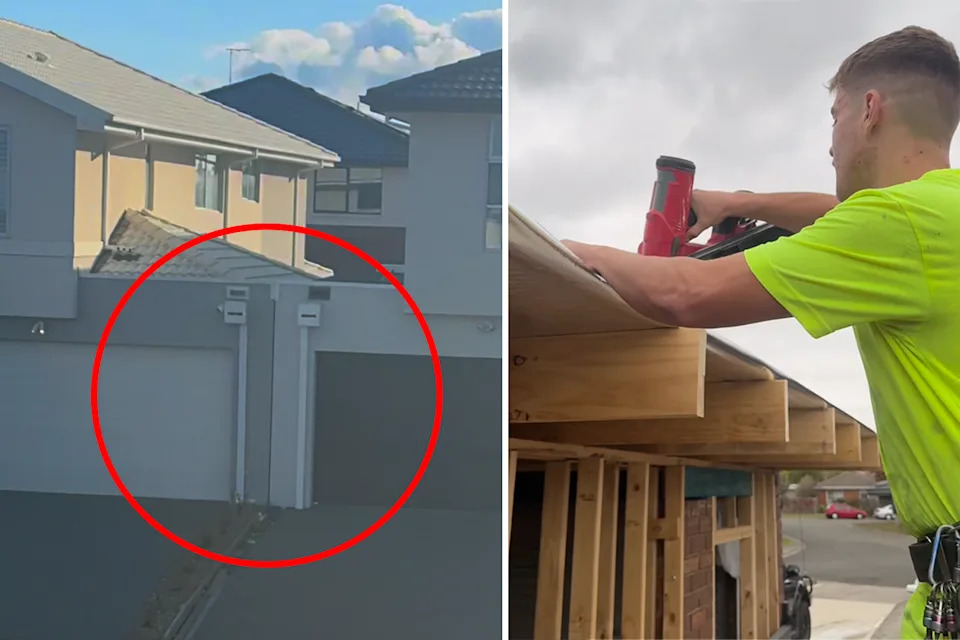
Australian homes are getting closer and closer to one another in overpopulated cities, as highlighted by a tradie on a worksite. Source: Supplied & TikTok/onlyframes
What does this trend mean for the long-term?
If the housing trend continues, and we keep building zero-lot suburbs, it’s important that we pay attention to the broader environment, Davies told Yahoo.
Higher-density living in outer suburbs would be a far more attractive option if there are nearby shopping strips or neighbourhood centres with supermarkets, cafes and some open, walkable spaces, he argued.
Overall, their existence is “an illumination into the reality of relying on markets to create affordable housing”, Davies said.
“Markets will create affordable housing by trying to decrease costs, but if we want quality affordable housing, we have to think more systemically about how we want to do that, and that means being more intentional with our planning system and expecting more from developers and landowners.
“But it also means expecting more from our governments to actually put in place processes to make more liveable and enjoyable suburbs.”
Do you have a story tip? Email: newsroomau@yahoonews.com.
You can also follow us on Facebook, Instagram, TikTok, Twitter and YouTube.