
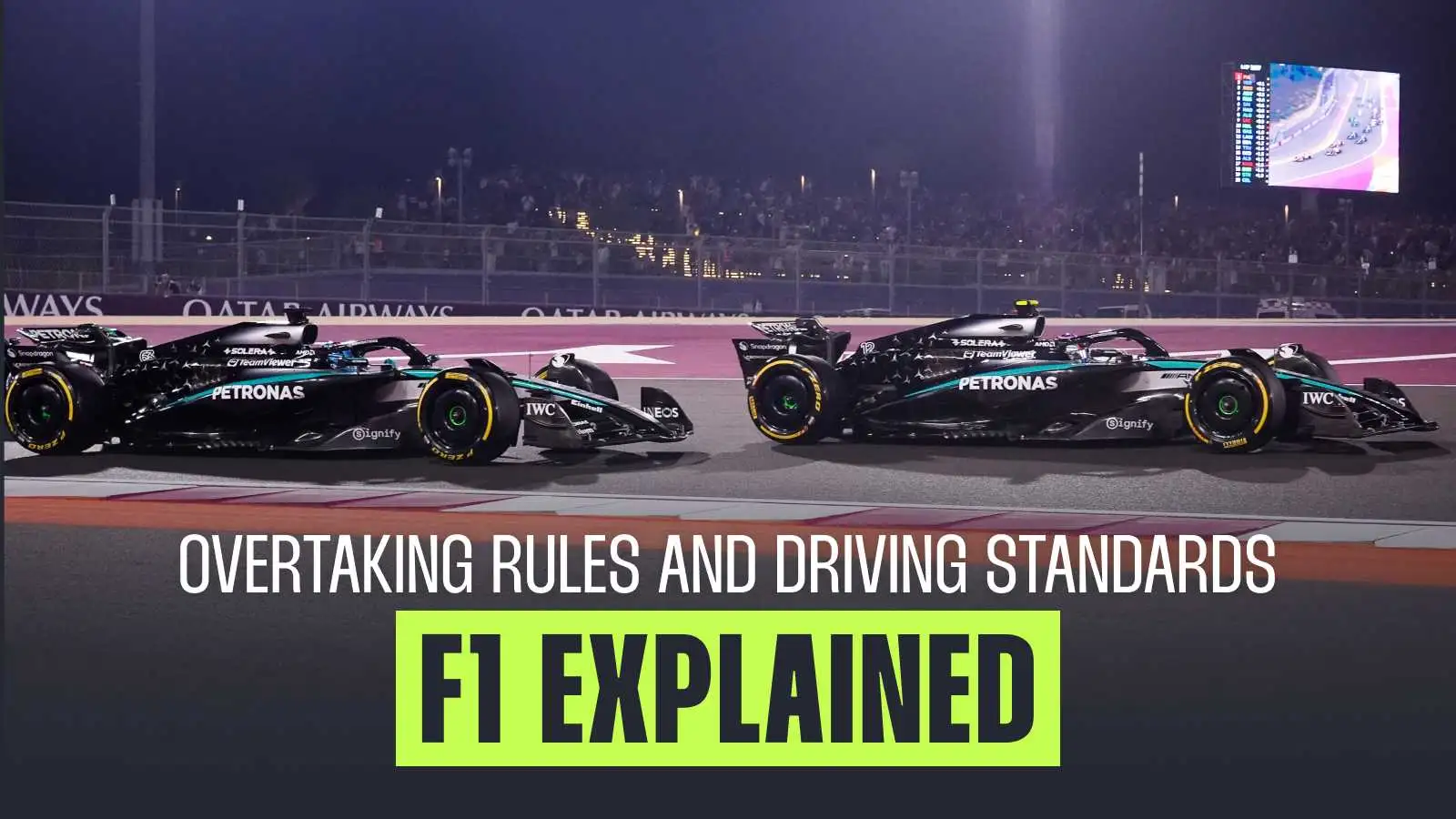
Formula 1’s overtaking rules, or Driving Standards Guidelines, have become an increasingly talked-about factor of the sport in recent years.
Introduced to clear up on-track incidents and help make the process of identifying possible penalties easier, here is a look at how Formula 1 drivers are expected to go racing.
Formula 1’s Driving Standards Guidelines
The sport introduced its Driving Standards Guidelines for the first time in 2022, effectively providing written clarity on the ‘right’ and ‘wrong’ way to overtake, when drivers need to cede positions, and catering for as many scenarios as possible when racing on track.
The FIA emphasises in the document that it standardises the process across all its categories, too, meaning drivers on the junior ladder now will be expected to know how to race fairly if and when they reach Formula 1 or other senior series.
Crucially, though, these are guidelines and not regulations – meaning they are not enshrined within official FIA rules. Every on-track incident is viewed subjectively by the stewards, but the guidelines provide a standardised way that each contentious moment should be viewed.
Formula 1’s overtaking guidelines
The most recent issue of the Driving Standards Guidelines states that, for drivers overtaking on the inside, the car must have its front axle at least alongside the mirror of the other car prior to and at the apex of a corner, to be entitled to racing room.
Also, the overtaking car must be driven in a “fully controlled manner”, and not be adjudged to have “dived in” to a corner, taking a reasonable racing line throughout and being able to remain within track limits, in the view of the stewards.
For cars going around the outside, it is seen as a tougher manoeuvre, so to be entitled to racing room, overtaking drivers must have their front axle ahead of the defending car’s front axle at the apex, while being able to round the corner within track limits.
Both rules also apply to respective parts of chicanes and esses, but the FIA clarified that priority would be given at the first corner element – so, on a left-right combination, the overtaking driver would need priority at the left-hander.
Track limits also play a part in overtaking, as drivers must not leave the track and gain a lasting advantage to overtake. If this happens, the driver to have overtaken will be required to hand the place back.
Likewise, if the defending driver breaches track limits to maintain position, when an attacker was entitled to racing room, the defending driver will be required to cede position in a safe and timely manner or risk a penalty.
F1 explained: More on the world of Formula 1 from PlanetF1.com
Explained: F1’s complex power unit upgrade system from 2026 onwards
F1 jargon decoded: Breaking down what key Formula 1 words mean
How defending a position is policed
If on a straight towards a corner, drivers defending a position are only allowed to conduct one defensive move to the inside or outside, meaning weaving is strictly prohibited.
Likewise, moving under braking is not allowed – so once a driver commits to the inside or outside line, they should stay there through the apex.
Crowding a driver is not allowed either, so if a driver is looking to overtake, turning so that the attacking driver is pushed outside track limits is prohibited.
These offences can all be considered forms of impeding, which also forbids drivers from blocking another’s path on track in the context of racing.
How attacking a position is policed
Drivers are not allowed to simply ‘divebomb’ their way past a rival if it means getting ahead, but the Driving Standards Guidelines to place emphasis on promoting ‘hard and competitive’ racing throughout, incentivising overtaking as much as possible.
The rules are less stringent on attackers as a result.
Because every contentious overtaking move will have subjective factors attached, however, the Driving Standards Guidelines offer the following for the stewards to consider when deliberating:
How did the cars get to the incident? (E.g. late braking, diving in, moving under braking.)
Was the manoeuvre late or “optimistic”?
What could the drivers reasonably see, know, or anticipate?
Do we believe the manoeuvre could be completed on the track?
Was there understeer / oversteer / locking?
Did someone position / handle their car in a way that contributed to the incident?
Did the type of corner contribute to the incident? (e.g. camber, kerbs, curve, apexes)
What were the relative tyres / tyre age / grip?
Alongside these points, as mentioned above, an attacking driver must keep their car under full control when overtaking, complete the move within track limits and take a reasonable racing line while doing so.
Should an attacking driver meet the requirement of having enough of the car alongside the defending driver as per the rules listed surrounding the inside or outside, however, the Driving Standards Guidelines state that the attacking driver has priority, meaning it is then incumbent on the defending driver to not force the attacker off track or cause a collision.
Penalties available to stewards when offences take place
The FIA made a full list of offences and the potential punishments attached available to the public in mid-2025, in a bid to improve transparency around stewarding decisions that were taking place.
We have compiled the full list from across the race weekend, but in the context of overtaking, we have condensed the FIA’s punishments into the relevant offences.
The majority of offences come with penalty points attached to a driver’s Super Licence, and if a driver reaches 12 points within a rolling 12-month period, they will be subject to a race ban.
Like the Driving Standards Guidelines, these are merely guidelines which the race stewards can use, with the asterisk (*) representing the maximum number of penalty points available for each transgression.
Offence
Possible punishments
Penalty points
Causing a collision ‘with apparent deliberate or reckless intent’
10s stop/go
4*
Causing a collision
10s penalty (baseline),
drive-through or 10s stop/go (or a grid penalty if the driver failed to finish the race)
5s penalty in mitigating circumstances
3*
Driving unnecessarily slowly in a dangerous manner
10s penalty (baseline), drive-through or 10s stop/go (or a grid penalty if the driver failed to finish the race)
5s penalty in mitigating circumstances
3*
Driving erratically or in a manner which could be deemed potentially dangerous
As above
3*
Dangerously crossing pit entry/exit line
Drive-through, 10s stop/go
3
Impeding with intent
Grid penalty
3
Moving in the braking zone “in a manner deemed potentially dangerous”
5s penalty up to drive-through
3
More than one change of direction to defend a position
5s penalty up to drive-through
3
Overtaking in pit entry/pit exit when SC using the pit lane
10s penalty up to 10s stop/go
3*
Overtaking another car in SC/VSC conditions
10s penalty up to 10s stop/go
2-3
Forcing a driver off the track (recklessly)
10s penalty up to 10s stop/go
2 (3)
Leaving the track and re-joining unsafely
5s penalty up to drive-through
2
Read next: How much does it cost to get to F1? The incredible price young drivers pay