
Photo-Illustration: Intelligencer; Photos: YouTube, Getty Images
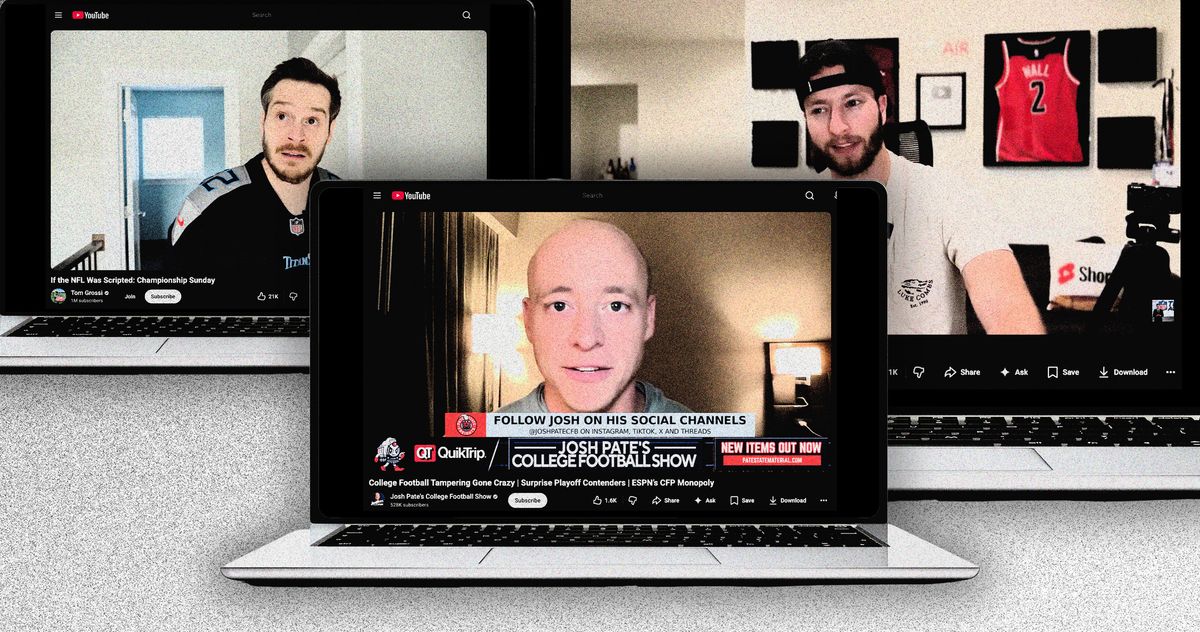
Last week, Josh Pate, a college football Youtuber with 500,000 subscribers, broadcast his popular show from a hotel room, those unmistakable curtains, floor lamps, and bedside sconces all in the background. Normally he produces content from a brick-lined, souvenir-laden studio in Nashville, but Pate had fled the city’s destructive ice storm to seek refuge out of town. The college-football season is over and there was no breaking news, and he’s only contractually obligated to put on a show twice a week in the offseason. For him, though, there was no question that the show must go on.
“We had all the reasons to slack off a little bit,” Pate said by phone recently. “But there is someone out there who is really counting on the episode drop on Tuesday.”
It’s not because Pate’s audience is thirsting for offseason college-football chat, exactly. It’s because he and many other football content creators are a lighthouse, or a North Star, both Pate’s words, to a generation of men, an audience who, behind the scenes, quietly and often reaches out to their favorite YouTubers and podcasters asking for help — or just for someone to listen. These fans might be going through a breakup, or lost their job, or are even contemplating suicide, but their favorite streamer is something to look forward to — maybe the only thing at the moment. For 21st-century media celebrities, this is the secret side of their professions. The ease of texting and private messaging has opened up a new dimension in parasocial relationships between sports-media celebrities and their fans, one in which there’s no offseason.
“If you’re having a shitty day at work, or you just failed a test, or your parents are getting divorced, you know I’m going to post something,” said Andrew Fenichel, another prolific creator who specializes in punchy sports takes in the TikTok overlay style. “I don’t want to speak for the audience, but from what they tell me, they know I post every day and that watching my stuff is an escape for them.”
The loneliness epidemic, you may have heard, has worsened. Studies show that Americans have fewer close friends than ever and that men in particular are starved for connection. Male sports fans are not a cohort known for being comfortable with vulnerability, and often listeners DM their favorite YouTuber or podcaster about football, or a segment on the show, over the course of months or years before feeling comfortable enough to really open up. Or they write, vaguely suggesting they’re going through a tough time, and they just need prayers or someone to listen to them.
Ask Pate what the most common things men need to talk about right now, and he’s clear about it. “Broken homes, by ten miles,” Pate said. “From ‘I’m getting a divorce’ to ‘We’re having issues with my kids’ — and then comes the piece of being under financial strain, which is leading to issues with the marriage. In fact, rarely can I remember an instance where the broken home and the financial piece didn’t eventually intersect.”
Then there are the sudden tragedies: a child diagnosed with cancer, or maybe a family member passing away. Still, all of this is traditionally the job of a therapist. Why are men talking to YouTubers?
“This is not at all a surprise to me,” said Dr. Gayle Stever, a social and behavioral sciences professor at SUNY Empire who has studied parasocial relationships for nearly 40 years. In fact, humans are predisposed to it.
“Attachment theory says that we are biologically hardwired to seek proximity to our comfort objects,” Stever says. “When we’re infants, those are our caregivers, but as we age, we develop transitional objects: a blanket, stuffed animal, or toy — but there’s an argument that media figures can become transitional objects. I think the argument could be made that they provide a sense of security, and so as we grow, the objects that we connect to become more sophisticated.”
YouTubers, podcasters, and TikTokers aren’t just providing entertainment. They are a source of comfort, and according to Stever, our brains automatically form a lasting attachment to these people. As algorithms (and advertising revenue) encourage daily frequency, their image and voice and opinions are always accessible.
This obviously isn’t easy for sports-content creators, few of whom are licensed therapists. There is only so much they can do. Oftentimes, though, it’s as basic as listening, or referring their audience member to a professional.
“I am not a trained anything,” Pate says. “I’m not capable of diagnosing much, but I’m capable of listening, at least offering a stable ear. Once you figure out specifics, maybe there’s a common-sense approach, or maybe at the very least you can offer support. Because sometimes this person needs nothing more than just to be heard and supported.”
Tom Grossi, a Packers fan with 1 million YouTube subscribers, makes a variety of NFL content, from slapstick sketches shot around his house to Friday night Q&As from behind a desk surrounded by Green Bay accoutrements, during which his audience sometimes opens up. Helping people feels like an implicit theme in his content: He’s raised more than $2 million for various charities over four years. He has been vocal about his own divorce and about the professional help he sought.
“I’m a former high-school teacher, so I was a mandated reporter, and I’ve taken that route with this as well,” Grossi says. “If somebody needs additional resources, you guide them to those resources, because sometimes it’s really difficult to reach out for help — and easier to reach out to a YouTuber than a therapist. Just being able to be a bridge for these people that need it, it puts some good into the world.”
Of course, not every creator takes the time to read or respond to their audience. A number of high-profile podcasters — retired players, new-media moguls, journalists — refused to comment about this or dismissed the topic as “tricky.”
While many content creators and anyone with a certain level of fame receives correspondence, creators like Pate, Fenichel, and Grossi do seem more approachable: They don’t have bombastic personas like the talking heads on TV; they don’t brazenly monetize their audience in the ways that star-studded shows with big sponsors often do; they are all bootstrappers, not retired players or former media stars with a built-in following. Grossi is open about helping others; Pate grew up in the South and finds that he shares a lot of lifestyle commonalities with his fans when he meets them; while Fenichel has a sincerity that comes through in his posts, and as a Gen-Z elder, is a digital native whose generation grew up forming relationships over the internet.
“I’m sure my grandma would think it’s strange that people are reaching out to me,” Fenichel says. “Even though this would have been a Black Mirror episode 20 years ago, I’m honored that these people come to me and I can be that person for some people.”
The irony here is that the internet is an obvious accelerant of the loneliness epidemic. Yet it can also act as a possible solution to depression or isolation, or at least the beginning of a solution. And while online sports fandom can be toxic and exclusionary, few things instill a sense of community like shared interest in a favorite team, sport, or even broadcaster.
Of course, fandom can coalesce around most any interest, but to Grossi, it’s significant that sports is the pretext for people reaching out to them.
“Sports have a really awesome unifying factor when that aspect is promoted,” Grossi says. “Not the ‘I hate you and I’m going to fight you in the parking lot’ aspect. When the positive aspect is promoted, it can do some really great things.”
Sign Up for the Intelligencer Newsletter
Daily news about the politics, business, and technology shaping our world.
Vox Media, LLC Terms and Privacy Notice