
Just weeks before the crisis emerged, Corporate Travel Management founder Jamie Pherous was beaming in the Brisbane Lions post-match sheds.
The ever-upbeat chief executive, Lions scarf draped around his shoulders, was arm-in-arm at the Melbourne Cricket Ground with young AFL player Logan Morris. Then came a selfie with teammate Jaspa Fletcher.
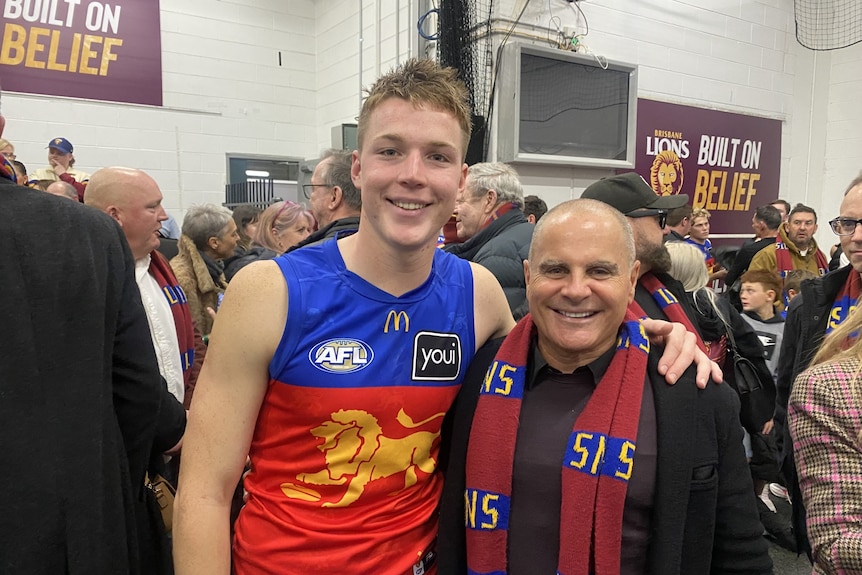
Jamie Pherous pictured with Brisbane Lions player Logan Morris. (Supplied: Facebook)
Pherous’s success equals access.
He’s hired singer Jimmy Barnes for his birthday party and taken US heli-skiing trips, and this night at the football was no different; his $2.3 billion Brisbane-based travel company sponsored the Lions training academy.
The smiles that August night last year were of smashing victories (Lions 92 Collingwood 65) and contrast with failures since enveloping Corporate Travel.
Weeks after the match, it warned auditors had found seemingly benign accounting discrepancies. Then, within months, the picture metastasised: UK customers including the British government had been overcharged up to £77.6 million ($150 million).
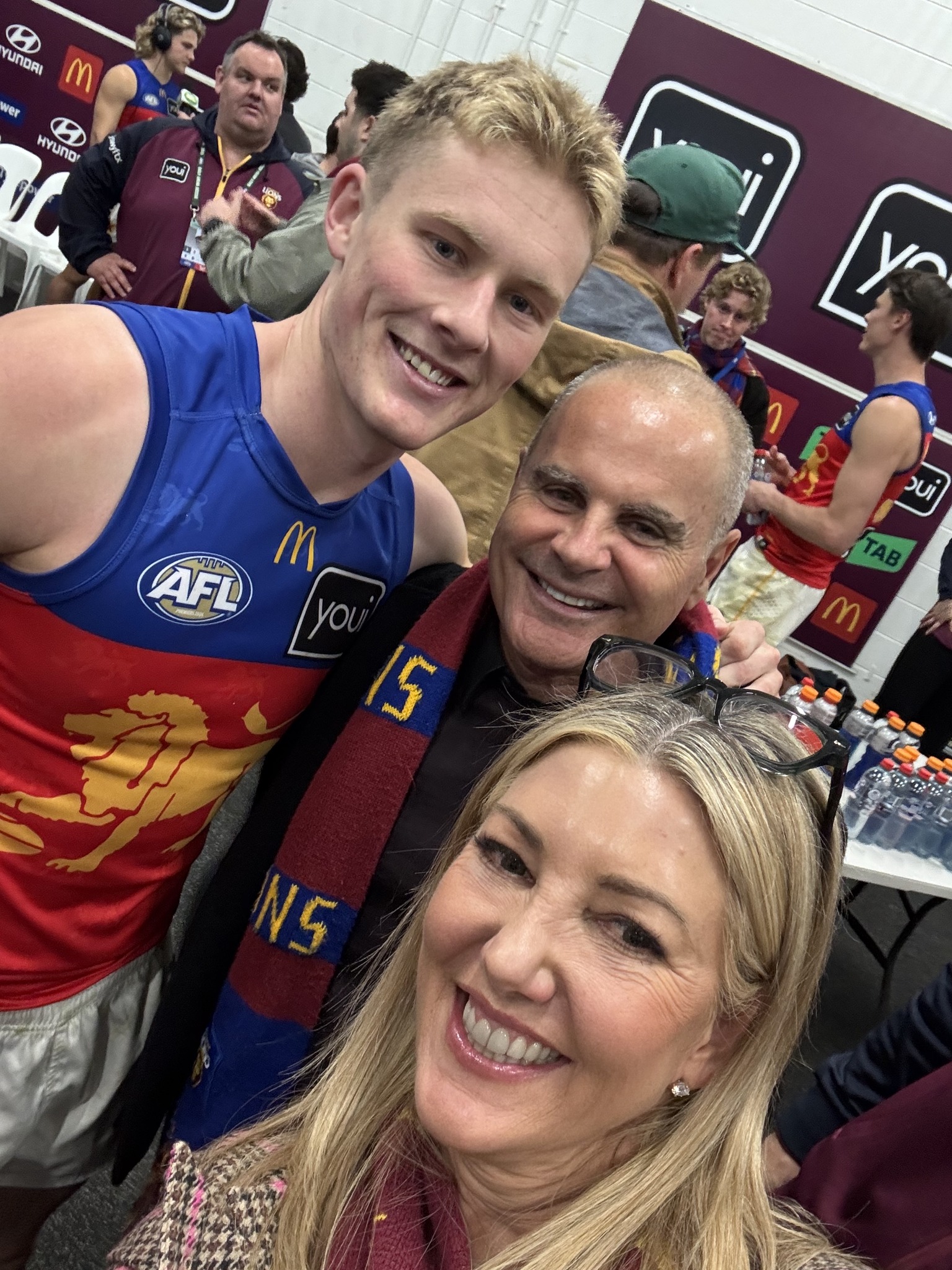
Brisbane Lions player Jaspa Fletcher with Corporate Travel Management CEO Jamie Pherous and Louise Pherous. (Supplied: Facebook)
By this week, with the ASX-listed company’s shares still suspended, Pherous departed as chief executive. Gone was an entrepreneur who grew a business that helped organise travel for big clients including the Australian government or Wesfarmers, and long defied critics.
Many questions remain. But the ABC today, via reviews of accounts and regulatory documents, and discussions with industry and sharemarket sources, can reveal more details about travel-industry overbilling allegations and auditor problems with big UK contracts.
Two employees to big profits
Brisbane-born Pherous, now 57, credited his entrepreneurialism to listening to his parents talk around the dinner table about their fashion boutique business.
“I always knew I wanted my own business, I just did not know what sort,” he said in earlier interviews.

Pherous was a prefect at Brisbane Grammar School. (Supplied)
He attended private school Brisbane Boys Grammar, becoming a prefect. His small stature helped him as coxswain — the one who barks instructions — in the school’s second VIII rowing team.

Jamie Pherous in his rowing days at Brisbane Grammar. (Supplied)
His ensuing accounting career with firm Arthur Andersen went from Papua New Guinea to the Middle East. But finding himself stuck in airports because the firm’s travel agency couldn’t arrange flights, he knew business travel could be done better.
From 1994, with only two employees, his Corporate Travel grew by 2010 to post $3.3 million profits and a stockmarket float at $1 a share.
Corporate Travel swelled with acquisitions and by 2015 handled $2.7 billion in customer trips. That year, the BRW Rich List estimated Pherous’ wealth at $300 million and he wed long-time partner Louise on Hayman Island. It was his second marriage and expanded his family to five sons.

Corporate Travel shares giddily shot past $30 each by 2018. But doubters were gathering.
Jimmy Barnes was belting out Working Class Man at Hamilton Island. It was November 2018 and Pherous was celebrating his 50th birthday with friends at the luxury Qualia resort, hiring the singer for $150,000.
The timing was poor. Days before, short-sellers, who make money from share prices falling, had portrayed Corporate Travel’s accounting as aggressive.

In 2018 Pherous paid $150,000 for Jimmy Barnes to perform at his 50th birthday party. (AAP Image: David Moir)
Margins were too far above rivals, interest income was odd, patents did not exist and some global offices were simply phantom outlets, they claimed. (They added photograph examples, like a supposed Alaskan office that was just a kiosk in a baggage collection area.)
Shares initially dropped 27 per cent. But Corporate Travel refuted the thrust of the allegations, albeit admitting to wrongly describing some technology as patented and its website needed updated office locations.
Other governance concerns emerged, such as when reporters discovered Pherous had in 2018 privately lent $13 million to Brisbane-based company Shine Lawyers. The issue was Shine chair Tony Bellas was also Corporate Travel’s then chair — so Pherous’s boss. (Bellas rejected any conflict of interest existed and said he did not negotiate the loan’s arms-length conditions).

Corporate Travel Management’s client list includes the federal government. (Corporate Travel Management)
Corporate Travel kept busy, traversing COVID-19’s border shutdowns seemingly far better than struggling rivals. One boost was a UK deal repatriating 40,000 Britons in five weeks during the pandemic’s darkest days.
Pherous later said the work had started with calls from a person “close to” then-UK Prime Minister Boris Johnson.
“They’ve just basically said, ‘We’ve got this problem. Can you solve it for us?’ We went, ‘Yeah, absolutely. Give us 12 hours’.”
This was typical Pherous; he did not answer ABC News questions this week but over a decade has been incessantly bullish in interviews or investor briefings.
He was an enthusiastic boss too, one who could switch from business suit to a KISS-style costume at work parties. The company had fantastic perks. One overseas trip to Spain for top staff, for instance, featured hot-air balloons and flamenco dancers.
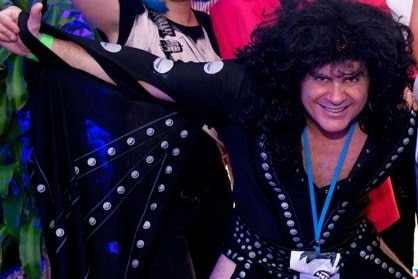
Pherous could be an enthusiastic boss, with staff at a 2013 travel event (Supplied)
Yet amid growth, European earnings leapt out; in 2022 and 2023 its margins were double the company’s other regions.
“It just didn’t add up,” GCQ’s Doug Tynan, a short-seller, would say later.
Then in March 2023, Corporate Travel won oversight of a controversial £1.6 billion UK contract to accommodate asylum-seekers. That included housing them on the floating barge Bibby Stockholm, horrifying refugee advocates.
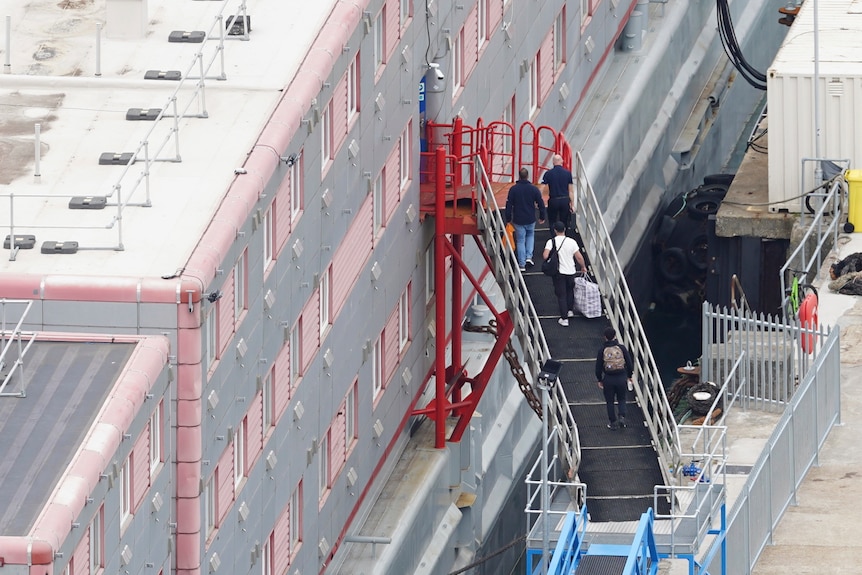
People board the Bibby Stockholm accommodation barge at Portland Port in Dorset in August 2023. (AP: James Manning/PA )
By 2024, the group’s profits were an “underlying” $113.3 million. Accounts for 2025 have not been released and shares remain suspended at $16.07 amid revelations refunds stretch back to 2021 work.
Corporate Travel is tight-lipped on what’s gone wrong, only saying new auditors Deloitte discovered initial discrepancies. So why did Deloitte find what predecessor auditors PwC missed?
One possibility is that the new UK Labour government has been blasting earlier asylum-seeker contracts. Just last May, companies Clearsprings and Mears announced repayments of £46 million, after earning above contracted margins from government hotel-accommodation deals.
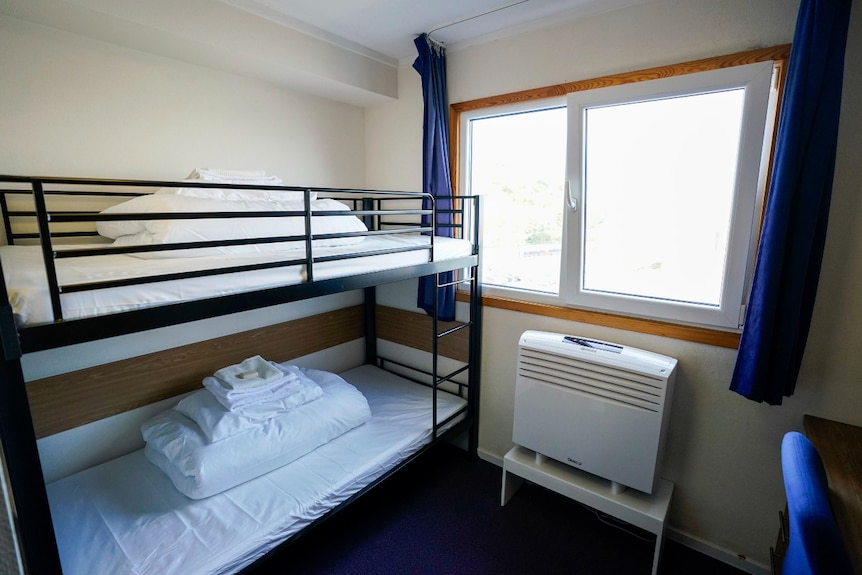
Inside the Bibby Stockholm barge in July 2023. (AP: Andrew Matthews/PA)
Still, sources close to Corporate Travel downplay suggestions government probes triggered the auditors to investigate closer.
Another theory whispered in business circles involves Deloitte itself; regulators have questioned Deloitte’s UK auditors about two earlier client companies with government contracts.
Tagging of criminals
One Deloitte client was Serco, which had a contract for electronic tagging of criminals in the 2010s, and submitted massive false expenses to the government to hide fat margins. The UK’s Financial Reporting Council fined Deloitte £4.2 million in 2019 for “failing to react to clear indicators of the risk of potential fraud on a UK government department”.
A second client was Go Ahead Group, whose majority-owned entity ran a railway in a government deal. That entity concealed for almost six years £27 million in transport department overpayments. UK regulators since 2022 have probed Deloitte’s audit work there.
The theory now goes Deloitte UK auditors were therefore hyper-vigilant to government contracts as they probed Corporate Travel accounts last year. Deloitte declined to comment.
Corporate Travel won’t detail how it overcharged government or other clients in the UK.
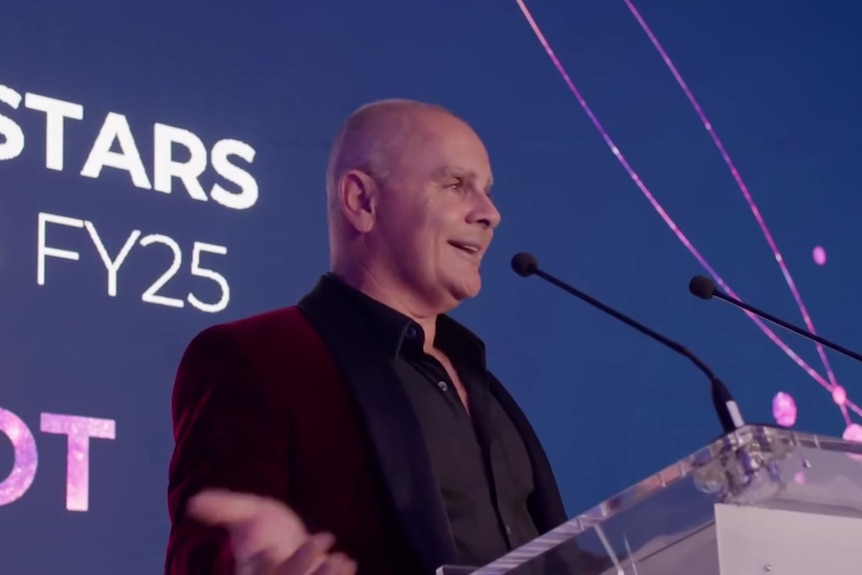
Jamie Pherous at Corporate Travel’s all stars winner tour in Spain in June 2025. (Supplied)
But freedom of information requests by the ABC with Australian governments also uncovered concerns about potential rip-offs by other companies in the sector. The tricks? Hidden airfare mark-ups, or travel agents wrongly pocketing commissions from suppliers such as hotel chains, auditors warned Queensland’s government in one 2022 review.
Another 2021 audit, the ABC can reveal, raised questions about Brisbane-based Flight Centre’s massive NSW government travel contract. The audit is mostly redacted but one section about Flight Centre and “commissions retention” discussed a “precedent of successful action”.
Overcharging allegations
The auditors continued: “in 2017 and 2018, National Australia Bank discovered [Flight Centre] had allegedly been overcharging it for several years by applying hidden mark-ups to airfares … The nature of the alleged wrongdoing was different, being mark-ups versus commission non-payment”.
NAB and the NSW government declined to detail what happened. Flight Centre told the ABC it had settled a “contractual dispute” with the bank amicably and confidentially, while downplaying the NSW government audit and rejecting any wrongdoing.
An auditor had made some “incorrect” comments, Flight Centre said. The travel company said it had responded to subsequent NSW government questions, “there were no outstanding issues and the contract was renewed”.
Corporate Travel Management’s client list includes the federal government. (Supplied)
Corporate Travel’s UK woes, meanwhile, are so serious the Home Office has confirmed investigating an “appalling overspend”.
Morningstar analyst Brian Han said Pherous’ vision had single-handedly built Corporate Travel but “the growth was not accompanied by robust systems.”
Accountability concerns would likely claim more scalps, especially among the board, he added. Still, Han believed a viable business existed.
‘Governance shortfalls’
Mark Wade, one of the few sharemarket analysts who early on published sceptical reports about Corporate Travel, said the company had ominously not updated its business’s performance. Unanswered questions include how “broader governance shortfalls were allowed to manifest”, he added.
Tony O’Connor is a veteran consultant for the travel industry and sees key risks looming for Corporate Travel including shareholder litigation, losing clients, refunds and drying up of credit. “That’s a lot of horsemen to fend off at once,” he said. The wildcard remains the details of the UK event.

A promotional video for Corporate Travel Management. (Corporate Travel Management)
There’s no suggestion of wrongdoing by Pherous – he has left the company on good terms, retaining a six-month consultancy paying almost $337,000 and the company praising his “pivotal” role in its success.
He has, according to multiple sources, recently discussed skiing in Colorado (Even his Instagram profile is of him clad in winter gear, arms outstretched, amid snowy mountains.)
His remaining 16.6 million shares were last worth $267 million but that value is now cloudy. Still, he had crystalised almost $125 million in net share sales, owns an $11.3 million Brisbane home with cliffside pool, and an $8 million beachside Noosa apartment.
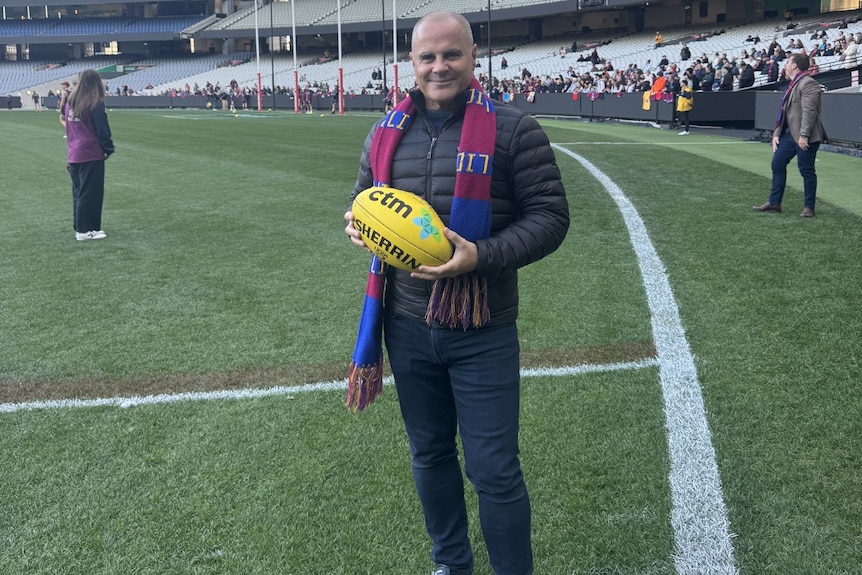
Jamie Pherous with a Brisbane Lions ball which is sponsored by Corporate Travel. (Facebook: Corporate Travel Management)
At least one market watcher thought something seemed odd on last November’s investor call about the massive refund problem.
Pherous was on the phone. Yet others did most of the talking. The usually evangelical entrepreneur’s spirit had seemingly already departed.