
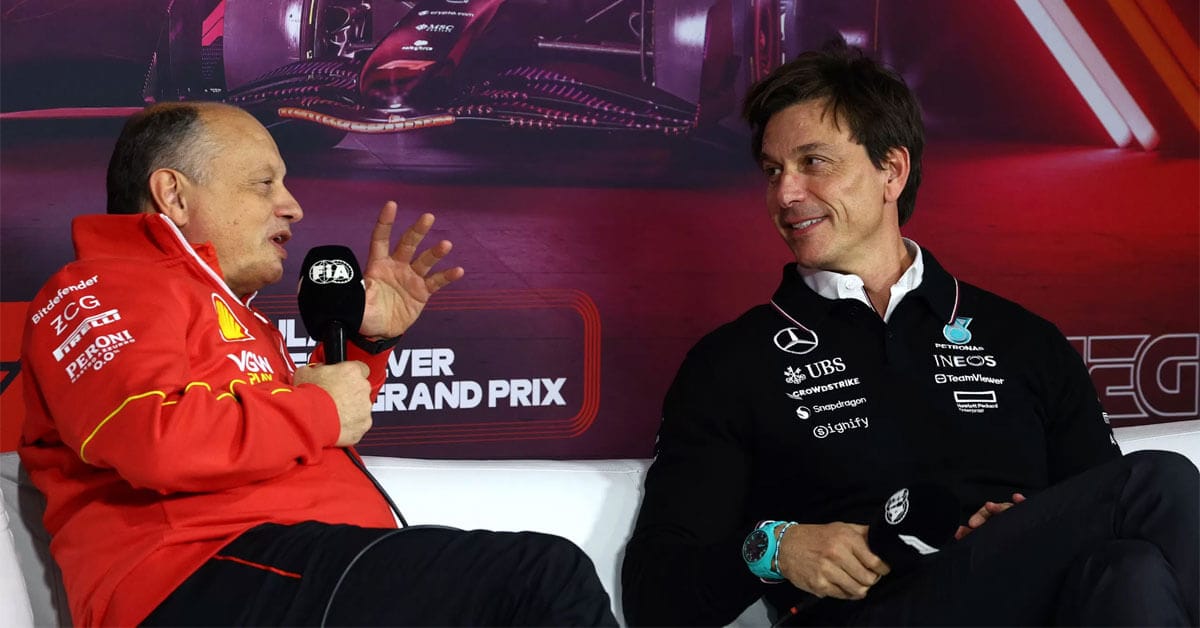
The Mercedes engine case continues to spark intense debate, with the team reportedly developing a solution that could “satisfy” both the FIA and its rivals.
Mercedes has found itself at the centre of controversy following the latest rumours suggesting it may be isolated against all the other engine manufacturers. According to the latest reports, the FIA is evaluating the introduction of new checks related to the compression ratio, with the aim of implementing a solution that could appease the Federation and rival power unit suppliers alike.
The so-called “PU Gate” appears to be taking a direction that aligns with the requests made by Ferrari, Honda and Audi. Red Bull, which from this season runs a power unit developed in-house in collaboration with Ford, is also said to be positioning itself on this side of the debate. As a result, Mercedes could find itself alone against all the other manufacturers.
Toto Wolff made some extremely strong remarks towards rival teams just a few days ago, underlining the growing tension surrounding the issue. The situation appears to be escalating further, particularly because the start of the championship is now only around a month away. The FIA is keen to close the matter as quickly as possible, but the complexity of the situation makes that far from straightforward.
It appears that the International Federation has accepted changes to the inspection procedures, introducing a new method that would be applied starting from the Australian Grand Prix. This new approach would involve measuring the “heated” engine components, but in a static form rather than under dynamic conditions.
Speaking on the issue, Mattia Binotto, former Ferrari team principal and current head of the Audi F1 project, offered a measured perspective during an appearance on the Terruzzi Racconta podcast.
“Even if someone has developed a system that, from a regulatory point of view, may be legal or illegal – and we could debate that for hours – it is not certain that, once you get to the track, this competitive advantage will immediately be shown,” Mattia Binotto explained. “Or shown at all, or in its entirety. So when someone says, ‘Ah, Mercedes has developed this system’, in reality we cannot know that for sure.
“Let us even assume that Mercedes has indeed developed a grey-area system. Even in that case, when you arrive at the track, it is not guaranteed that you will immediately see a clearly superior Mercedes engine. But not because it is not superior. Perhaps, once again, it is simply a strategic choice.”
Mattia Binotto’s comments are closely linked to the ADUO, a system that could help align engine manufacturers in terms of power output through periodic FIA checks.
According to the latest report published by Motorsport.com, Mercedes could also opt to use a fuel with a lower calorific value than the one originally developed by Petronas. This approach could help find a balance by reducing the advantage theoretically obtained through thermal expansion.
However, it is unlikely that this alone will be the definitive solution to an extremely complex situation, one that blends political manoeuvring and technical considerations in the world of Formula 1, right at the dawn of a new regulatory cycle.
The strategic maneuvering between Brixworth and the FIA will be a defining story of the pre-season. Mercedes’ potential willingness to sacrifice a few horsepower via fuel choice shows how high the political stakes have become. For the fans, the true hierarchy of these new 2026 power units remains shrouded in mystery, hidden behind technical grey areas and the looming threat of the first official protests in Melbourne. The desert sun of Bahrain might provide the first real answers, but the legal battle could last much longer.
Feb 7, 2026Maria Lombardi
Let other Scuderia Fans know about us


