
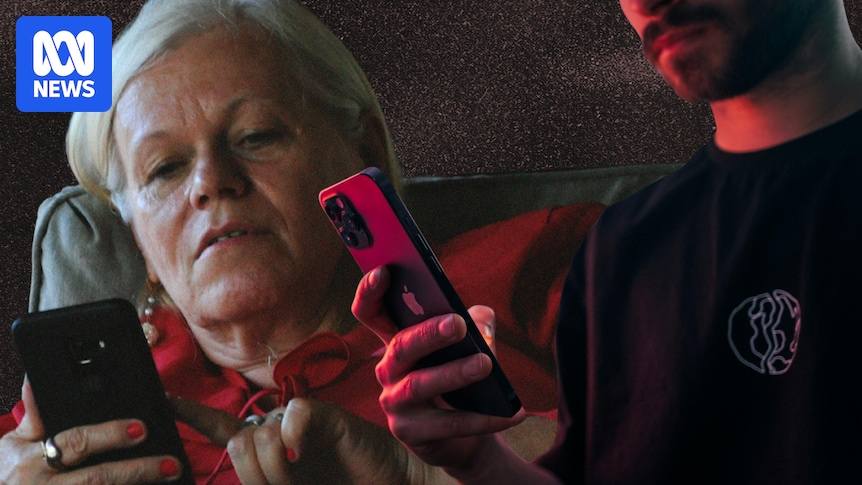
Like many young people, Bailee has faced criticism from older people about her screen time.
“My mum is always like, ‘it’s that phone’, like every single time I do something wrong, she’s like, ‘it’s that phone,'” the 24-year-old told triple j hack.
But after spending time with her mother, Bailee said she was not convinced she was the only one whose relationship with screens was a problem.
“My mum’s addicted to Candy Crush,” she said.
Loading…
“I’ll try to talk to her for like a solid 30 seconds and she’s just locked in on something, and I literally look and it’s just a bubble popping game.”
Social media bans target teenagers
Earlier this week, Spain and Greece joined countries including Britain and France in considering introducing tougher stances on social media, after Australia in December became the first nation to prohibit access to some platforms for children aged under 16.
As in Australia, the focus in other countries in debates about mental health and screen time is on teenagers and young adults, but young people have told triple j hack they are noticing older people are in the grips of their devices too.
“The older generation is a bit more addicted than they want to admit,” Bailee said.

Bailee, 24, thinks her mum is addicted to the game Candy Crush. (Supplied)
A YouGov survey conducted last year in the United States suggested older people were clocking significant screen time, with more than half of 45 to 64-year-olds reporting spending five or more hours per day looking at screens, and one in five estimating their screen time at between seven and eight hours daily.
And while the survey, which polled more than 1,000 people, did show younger people spent the most time on screens — 70 per cent of 18 to 29-year-olds reported five or more hours a day, while nearly one in three spent at least nine hours — neuropsychologists say the differences between the age groups are narrowing over time.
‘Digital natives’ can help parents: psychologist
Michoel Moshel, a Melbourne-based neuropsychologist who has researched the impact of screens on the brain, said screen time was rising across all age groups.
But Dr Moshel said he believed younger “digital natives” may be able to play a role in helping older people recognise problematic screen use.
“I think this is one of the skills that actually younger people are a lot more comfortable in the digital environment than older people,” Dr Moshel told triple j hack.
“So, I think there is some place for younger people, if they feel like they are in control of their technology use … to have a very frank conversation with their parents, with their grandparents, and say, ‘Look, there’s a lot of these features that are in-built into these technologies that wrestle this control we have away from us’.
“I think for elderly people, this might not be as intuitive as it is for younger people.”

Michoel Moshel specialises in the intersection of digital technology and brain health. (Supplied)
According to the YouGov survey, younger people in the United States were also more likely to acknowledge their struggles with screen time, with almost 70 per cent of 18 to 29-year-olds wanting to cut back on their screen use and nearly half saying they had intentionally tried to reduce their screen time within the past 12 months.
But for Bailee, spending time away from screens is harder to implement than it is to commit to.
“Your wallet’s on your phone, all your personal details are on your phone — you have to have a phone to be able to be in society at this point,” she said.
But one observation, she said, was the uptake of scrolling, watching reels, playing games and seeking the dopamine-driven reward cycles that app developers can manipulate to keep users engaged.
“It is also like a quick dopamine hit, I think for everybody, but I think, like, it’s other generations included now,” Bailee said.

Jess, 22, says an older woman complimented her and her friend for “actually speaking to each other”. (Supplied)
Jess, 22, has also tried cutting back — including by setting time limits on some apps and deleting others altogether — but, she said, largely without success.
“I would say I’m in a constant limbo of trying to get my screen time lower, and I fear I’ve been failing for years,” she told hack.
Jess also said that, over time, her parents had become more understanding of her generation’s phone use.
“When I was younger, my parents used to be like, ‘You’re wasting your life on your phone’, whereas now they’re coming a bit more to the understanding of like, ‘Actually, this is the generation you’re in and you’re used to being on your phone 24/7,'” Jess said.
But still, she said, there had also been comments from older people about younger people and their phones, including one time when she said a woman approached her and her friends.
“She was like, ‘I just have to tell you, it’s so refreshing to see a group of young people just actually speaking to each other and not being on their phones,'” she told hack.
A YouGov survey in the United States found 11 per cent of adults leave their phone in another room at night. (Adobe Stock: terovesalainen)
Different generations watching different screens
Researchers say Australian data on screen time, broken down by age, is not regularly collected, but one dataset published by the Australian Bureau of Statistics on screen time in 2020-21 suggested time spent watching TV and video screens increased with age, with interwar and baby boomer generations recording daily averages of more than three hours.
According to the same dataset, gen Z females spent the most time on their phones, while gen Z males played digital games for longer than any other generation.

Jazmin, Jess, Bailee and Blaize reflect on screen time with triple j hack. (triple j hack: Alice Angeloni)
In terms of problematic screen use, Dr Moshel said some statistics suggested that about one in 10 people have a problem with time spent in front of screens, which he said was defined as a loss of control over screen time with negative consequences.
Dr Moshel said somewhere between 3 and 5 per cent of people were addicted to screens in a clinical sense.
“Typically, when I speak to people who have some sort of problematic relationship, it’s that ‘I can’t get off it’ … so I have an intention, the amount of time that I want to spend, the sort of platforms that I want to use, but I’m really finding no matter how much I try to intentionally use these technologies, I’m just not able to.
“The negative consequences that they’re experiencing as a result of this loss of control … there has to be a recognition that something is problematic, and that really helps when it comes to trying to turn it back and trying to gain some measure of control.”
Teenagers experience summer without social media
On the eve of the implementation of the social media ban in December, Prime Minister Anthony Albanese had a message for Australia’s youth.
“Start a new sport, learn a new instrument or read that book that’s been sitting there on your shelf for some time,” Mr Albanese told younger people.
Jazmin, 15, said she was booted off most social media apps ahead of summer, and her screen time had reduced because of it.
“Now I don’t have as many apps, I don’t really use my socials that much,” Jazmin told hack.
“I only use it when I need it, and at first it was like, ‘Oh, I feel like I’m missing out on things’, but it’s actually been pretty good cause I’ve gotten out more.”
Her friend Blaize, who at 16 years old is not included in the ban, said he believed his screen time had been impacted, too.
“I used to be on my phone 24/7 scrolling my friend’s posts, talking to everyone, but now I can only talk to people that are my age or higher,” Blaize said.
And on older people’s screen time, Blaize said it was something he had noticed too.
“My mum just uses it to gossip with her friends and play Candy Crush — same with my pop and my nan.”
But among young people and older, 19-year-old Amos shows not everyone is glued to their phone.
“I don’t use it as much as a lot of people my age,” Amos said.
He said he only used his phone for essentials, as he had seen among the older people in his life, too.
“I feel like I kind of used to be like that in high school, but now I just use it for, I guess, more necessities and ways to keep me happier,” he said.